What if the most valuable conversions in your campaign are the ones you can't see?
For most service businesses, phone calls are the highest-value lead channel. Phone leads are 10 to 15 times more likely to convert than web form leads. In personal injury law, 85% of leads come via phone.
Yet without call tracking, every one of those phone leads is a black hole in your marketing data. You know someone called, but you have no idea which ad, keyword or campaign made it happen.
This is the complete guide to fixing that.
What Is Call Tracking?
Call tracking replaces your standard phone number with unique, trackable numbers assigned to specific marketing sources or individual visitor sessions.
A JavaScript snippet on your website swaps the displayed number in real time based on how the visitor arrived. Someone who clicks a Google Ad sees one number. Someone who found you through organic search sees another. Someone who came from a Facebook ad sees a third.
When any of those numbers ring, the call routes to your real business line. The caller never knows the difference, but you now know exactly which channel, campaign and keyword brought them to the phone.
Three Levels of Tracking
Source-level tracking assigns one number per channel: one for Google Ads, one for organic and one for Meta. Simple and lower cost. Tells you which channels generate calls.
Session-level tracking assigns a unique number to each visitor session. Far more granular. Captures the exact keyword, ad, landing page, and device that led to the call. Requires a larger pool of numbers but gives you keyword-level attribution.
Keyword-level attribution is the highest-value layer. When combined with Google Ads integration, session-level tracking ties a phone call back to the exact search term someone typed before clicking your ad and calling.
Why Most Service Businesses Get This Wrong
Most service businesses running paid campaigns don't have dynamic phone tracking set up at all. They might be tracking phone clicks in Google Ads, but phone clicks and phone calls are not the same thing.
The Phone Click Problem
When someone taps your phone number in a Google Ad on their mobile, Google records that as a "click to call." But Google doesn't know whether the call actually connected, if the person hung up after two seconds or if the call went to voicemail.
The result is that your campaign data shows "conversions" that may never have been real conversations.
Worse, if Google's Smart Bidding treats phone clicks as conversions, it will optimise for cheap taps rather than genuine prospects. You might see your cost per "conversion" improving while your actual signed clients stay flat.
The fix: set Calls from Ads with a minimum duration threshold (45+ seconds) as your primary conversion action. Relegate clicks to call to observation-only status. Then layer in a proper call tracking platform for the full picture.

Why Some Agencies Get This Backwards
Something we've seen when auditing campaigns for larger clients is agencies recommending that clients deprioritise phone calls because they can't track them.
For a firm where getting someone on the phone is the most valuable thing that can happen, deprioritising phone calls because your tracking can't measure them is exactly backwards. The focus should be "how do we get this tracked", not "let's ignore what we can't measure."
If phone calls matter to the business, they matter to the campaign. The tracking needs to catch up, not the strategy.
Choosing a Call Tracking Platform
Delacon (Australian-Based)
Delacon is the platform we use most in Australia. They're based in Bondi Junction, NSW, with over 25 years in call tracking. Australian numbers, local support and integrations with Google Ads, GA4, Salesforce and most major platforms.
Features include dynamic number insertion, call recording, AI-powered speech analytics, sentiment analysis and call routing. Pricing is quote-based, so you'll need to contact them for specifics. They offer a free trial.
Delacon clients have reported results including a 67% decrease in CPA and 20% ROI increase.
CallRail
CallRail is US-based but available in Australia. Four plans from $50 to $195 per month. The $100/month Conversation Intelligence plan adds AI transcription and keyword analysis. The $195 Complete plan includes sentiment analysis and conversation trends.
Strong integrations with HubSpot, Salesforce and Google Ads. AI transcription accuracy improved 23% through their AssemblyAI partnership.
WhatConverts
WhatConverts stands out because it tracks calls, forms, live chat and eCommerce transactions in one platform. Plans range from $30 to $160 per month. Available in 40+ countries.
Google Ads Built-In Tracking
Google offers free call tracking through forwarding numbers within Google Ads. It's limited to Google Ads traffic only (no organic or social attribution), and you can't use the numbers outside Google's ecosystem. But if you're running Google Ads and not ready for a full platform, it's better than relying on phone clicks alone.
Worth noting: Google is phasing out Call-Only Ads. No new Call-Only Ads can be created as of February 2026, and existing ones will stop serving by February 2027. The migration path is Responsive Search Ads with call assets.
Which One?
For Australian businesses serious about attribution, Delacon is the strongest option for local support and Australian numbers. CallRail offers the best AI features for the price. WhatConverts makes sense if you need to track forms and chat alongside calls. Google's built-in option works as a starting point.
The Integration That Changes Everything
Call tracking on its own tells you which channel generated a call. That's valuable, but it's only half the picture.
The real shift happens when call data flows back into your ad platforms.
Offline Conversion Imports
Here's how it works with Google Ads:
- Someone clicks your ad (Google captures a click ID called a GCLID)
- Your call tracking platform records the call and links it to that GCLID
- The lead goes into your CRM. Maybe they book a consultation. Maybe they sign up as a client
- When that real business outcome happens, the conversion is uploaded back to Google Ads
Now Google's algorithm knows which keywords, audiences and ad combinations produce actual signed clients.
This is what makes the difference between a campaign optimising for cheap leads and one optimising for valuable ones. We've seen clients achieve roughly three times the industry conversion rate benchmarks once this loop is properly closed.
The same principle applies to Meta. Meta's Conversions API (which replaced the separate Offline Conversions API in May 2025) lets you push CRM events back to Meta for the same algorithmic learning.
Google's Data Manager API, available since October 2025, makes this integration more accessible than it used to be. Performance improvements typically show within 4-8 weeks of consistent data upload.
What Call Tracking Can't Tell You
Call tracking solves the digital attribution problem. It doesn't solve all attribution.
The "How Did You Hear About Us?" Gap
Some leads will always arrive through channels no software can track: a friend's recommendation, a podcast mention, someone sharing your link in a WhatsApp group, driving past your office.
A 12-month study by Refine Labs found a 90% measurement gap between software-based attribution and what customers actually reported when asked directly.
This means you still need to ask "How did you find us?" during intake. It fills the gap that no tracking platform can.
The AI Recommendation Blind Spot
Someone asks ChatGPT, "Who's a good personal injury lawyer in Brisbane?" and gets a recommendation. First, they Google the firm name, then they call.
In your analytics, that shows as a branded Google search. Your call tracking attributes it to organic, but the actual source was ChatGPT.
ChatGPT referral traffic grew 1,079% year-over-year through 2025, but that only counts trackable referrals. Most AI-influenced visits arrive via branded search, making the true influence invisible.
The only way to capture this is to ask. Add "AI assistant (ChatGPT, Perplexity, etc.)" as a specific option in your intake form or CRM. We've had cases where a client says, "Oh yeah, I was chatting with ChatGPT, and it recommended you, so I Googled you." Without asking, that attribution is lost forever.
When combined, software attribution and self-reported data provide excellent accuracy on lead tracking. Neither alone is sufficient.
AI Features Worth Knowing About
Call tracking platforms in 2026 do more than just record calls and assign numbers.
AI transcription turns every call into searchable text. You can search across thousands of calls for specific keywords, competitor mentions, or common objections. Costs are low: typically $0.01-$0.05 per minute.
Sentiment analysis has moved well beyond simple positive/negative. Leading platforms now detect trust, urgency, disappointment and scepticism by combining text analysis, vocal tone and context.
Automated lead scoring categorises calls based on keywords spoken, duration, caller intent, and which campaign generated the call. Instead of manually listening to every call, the platform flags the ones that matter.
Call summaries generate automatic recaps of each call, extracting key topics and outcomes. Practice managers and agency teams can review 50+ calls in minutes instead of hours.
The Cost Conversation
Call tracking typically costs $50-$200 per month, depending on the platform and plan. That's $600-$2,400 per year.
For context: the average service business loses $75,000 per year to missed calls alone. 62% of calls to small service businesses go unanswered during business hours. 85% of people who don't reach you on the first attempt won't call back.
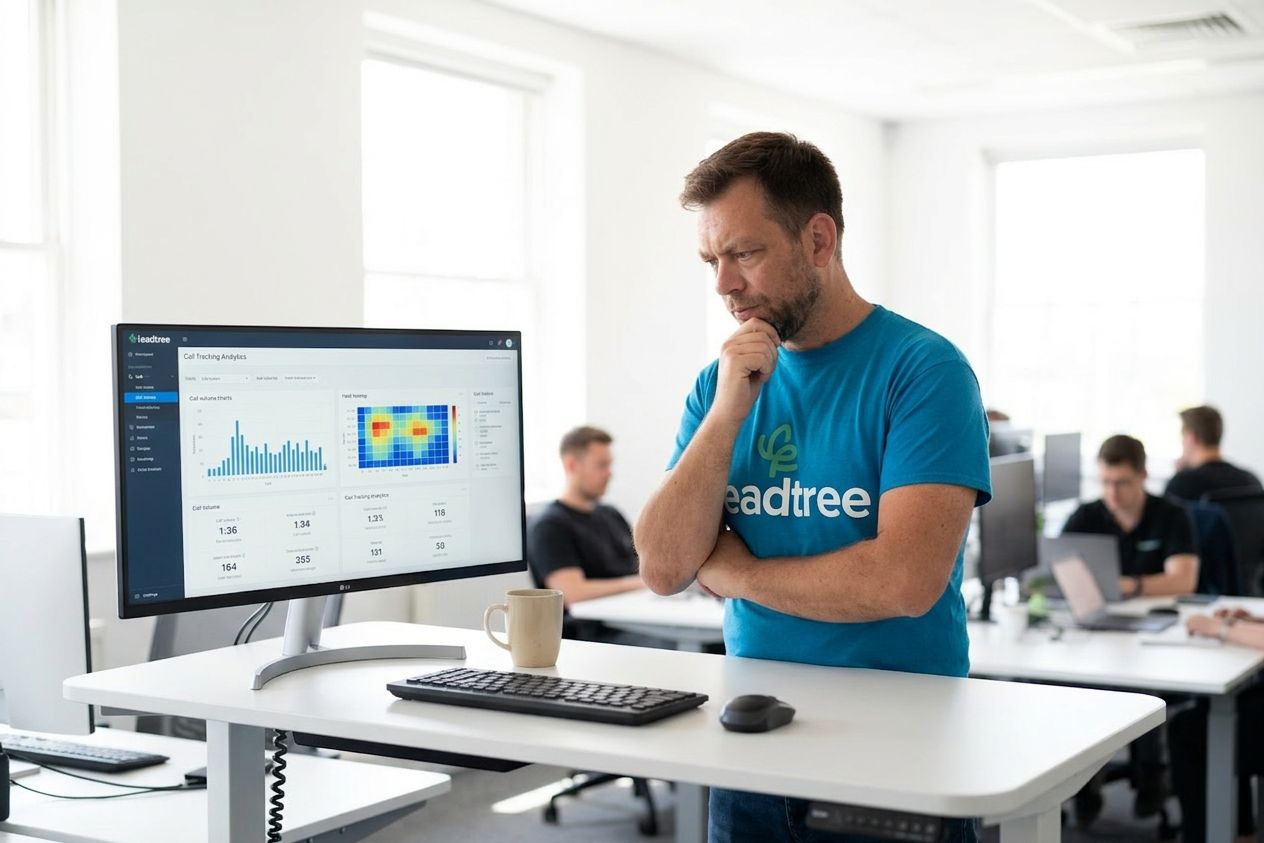
Call tracking doesn't directly solve missed calls. But it makes them visible. When you can see how many calls you're missing, from which campaigns, at what times, you can fix the problem.
And the attribution value is even more significant. If call data helps you identify even $500 per month in wasted ad spend and redirect it to channels that produce signed clients, the platform pays for itself many times over.
Where to Start
If you're running paid campaigns with no call tracking: Start with Google Ads' built-in call tracking. Set up forwarding numbers and track Calls from Ads with a 45-second minimum duration. This gives you basic attribution at no extra cost.
If you want proper attribution: Set up Delacon or CallRail with dynamic number insertion on your website. Configure session-level tracking for keyword attribution.
If you want the full loop: Integrate your call tracking platform with your CRM and set up offline conversion imports to Google Ads and Meta's Conversions API. This is where campaign performance steps up significantly.
Regardless of your setup: Add a "How did you hear about us?" field to your intake process. Include AI assistants as a specific option. The combination of software tracking and self-reported data gives you the most complete picture of what's actually driving your business.
Phone calls might seem like a background detail compared to the dashboards and metrics that fill most marketing reports. But for service businesses, they're often where the money is made. Making them visible is one of the highest-value things you can do for your campaigns.