If you've noticed a drop in organic traffic from Google over the past six months, you're not alone. Google's AI Overviews, those AI-generated summaries you’ve most likely seen that appear at the top of search results, are fundamentally changing the way people are conducting their internet searches.
The numbers are a little scary: organic click-through rates for queries with AI Overviews have dropped 61%. The question we should all be asking ourselves is ‘what will be the future effects of such a shift?’
In this article, let’s take a look at the wider picture, look at how Australian service businesses are being affected, and the opportunity hiding inside this change.
The Numbers: How Bad Is It?
Let's start with what we know from the data.
Organic CTRs for AI Overview queries dropped from 1.76% to 0.61%, a 61% plunge. Paid CTRs fared even worse, crashing 68% from 19.7% to 6.34%.
Even queries without AI Overviews saw a year-over-year organic CTR decline of 41% within Seer Interactive’s study of 3,119 informational queries. Plus, 60% of Google searches now end without any click to a website, up from 58% in 2024.
For publishers and content-heavy sites, traffic declines of 30-40% are becoming common in some studies. Some have reported drops as severe as 89% for specific content types.
What We're Seeing With Australian Service Business Clients
Something important to take into account is that the impact isn’t uniform across all queries.
For informational searches, such as ‘what is family law’, ‘how does conveyancing work’, and ‘what to expect in a dental implant procedure’, there are big declines. These are the queries where AI Overviews appear most frequently and where Google is most comfortable providing a direct answer.
What’s interesting is that people are saying they were recommended by ChatGPT or found the firm through an AI search. This doesn’t show up clearly in the data, though.
In many cases, the AI mentions the business, and then the person goes and searches for the firm by name on Google. From an analytics point of view, that looks like a branded search rather than someone coming in through an article or informational page.
So even though AI-driven recommendations are clearly influencing decisions, they are often invisible in standard reporting. The conversion is happening, but it is not being credited as organic search in the way we are used to seeing.
Asking ‘How did you hear about us?’ during intake matters more than ever. The numbers alone no longer tell the full story, and without that question, a lot of AI-influenced leads simply look like they’ve appeared out of thin air.
The Citation Opportunity: Why Being Featured Matters More Than Ranking
Here's where it gets interesting.
While overall traffic from AI Overview queries is down significantly, brands cited in AI Overviews earn 35% more organic clicks than those not cited. For paid clicks, being cited results in 91% more clicks.
What this means: if Google's AI cites your law firm as a source in its overview about ‘how to choose a family lawyer’, you're not just getting brand visibility to everyone who sees that overview, you're also getting more clicks than you would have gotten from a traditional organic ranking.
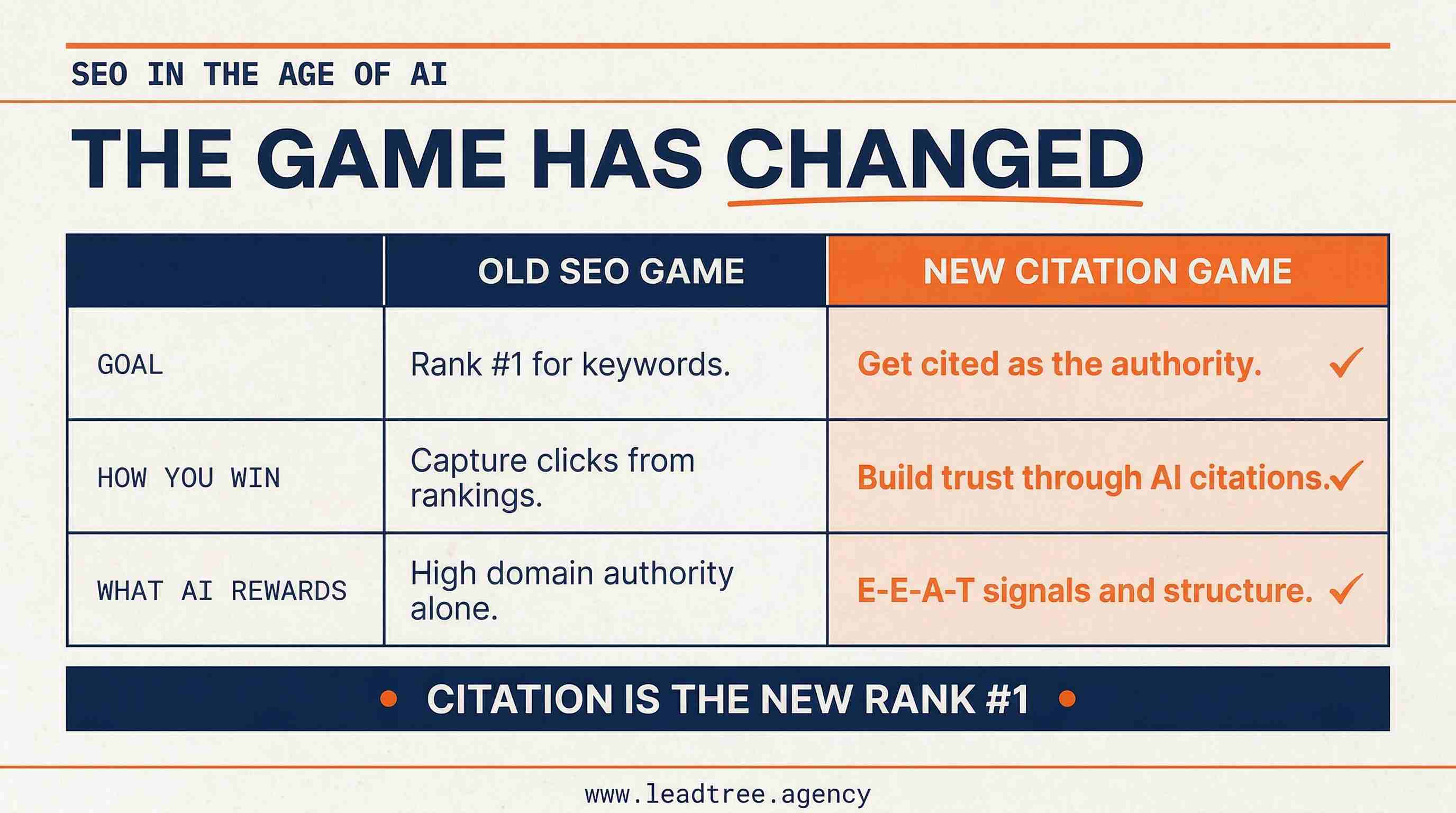
The shift is from ‘rank #1 and capture clicks’ to ‘get cited and build authority’. It's a different game, but you can still be a winner.
What We're Doing Differently
We've adjusted our content strategy for clients in several key ways since AI Overviews became the norm.
Focus on E-E-A-T Signals
E-E-A-T: Experience, Expertise, Authoritativeness, and Trustworthiness, was always important for Google. With AI Overviews, it's become critical.
One study found that 96% of AI Overview citations come from sources with verified E-E-A-T signals. The AI is essentially looking for answers from trusted sources.
For service businesses, this means:
Experience: Demonstrate hands-on, real-world work. Case studies, specific examples, and showing the actual process matter more than generic advice.
Expertise: Author bylines with credentials. If a lawyer writes about family law, their name, qualifications, and specific practice area should be clear. Findings suggest that content with expert authorship is 3.2x more likely to be cited than general staff-written content.
Authority: External validation. Being quoted in other publications, having a Wikipedia entry (if applicable), and maintaining consistent profiles across platforms.
Trustworthiness: Up-to-date information, clear sources for claims, no misleading statements.
We've started treating every article like it needs to pass a ‘would an AI cite this?’ test. That means tighter writing, clearer credentials, and more emphasis on demonstrable expertise rather than generic information. And the results? Well, it works.
Structured Data and Schema Markup
Content containing proper schema markup has a 2.5x higher chance of appearing in AI-generated answers. A schema helps AI systems understand what your content is about and extract the right information to cite.
The schema types that matter most:
- FAQPage schema: this works best for clear questions and answers. For example, if your page answers something like ‘What should I bring to my first consultation?’, the schema helps AI tools pick up and reference that information more easily.
- Article Schema: Establishes content type, authorship, and publication date. This all signals freshness and credibility.
- HowTo Schema: For procedural content. Step-by-step guides benefit significantly from structured markup that tells AI systems, ‘this is a process with these specific steps’.
- Organisation Schema: Connects your business to external authority sources. If your firm has a Wikidata entry, citations in industry publications, or professional association memberships, the Organisation schema with sameAs links reinforces that authority.
We implement this for every client. Going forward, we don’t see any other option if firms want the same amount of hits.
Content Structure: The ‘Short Answer + Deep Dive’ Format
AI systems favour content that provides a clear, concise answer upfront, and then supporting, in-depth information that follows.
The structure we use:
## [Question as H2 Heading]
[1-2 sentence definitive answer] ← This is what AI extracts and cites
[3-4 paragraphs of detailed explanation, context, examples]
[Supporting data, specific scenarios, caveats]
This format serves two audiences: the AI that wants a quotable summary, and the human reader who needs the full context. Furthermore, pages that use clear H2/H3 structures and bullet points are 40% more likely to be cited.
Keeping Content Updated
Freshness matters more than it used to. AI systems prioritise recently updated content because they're trying to provide current, accurate answers to their users.
For this reason, we implement a content refresh schedule:
- Core topic articles: reviewed and updated every 3-6 months
- Trend-related content: updated whenever significant changes occur
- Statistics and data: refreshed at least once a year
- Legal/regulatory content: updated immediately when laws change
Each update includes a visible ‘Last updated: [date]’ note at the top. This signals both to AI systems and to readers that the information is current.
Broad Topic Coverage, Not Just High-Volume Keywords
One thing we see working well is comprehensively covering a topic area rather than just targeting individual high-volume keywords.
For a family law firm, that means having articles on custody arrangements, property division, support for spouses, parenting plans, mediation processes, court procedures, and common scenarios, not just ‘family lawyer Melbourne’.
The benefit: when someone asks ChatGPT or Gemini a question about any aspect of family law, there's a higher likelihood that something from that firm's content library gets cited. Over time, this builds authority that makes future citations more likely.
We're seeing this pay off. Clients with extensive, well-maintained content libraries are getting cited much more than they were previously. Even if individual pages see less direct traffic, the cumulative effect of multiple citations across different queries maintains overall visibility.
Creating New Content to Fill Gaps
As AI Overviews highlight what people are actually asking about, we're identifying content gaps, questions where high search interest but limited quality content is answering them.
Creating content specifically for these gaps increases the chances of citation because there's less competition for that particular answer.
What We’re Looking Out For Down the Line
These are a few things we're monitoring closely:
Do citation clicks convert as well as traditional organic clicks?
This is the big question. It’s certainly true that being cited generates clicks. But are those clicks from people who are genuinely ready to engage, or are they just curious surfers who got their answer from the AI and clicked through out of mild interest?
To get a better picture of this, we’ve begun tracking lead quality and conversion rates from different traffic sources to understand whether AI-driven traffic converts at the same rate as traditional SEO traffic. Early data suggest it's comparable, but we need more time to be certain.
How local and commercial queries evolve
Currently, local queries (‘family lawyer near me’, ‘dental implants Brisbane’) and high-intent commercial queries still work as before. AI Overviews appear less frequently, and when they do, they're less detailed.
If Google starts applying AI Overviews more aggressively to these queries (which it is more than likely to do), that's a bigger problem for service businesses because these are the queries that drive consultations and bookings.
The role of Google Ads in an AI Overview world
Paid clicks dropped 68% for AI Overview queries. That's brutal. If AI Overviews expand to more commercial queries, will service businesses need to fundamentally rethink their Google Ads strategy? Or will Google protect ad revenue by keeping AI Overviews away from high-value commercial queries?
With this in mind, we’ve got one eye on AI expansion and another on what route Google’s advertising business model takes.
What's Overhyped vs What's Real
Let's separate the panic from the reality.
Overhyped: ‘Search Engine Optimisation (SEO) is dead’ and ‘organic search is over’.
Reality: Traffic patterns are shifting, but search isn't gone. People still search. They still click. The method of capturing that traffic has changed, but the opportunity remains, especially for businesses that adapt.
Overhyped: ‘You need to be #1 in rankings to get cited.’
Reality: 76% of AI Overview citations come from the top 10 organic results, but 46.5% of cited URLs rank outside the top 50. Structure, authority, and citation-worthiness are becoming the major players.
The CTR drop for informational queries is significant and not recovering. It’s projected that CTRs for high-funnel queries may be 20-30% lower by 2026 relative to where they would be if the recent 6-month decline continued at the same rate. In other words, an extended drop from current levels.
The uncomfortable truth is, if you are not optimising for AI citation now, you are already falling behind competitors who are. And while local and commercial queries are largely protected for the moment, that situation could change quickly.
What to Do If You're Behind
If you've seen your traffic declining but haven't adjusted your content strategy, this is what you should prioritise:
- Audit your E-E-A-T signals. Do your articles have clear authorship? Do they demonstrate real expertise? Are they current?
- Implement schema markup. FAQPage, Article, and HowTo schema as relevant. This is technical but not difficult; most modern CMSs make it straightforward.
- Restructure existing high-performing content to use the ‘short answer + deep dive’ format. AI needs that clear, quotable summary.
- Add ‘Last updated’ dates and commit to keeping content fresh. Stale content gets ignored.
- Fill content gaps. Look at what questions your ideal clients are asking and create comprehensive answers that don't exist yet.
- Track beyond Google Analytics. Ask clients where they heard about you. It is getting harder to see exactly where leads are coming from.
- Don't abandon traditional SEO. You still need to rank well organically to increase the chances of citation by AI. This isn't either/or, it's both.
The Bigger Picture
Google is training people to get answers directly from search results rather than clicking through to websites. That's not going away.
For service businesses, this isn't necessarily catastrophic. Your advantage has always been trust, expertise, and the relationship you build with clients. AI can summarise information, but it can't replace the consultation, the advice tailored to someone's specific situation, or the relationship that makes someone choose you over a competitor.
What's changing is the path to garner that relationship. Instead of ‘rank for keywords → capture clicks → convert to leads’, it's becoming ‘get cited as an authority → build familiarity and trust → capture branded searches and referrals → convert to leads’.
The businesses that make this shift, treating content as authority-building rather than just traffic-generation, will be the ones that thrive as AI Overviews expand.
The traffic might look different in your analytics, but the opportunity to attract clients through search hasn't gone away entirely. It's just wearing a different face.
Seeing organic traffic drops since AI Overviews rolled out? Leadtree specialises in AI citation strategy and E-E-A-T implementation for Australian service businesses. We restructure your content with proper schema markup, expert authorship and the ‘short answer + deep dive’ format that gets cited by AI.
Book a 30-minute no-obligation call to discuss how we can future-proof your search visibility: https://calendly.com/leadtreemarketing/30min.