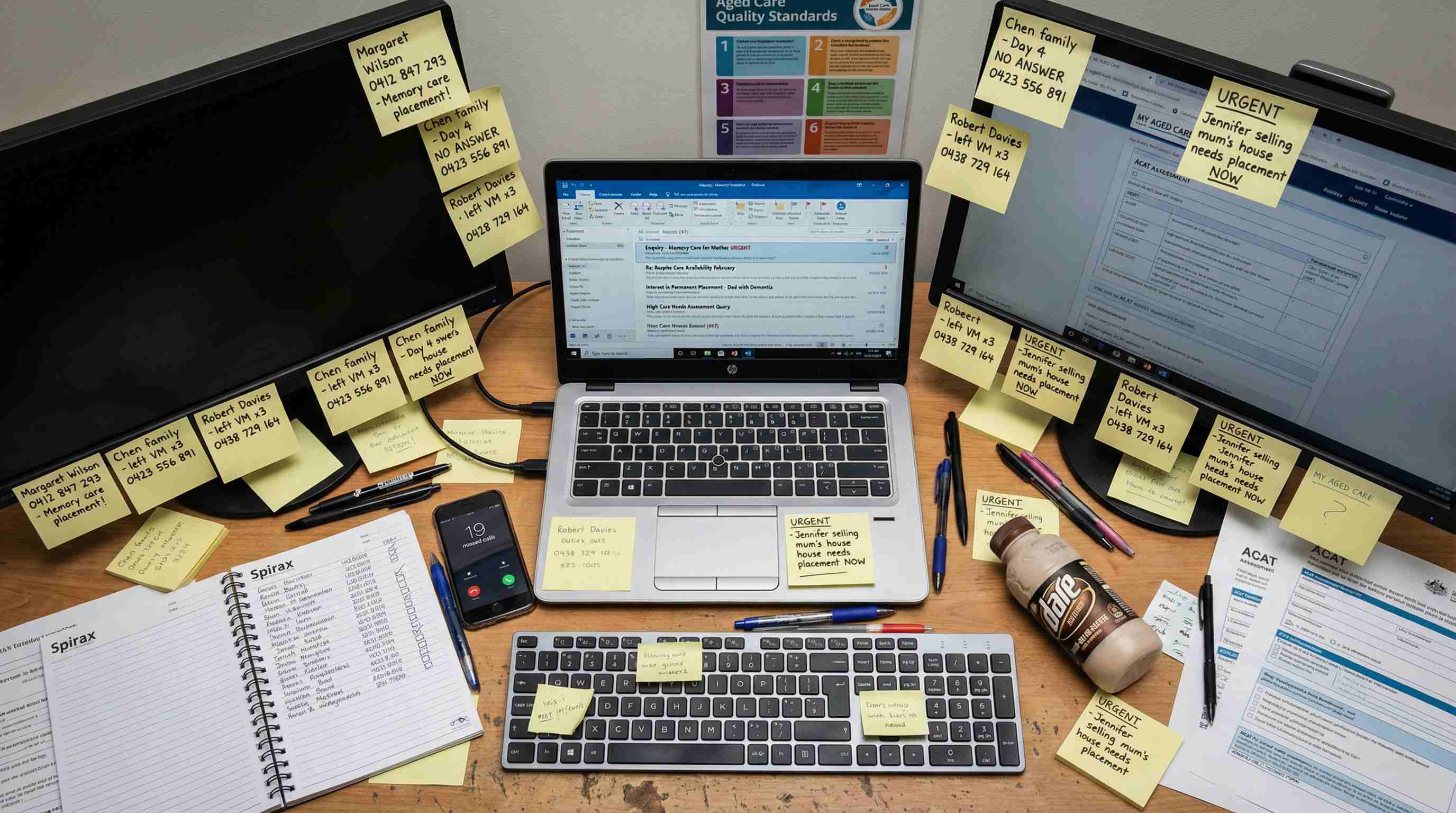
You've invested in marketing. The leads are coming in. Your team is busy. Everything looks fine on the surface.
Then you dig into the numbers and realise something horrifying: 44% of your team makes only one follow-up attempt before moving on. Meanwhile, the leads that actually convert require 6-8 touchpoints before saying yes.
Most Australian service businesses, aged care facilities, dental practices, healthcare clinics and retirement living communities are losing money because their follow-up process is fundamentally broken. And the worst part is, they don't even know it's happening.
The Hidden Revenue Leak in Your Business
If you're generating 50 qualified leads per month at an average service value of $5,000, you should be closing roughly 10-15 of those leads.
That's $50,000-$75,000 in monthly revenue. $600,000-$900,000 annually.
Now cut that in half because your follow-up process is inconsistent. You're leaving $300,000-$450,000 on the table every single year.
The problem isn't your service quality or your pricing, but rather the systematic failure happening between ‘lead captured’ and ‘deal closed.’
What You Need Before You Start
Keep in mind this isn’t a quick fix, and you’re going to need:
- Time commitment: 2-4 hours to audit your current process, 1-2 weeks to implement changes
- Tools: Your CRM (or a spreadsheet if you're still old school), call recording software and access to your lead source data
- Team involvement: Sales team, reception staff, practice managers and anyone who touches a lead
- Baseline data: Last 90 days of lead volume, source, first contact time and conversion rate
You need to have this data, as you can’t fix what you can’t measure.
Step 1: Map Your Current Follow-Up Reality (Not What You Think Happens)
Most business owners believe their follow-up process works like this:
- Lead comes in
- Team member gets notified
- Contact happens quickly
- Follow-up continues until conversion or disqualification
Here's what actually happens in 70% of Australian service businesses we've audited:
- Lead comes in
- Lead sits in CRM for 4-8 hours (or gets lost in email)
- First contact attempt happens next business day
- If no answer, one more attempt is made
- Lead is marked ‘unresponsive’ and forgotten
Your action: Pull your last 100 leads. Track these specific data points:
- Time from lead capture to first contact attempt (not first successful contact, first attempt)
- Number of follow-up attempts before the lead was marked closed/lost
- Channel used for each attempt (phone, email, SMS)
- Time between each attempt
Use a simple spreadsheet with columns: Lead ID, Source, Timestamp Received, First Attempt Timestamp, Attempt 2, Attempt 3, etc.
Time estimate: 90 minutes for 100 leads
The data will shock you. We've seen Brisbane dental practices with 18-hour average first response times and Sydney aged care facilities, where 60% of leads received only one follow-up call.
Step 2: Identify Your Collapse Points
Your follow-up process has five critical stages where leads disappear:
Stage 1: Capture → Assignment (0-15 minutes)
The lead form is submitted. Does it automatically assign to a team member? Or does it sit in a general inbox waiting for someone to notice?
Stage 2: Assignment → First Attempt (15 minutes - 24 hours)
Your team member receives the lead. How quickly do they make contact? Research shows leads contacted within five minutes are 9 times more likely to convert than those contacted after 30 minutes.
Stage 3: First Attempt → First Connection (1-7 days)
You called, but no answer. What happens next? Is there a scheduled second attempt? Or does it depend on how busy you are that day?
Stage 4: First Connection → Qualification (1-14 days)
You've made contact. Now what? Is there a structured conversation? A next step booked? Or just a vague ‘I'll send you some information’?
Stage 5: Qualification → Close (7-90 days)
This is the longest and most critical stage. The one where 80% of leads die because your team gives up after 2-3 attempts.
Your action: For each of the 100 leads you tracked in Step 1, identify which stage they failed at. Create a simple tally:
- Lost at Capture → Assignment: X leads
- Lost at Assignment → First Attempt: X leads
- Lost at First Attempt → First Connection: X leads
- Lost at First Connection → Qualification: X leads
- Lost at Qualification → Close: X leads
Time estimate: 30 minutes
This tells you exactly where to focus your fix. If 40% of leads are lost between Assignment and First Attempt, you have a notification/prioritisation problem. If 60% are lost between Qualification and Close, you have a persistence problem.
Step 3: Fix the Speed Problem First
Speed is the easiest variable to fix and has the most dramatic impact. Conventional wisdom says to ‘respond within 24 hours.’ However, by 24 hours, your lead has already contacted three competitors and probably made a decision.
Response rates are 450% higher when initial follow-up occurs within one hour. Not the same day and not by the end of business. It needs to be within 60 minutes.
For Australian service businesses, this creates a specific problem as timezone differences (AEST vs AWST), after-hours leads and weekend inquiries become issues. For example, a Perth retirement living facility receiving a lead at 5:30 pm AWST on Friday can't wait until Monday 9 am to respond, so the lead becomes cold.
Your action: Implement a speed-to-lead protocol:
For business hours leads (8 am-5 pm):
- Automated SMS acknowledgement within 2 minutes: ‘Thanks for your inquiry about [service]. [Name] from our team will call you within the next 30 minutes.’
- First call attempt within 30 minutes, no exceptions
- If no answer: Second attempt within 2 hours
- If still no answer: Email sent with booking link for callback
For after-hours leads:
- Automated SMS acknowledgement within 2 minutes with expected callback time: ‘Thanks for your inquiry. Our team will call you tomorrow at 9 am. Need to speak sooner? Call [number].’
- First call attempt at 9 am sharp, next business day
- Follow the same cadence as business hours leads
For weekend leads:
- Same automated SMS acknowledgement
- Monday, 9 am first call attempt
- Consider implementing a weekend duty roster for high-value services (aged care, retirement living) where decision timelines are compressed
Time estimate: 2-3 hours to set up automation (most CRMs have this built in), 1 hour to train the team.
The SMS acknowledgement is critical as it buys you time and sets expectations. Without it, your lead is wondering if you even received their inquiry.
Step 4: Build Your Follow-Up Cadence (The 5-12 Touch Reality)
Most service businesses give up too early. Remember, 80% of successful sales require 5-12 follow-up attempts, but 44% of salespeople quit after one attempt. You need to be present when your lead is ready to decide.
Your action: Create a structured 14-day follow-up sequence for every lead:
Day 1:
- Attempt 1: Phone call (within 30 minutes of lead capture, ideally 5 mins). Trigger an SMS if no answer (way better than voicemail).
- Attempt 2: Phone call (2 hours after Attempt 1 if no answer)
- Attempt 3: Email with specific information and quotes regarding their inquiry (same day, evening)
Day 2:
- Attempt 4: Phone call (morning, 9-11 am)
- Attempt 5: SMS (afternoon, 2-4 pm) - ‘Hi [Name], tried calling yesterday about [specific service]. Best time to reach you today?’
Day 4:
- Attempt 6: Phone call (different time of day than previous attempts)
- Attempt 7: Email with case study/testimonial relevant to their inquiry
Day 7:
- Attempt 8: Phone call
- Attempt 9: LinkedIn connection request (if B2B service) or personalised video message
Day 10:
- Attempt 10: Phone call
- Attempt 11: Email with a limited-time offer or consultation availability
Day 14:
- Attempt 12: Final phone call
- Attempt 13: ‘Break-up’ email - ‘I haven't been able to reach you. I'll assume now isn't the right time. Feel free to reach out when you're ready: [direct contact details]’
Critical nuances:
Vary your contact times. If you call at 10 am every time and they're in meetings at 10 am, you'll never connect. Try morning, lunch, afternoon and early evening.
Use a multi-channel approach. Phone, email and SMS. Different people prefer different channels. We've seen aged care leads who ignore calls but respond immediately to SMS. Dental practice leads who never check email but always answer their phone.
Personalise every touchpoint. Reference their specific inquiry, mention their suburb and acknowledge their situation.
Time estimate: 3 hours to build templates and sequence in your CRM, 30 minutes to train the team.
Step 5: Implement the ‘Why They Didn't Convert’ Audit
What separates good service businesses from great ones is that they know exactly why leads don't convert.
Your action: For every lead that doesn't convert, require your team to categorise the reason:
Category 1: Timing
- Not ready now, future need (3-6 months)
- Not ready now, future need (6-12 months)
- Seasonal/specific date requirement we couldn't meet
Category 2: Fit
- Service mismatch (we don't offer what they need)
- Location mismatch (too far, wrong area)
- Budget mismatch (we're outside their range)
Category 3: Competition
- Choose competitor (known)
- Choose competitor (unknown)
- Decided not to proceed with any provider
Category 4: Process Failure
- Never connected despite attempts
- Connected, but no follow-through from our team
- Connected, but the lead became unresponsive
- Not a genuine lead (spam, wrong number, etc.)
Category 5: Quality
Track this in your CRM and review monthly. This data tells you:
- If you have a lead quality problem (high Category 5 = fix your lead sources)
- If you have a competitive positioning problem (high Category 3 = pricing/value proposition issue)
- If you have a process problem (high Category 4 = fix your follow-up cadence)
Time estimate: 5 minutes per lost lead, ongoing
For a Melbourne healthcare clinic we worked with, this audit revealed 40% of their lost leads were ‘never connected despite attempts.’ They were calling during business hours when their target audience (working professionals) couldn't answer. When they shifted call times to 7-8 am and 6-7 pm, their conversion rate jumped 28%.
Common Mistakes That Kill Follow-Up (And How to Avoid Them)
Mistake 1: Treating all leads equally
Not all leads are created equal. A retirement living inquiry from someone selling their family home is more urgent than a ‘just browsing’ dental inquiry. Your follow-up intensity should match lead quality and urgency.
Fix: Implement lead scoring. High-value, high-intent leads get immediate personal attention. Lower-value leads get automated nurture sequences until they show buying signals.
Mistake 2: Relying on email as the primary follow-up
Email is easy and comfortable, but it’s also ignored 70% of the time for service business inquiries.
Fix: Always phone first. Email is for documentation and additional information, not the primary contact. If you're scared of calling, that's a training issue, not a strategy issue.
Mistake 3: No clear next step after first contact
You connected. You had a nice chat. You said, ‘I'll send you some information.’ Then... nothing. Just hope that they'll call back.
Fix: Every conversation must end with a scheduled next action. If they won't commit to a next step, they're not a real lead.

Mistake 4: Giving up because ‘they're not interested’
One unreturned call doesn't always mean disinterest. It could mean they weren’t busy, didn't recognise the number, or forgot they submitted the inquiry.
Fix: Follow the 6-8 touch cadence. If they explicitly say ‘not interested,’ respect that.
Mistake 5: No system for re-engaging old leads
A lead that wasn't ready six months ago might be ready now. But if you've deleted them from your CRM, then you've lost that opportunity.
Fix: Create a ‘nurture’ status for leads that aren't ready now. This could be a monthly check-in email or a quarterly phone call. They already know you, so the trust is built, meaning they're easier to convert than cold leads.
The Bottom Line
Your follow-up process is either a revenue engine or a money pit. There's no middle ground.
The Australian service businesses that consistently convert 25-35% of their leads aren't doing anything magical, they're just doing the basics systematically:
- Responding within 30 minutes
- Following up 5-12 times across multiple channels
- Tracking why leads don't convert
- Fixing the specific collapse points in their process
All you need is visibility into where leads are falling through the cracks and the discipline to fix it.
Start with Step 1. Map your current reality. The data will tell you exactly what to fix.
Ready to stop losing leads in the follow-up black hole? Leadtree specialises in lead management and conversion systems for Australian service businesses. We've helped aged care facilities, dental practices and healthcare clinics recover hundreds of thousands in lost revenue by fixing their follow-up process. Book a 30-minute free call to discuss how we can help: https://www.leadtree.agency/product/book-call