

You’re spending over $20,000 a month on lead generation, yet your cost per lead keeps creeping up. Somewhere along the way, between a prospect being labelled as qualified and actually booking an appointment, around a quarter of your best leads simply disappear.
Let’s take a look at what’s happening: Your marketing automation is doing its job. Leads are being nurtured, scored, and flagged as sales-ready. But the handoff to your broker team? This is where things seem to fall apart.
The standard thing is to tell you that your CRM system needs updating, or you need more automation. Although in reality, this doesn’t make a lot of sense, given that most finance brokerages don't have a technology problem. The problem is with the process.
Firms with sophisticated marketing stacks still lose 25-30% of qualified leads at that transition point from nurture to sales. And it’s not because the leads weren’t ready; it’s because the handoff process wasn’t quite pulling its weight.
Let's compare the two approaches that actually work: manual SLA frameworks versus automated handoff systems. Both can recover the lost 25%. The question is which one fits your specific business model.
The Real Cost of Handoff Breakdowns
Before we get into solutions, let's state exactly what's at stake.
If you're generating 200 qualified leads per month at $100 CPL (conservative for major capital markets), you're investing $20,000. If 25% disappear without a trace at handoff, that's 50 lost opportunities. More importantly, that’s $5,000 in acquisition costs alone.
But the real cost is conversion value. Considering the average mortgage broker settles around, even at conservative commission rates, losing 50 qualified leads per month represents a six-figure revenue leakage.
The breakdown typically happens in three places:
- Response time failures: Marketing passes a lead to sales, but the broker doesn't respond within the first hour (a critical time period). The lead then moves on to a competitor who does.
- Context loss: The broker receives a name and phone number but is clueless about the content the lead engaged with, their specific needs, or where they are in the decision journey.
- Capacity mismatches: Marketing continues to nurture and qualify leads at the same pace, while sales capacity fluctuates. Leads pile up, response times get longer, and conversion rates start to slide.
Here's the thing: Both manual and automated approaches can solve these problems. But they solve them differently, and the right choice depends on your team structure and lead volume.
Manual SLA Frameworks: The High-Touch Approach
Manual SLA (Service Level Agreement) frameworks are exactly what they say on the tin: documented processes that define who does what, when, and how during the nurture-to-sales transition.
How Manual SLA Frameworks Work
The core of a manual framework is a written agreement between marketing and sales that specifies:
- Lead qualification criteria: What constitutes a ‘sales-ready’ lead (not just a score, but specific behaviours and attributes)
- Handoff triggers: The exact moment ownership for a lead shifts from marketing to sales
- Response time commitments: How quickly sales must contact a lead that has been handed off to them (typically within 60 minutes for finance brokers)
- Context transfer protocol: What information marketing must provide to sales (lead source, content engagement history, stated needs)
- Feedback loops: How sales communicates lead quality back to marketing
In practice, this often looks like a shared spreadsheet or project management board where marketing assigns qualified leads to specific brokers, along with a brief context summary.
When the Manual SLA Frameworks Excel
Manual frameworks work best for:
- Smaller broker teams (3-8 brokers), where personal accountability is high, and everyone can see the full pipeline
- Complex, high-value transactions where the broker needs to understand the complexities of the client's situation before making contact (commercial lending, SMSF lending, complex structures)
- Businesses with variable lead flow, where some weeks bring 10 qualified leads and others bring 50, so full automation can be more trouble than it’s worth
- Teams moving from referrals into paid lead generation, who need to get the handoff right before layering in automation
The key advantage of manual frameworks is flexibility. When a broker sees that a lead has been researching commercial property loans in Melbourne's eastern suburbs and has downloaded three guides on structuring trusts, they can tailor their outreach to perfectly match.
The Hidden Difficulties of Manual Approaches
Manual frameworks aren't free, regardless of whether new software is needed or not.
They demand consistent discipline. Every lead must be logged, every handoff must be documented, and every response time must be tracked.
They create information bottlenecks. If your marketing coordinator is the only person who knows how to properly hand off leads, you've built a single point of failure into your system.
They don't scale gracefully. A manual framework that works beautifully at 50 leads per month becomes unwieldy at 150 and is likely to break down completely at 300.
Most critically, manual frameworks rely on human judgment at every step. That's powerful when judgment is needed, but ultimately, it’s problematic when it’s consistency that matters more.
Automated Handoff Systems: The Scalable Approach
Automated handoff systems use marketing automation platforms (HubSpot, ActiveCampaign, Salesforce) to trigger sales actions based on lead behaviour and qualification criteria.
How Automated Handoff Systems Work
Instead of a person deciding when to hand off a lead, the system makes that decision based on predefined rules:
- Behavioural triggers: When a lead completes specific actions (books a callback, reaches a lead score threshold, visits pricing pages three times)
- Automatic assignment: Leads are distributed to brokers based on round-robin, specialisation, or capacity
- Context delivery: The assigned broker receives an automated notification with the lead's full engagement history, stated needs, and recommended talking points
- Response tracking: The system monitors whether the broker contacts the lead within the SLA window and escalates if they don't
The best automated systems also include capacity throttling: if your broker team is at capacity, marketing automation slows down the qualification process, keeping leads in nurture longer rather than handing them off to overwhelmed brokers who can't respond quickly.
When Automated Systems Perform Miracles
Automation makes sense for:
- Higher-volume operations (100+ qualified leads per month) where manual tracking for a small-to-medium-sized team becomes tough
- Distributed teams across multiple locations where a centralised handoff coordinator doesn't make sense
- Businesses with consistent lead flow that justifies the investment and ongoing optimisation costs
- Teams with defined specialisations where leads need to be routed to specific brokers based on loan type, location, or client profile
The primary advantage of automation is consistency. Every lead gets the same quality of handoff, regardless of who's on holiday, who's having a busy week, or who's new to the team.
The Real Limitations of Automation
Here's what the CRM vendors won't tell you: automation only works if your underlying process is watertight.
We've seen finance brokers invest $30,000 in HubSpot implementations that failed to improve handoff conversion simply because they were automating a process that was already broken. The system dutifully assigned leads to brokers who didn't have capacity. It sent notifications that brokers ignored. It tracked response times that no one acted on.
Automation also struggles with nuance. If a lead's behaviour suggests they're ready to be contacted, but their stated timeline is 6-12 months, should they be handed off now or nurtured longer? An experienced human can make that judgment call, but an automated system that very often blindly follows its programmed logic might not.
Finally, automation requires ongoing optimisation. Lead scoring models drift. Assignment rules become outdated. Notification templates stop resonating. Without regular tuning, automated systems gradually become less effective.
The Direct Comparison: Manual vs Automated
Let's compare these approaches for finance brokers specifically:
Setup Cost and Timeline
Manual SLA Framework:
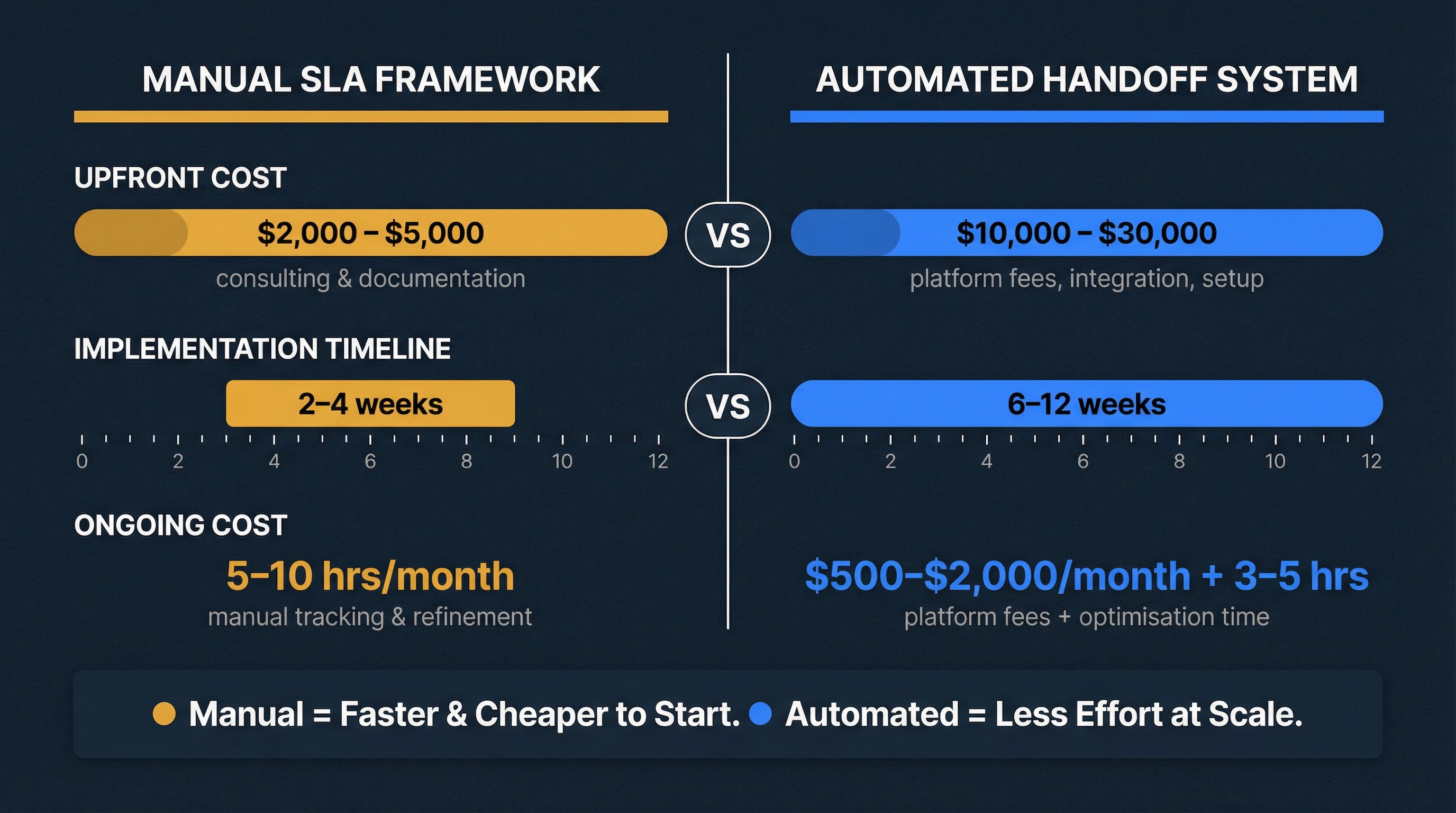
- Cost: $2,000-5,000 (mostly consulting/documentation time)
- Timeline: 2-4 weeks to document, train, and implement
- Ongoing cost: 5-10 hours per month for tracking and refinement
Automated Handoff System:
- Cost: $10,000-30,000 (platform fees, integration, setup)
- Timeline: 6-12 weeks for proper implementation
- Ongoing cost: $500-2,000/month in platform fees plus 3-5 hours for optimisation
The verdict: Manual SLA frameworks are cheaper and faster to put in place but require ongoing effort, while automated handoff systems take longer and cost more upfront, yet reduce manual workload once properly in place.
Response Time Consistency
Manual SLA Framework:
- Best case: 15-30 minutes (when the assigned broker is available)
- Worst case: 4-24 hours (when leads arrive outside business hours or during busy periods)
- Average: 2-4 hours
Automated Handoff System:
- Best case: Immediate notification, 15-30 minute response
- Worst case: 1-2 hours (with escalation protocols)
- Average: 45-90 minutes
The verdict: The automated approach wins on consistency, but the gap narrows significantly if your manual framework includes after-hours protocols and backup assignments.
Context Transfer Quality
Manual SLA Framework:
- Highly customised context (the marketing person knows what's important)
- Risk of information loss if the handoff is rushed
- Difficult to maintain consistency across team members
Automated Handoff System:
- Consistent context delivery every time
- Can include more data points than a human would manually compile
- Risk of information overload (too much data, not enough insight)
The verdict: This is closer than it appears. Manual handoffs can provide better qualitative context ("this lead is nervous about rate rises"). Automated handoffs provide better quantitative context ("viewed rate comparison page 7 times").
Scalability
Manual SLA Framework:
- Works well up to 75-100 leads per month
- Becomes strained at 100-150 leads per month
- Breaks down beyond 150 leads per month
Automated Handoff System:
- Handles 100-500+ leads per month without degradation
- Scales to multiple teams and locations seamlessly
- Requires a more sophisticated setup for complex routing
The verdict: If you're currently at 50 leads per month but planning to scale to 200, automation is the better long-term investment. If you're at 80 leads per month and happy there, manual frameworks are more cost-effective.
Adaptation Speed
Manual SLA Framework:
- Can be changed immediately (update the spreadsheet, send a Slack message)
- Easy to test new approaches
- Relies on team discipline to maintain changes
Automated Handoff System:
- Requires workflow updates and testing (days to weeks)
- Changes affect all leads consistently
- Harder to experiment, but changes often stick
The verdict: Manual SLA frameworks are easy to adjust and experiment with, but depend heavily on team discipline, while automated handoff systems take longer to change, yet apply those changes consistently once they’re in place.
Decision Time
Choose manual SLA frameworks if...
- Your lead volume is under 100 qualified leads per month. The ROI on automation doesn't justify the investment at this scale.
- Your transaction values are very high ($500k+ average loan size) and warrant the extra personalisation that manual handoffs enable.
- Your broker team is small and co-located. When everyone sits in the same office (or the same Slack channel), manual coordination often feels more natural.
- You're still refining your qualification criteria. Manual frameworks let you experiment with what sales-ready actually means before it becomes frozen in an automated system.
- You have strong team discipline. Manual frameworks only work if everyone is on the same page. If your brokers are already good at responding quickly and documenting their activities, manual processes are likely to work.
A manual SLA framework can recover that lost 25%, but only if it’s done properly. That means clear documentation, real accountability, and keeping an eye on it consistently, not just setting it up and hoping for the best.
Choose automated handoff systems if...
- Your lead volume exceeds 100 qualified leads per month, or you're planning to reach that level within 6 months.
- You have multiple brokers with different specialisations and leads need to be routed based on loan type, location, or complexity.
- Your team is distributed across multiple offices or states, making centralised manual coordination impractical.
- Response time consistency is critical to your competitive advantage. If you're competing in markets where the first broker to respond wins, the speed advantage of automation is a huge plus.
- You have the budget and patience for proper implementation. Rush things, and it’ll go wrong.
Again, a well-implemented automated handoff system can recover that same 25% of lost conversions, but only if it’s set up with care. Clear rules, realistic capacity planning, and the patience to test and refine the system over time all matter. Rush it, and automation won’t fix your handoff problems; it’ll compound them.
MFAA benchmarking data gives brokers a clear sense of how they’re performing compared to the rest of the industry. While the exact conversion figures aren’t public, the message is consistent: brokers with a structured approach to lead management, whether manual or automated, consistently outperform those relying on ad-hoc processes.
The Hybrid Approach That Actually Works
The best-performing firms don't choose between manual and automated. They use both strategically.
They start with a manual SLA framework to establish discipline and refine the process. Once the framework is working consistently for 3-6 months, they selectively automate the parts that benefit most from consistency:
- Lead assignment: Automated round-robin or specialisation-based routing
- Initial notifications: Automated alerts to brokers when leads are ready
- Response time tracking: Automated monitoring and escalation
- Context delivery: Automated summaries of lead engagement history
But they ensure human judgment also has its role:
- Qualification decisions: Marketing coordinators still review borderline leads before handoff
- Complex routing: High-value or unusual leads get manually assigned to the most appropriate broker
- Feedback loops: Regular conversations between marketing and sales about lead quality
This hybrid approach gives you the consistency of automation (speed, tracking, routing) while preserving the flexibility of manual processes where judgment is valuable.
Implementation Roadmap: 90 Days to Better Handoffs
Whether you choose manual, automated, or a hybrid of them both, here's how to implement it properly:
Weeks 1-2: Audit
Document your existing handoff process (even if it's informal). Track every lead for two weeks: when they were qualified, when they were handed off, when they were contacted, and what happened. Calculate your current handoff conversion rate and average response time.
Weeks 3-4: Define Your SLA
Get marketing and sales in a room (or on a Zoom call) and agree on:
- What sales-ready actually means
- How quickly must leads be contacted
- What context does sales need from marketing
- How sales will communicate lead quality back to marketing
Write it down and be specific. ‘Respond quickly’ isn’t an SLA. ‘Contact the lead within 60 minutes during business hours, and within four hours outside business hours’ is.
Weeks 5-8: Implement and Train
If you're going manual, build your tracking system (spreadsheet, Trello board, whatever works for you) and train everyone on the process. If you're automating, this is when you configure workflows, test routing rules, and set up notifications.
Weeks 9-12: Monitor and Refine
Track the same metrics you measured in weeks 1-2. Are response times improving? Is handoff conversion increasing? Where are leads still falling through the cracks?
Be prepared to make adjustments. Your first version won’t be perfect, and that’s fine. The goal is steady, systematic improvement, not instant perfection.
The Bottom Line
The nurture-to-sales handoff breakdown isn't always a technology problem. It’s likely a process problem that can be solved with either manual discipline or smart automation.
Manual SLA frameworks work brilliantly for smaller teams with lower lead volumes who need flexibility and can maintain discipline. Automated handoff systems are essential for higher-volume operations that need consistency and scale.
The truth: most finance brokers don't need to choose. Start manual, prove the process works, then selectively automate the parts that benefit most from consistency.
The rule: Fix the process first. Then, if it makes sense, automate it.
Ready to fix your handoff process and recover those lost conversions? Leadtree specialises in lead nurturing and sales alignment for Australian finance and insurance brokers. Book a 30-minute free call with our founder, Richard, to discuss how we can help: https://www.leadtree.agency/product/book-call.