

Here's a scenario that plays out more often than most law firms realise.
A potential client has a family law matter. They're anxious, stressed, and motivated to get help. They fill out enquiry forms for three different firms on a Wednesday evening.
The next morning, your intake coordinator calls. They have a solid conversation. The lead is qualified, and a consultation is booked. Everything’s looking good.
But twenty minutes later, another firm calls back, and it's a solicitor, not an intake coordinator. And this solicitor will spend fifteen minutes talking through the situation, asking the right questions, expressing genuine empathy, and explaining how they'd approach the matter at a high level. By the end of that call, the prospect feels genuinely heard and helped. As a result, the upcoming consultation with your firm is now less of a priority than it was.
By the time the prospect arrives at your consultation, their mind is already half made up, and although they don’t sign on the day, they ultimately choose the other firm.
So, what’s happened here? Your intake coordinator qualified the lead perfectly, the process technically worked, and yet the client still slipped away.
The Misunderstanding at the Heart of Most Intake Processes
Most law firms design their intake process around one core question: Is this lead worth our time?
This is completely understandable. After all, a solicitor’s time is genuinely scarce. Firms can't spend an hour on every unqualified enquiry. So intake processes get built around filtering, efficiently determining whether a lead meets the criteria to move forward.
The problem is that qualification and conversion are two different things. And a process optimised purely for qualification can actively undermine conversion.
A lead who gets off the phone feeling assessed is different from a lead who gets off the phone feeling helped. The first prospect has been processed, whereas the second has already started their client relationship.
That shift, from intake as a filter to intake as the beginning of a relationship, is what separates firms with strong conversion rates from those puzzled by why so many 'good leads' don't become clients.
What the First Call Actually Needs to Accomplish
The goal of the first call isn't to get that first consultation booked. In fact, getting to that stage is a direct result of another goal: The prospect hanging up, feeling like their search is finally over.
They leave the call:
- Clear on what happens next and when
- Confident they're dealing with a firm that understands their situation
- With their primary concerns and objections addressed
- Feeling that this firm has the experience and capability to help them
- Not wondering whether to call someone else
When all of those things are true, no-show rates drop, appointment conversion rates rise, and prospects arrive for consultations ready to move forward. When any of those things are missing, uncertainty fills the gap. And uncertainty is where competing firms can swoop in.
The Components of a Call That Converts
Understand the situation before qualifying it
The instinct to quickly establish whether a lead qualifies can lead to a call that feels like a survey rather than being genuinely helpful. A rapid-fire sequence of qualifying questions in the first few minutes signals to the prospect that they're being assessed, not helped.
The better approach: spend the first few minutes genuinely understanding what's happening. Not just the facts that determine eligibility, but what the person is worried about, what they're hoping to achieve, and what they've already tried. This not only gathers qualifying information but also makes the prospect feel heard.
Position the firm's experience with confidence
If the first call isn't handled by a senior solicitor, that's fine; most practices can't staff intake that way. But the person handling the call needs to speak confidently about the firm's capabilities, with concrete insights about those who will actually be doing the work.
This means intake coordinators should be comfortable saying: 'This is something our family law team deals with regularly. [Partner name] has 15 years of experience in exactly these types of matters and has achieved strong outcomes for clients in similar situations.' They're not pretending to be the expert. They're connecting the prospect to the firm's expertise in a way that builds confidence.
Where firms often go wrong is having intake team members who lack subject knowledge, which can lead to a call that feels vague for the prospect. Someone who sounds uncertain or reads from a script gives the prospect less confidence, not more. Training people to speak knowledgeably about the firm's practice areas, not to give legal advice, but to communicate credibly about the firm's capabilities, can make all the difference.
Handle objections before they become barriers
The most common objections in legal intake are about cost, process, timeframes, and likelihood of success. Most intake calls end up leaving this until the consultation. But if a prospect hangs up still worrying about whether they can afford representation, they may simply not show up.
The goal isn't to make guarantees or provide specific legal advice. The goal should be to de-escalate the concern sufficiently so it doesn't become a reason to cancel: 'Thanks for the question. Cost is something we walk through in detail at the consultation, but I can tell you we offer flexible payment arrangements and the initial consultation is…, so you'll have a clear picture of what you'd be committing to before any decisions are made.'
Create clarity about what happens next
A prospect who ends the call unsure about what happens next is more likely to keep looking at other options. But a prospect who knows exactly what is coming, when their consultation is, who it is with, how long it will take, and what they need to bring feels far less need to keep searching.
'Great, so you’re all set. Your consultation is booked for Thursday at 2 pm with Ms Johnson, one of our solicitors. It will take about an hour, and she will go through your situation in detail and explain your options. I will send you a confirmation email shortly with everything we have discussed, including what to bring with you. If anything comes up before then, please let us know. Otherwise, we look forward to seeing you on Thursday.'
End the call with momentum
The end of the call is just as important as the start. The final 60 seconds should leave the prospect moving forward, not trailing off. Briefly recap what was discussed, confirm the next step, and express genuine enthusiasm about helping them. 'That’s everything then. We're looking forward to meeting you on Thursday. And don’t worry, we work on matters like yours regularly and I think you'll find the consultation really useful.' Keep it simple. Don’t over-promise.
The Multi-Stage Process: What Happens After the First Call
The first call sets the trajectory, but the conversion process doesn't end there. Between the first call and the consultation, prospects can go cold, particularly if they don't hear from the firm again until the day of the appointment.
What works well: a confirmation message immediately after booking, a reminder 24 hours before the appointment, and a same-day reminder on the morning of the appointment. None of this needs to be manual. Set it up in the CRM so it runs automatically.
The tone of these messages matters. A plain calendar reminder feels transactional. A message that reinforces confidence. A message, such as 'Looking forward to meeting you tomorrow. If anything comes up before then, just call us on…', maintains that personal feeling already expressed in the initial call.
For firms handling high-value matters where consultations don't convert to signed agreements immediately, a systematic post-consultation process is equally important. Sending the client agreement promptly, following up if it has not been signed within 24 to 48 hours, and checking in with undecided prospects after a few days should all be built into the process, not left to chance or memory.
What to Measure and How Firms Track the Wrong Things
Most law firms track how many monthly leads. Fewer track what happened to those leads.
These are the metrics that show whether your intake process is working:
Lead-to-consultation rate: Of all enquiries received, what percentage booked a consultation? If this is lower than it should be, the issue is usually response speed or first-call quality.
No-show rate: Of consultations booked, what percentage actually attended? A high no-show rate is a signal, not about lead quality, but about the first call. Prospects who leave that initial conversation uncertain are the ones who don't show up.
Consultation-to-signed rate: Of consultations that occurred, what percentage resulted in a signed agreement? This reveals consultation quality and the follow-up process after the consultation.
Time-to-first-contact: How quickly is someone reaching out to new leads? In a competitive environment where prospects have often enquired with multiple firms, speed of response matters more than most firms account for.
Tracking all four gives you a pipeline view. You can see where prospects are falling out, and that tells you precisely where to focus. If your lead-to-consultation rate is strong but your no-show rate is high, the first call is the problem. If your no-show rate is fine but your consultation-to-signed rate is weak, the issue is in the consultation itself, or the follow-up after it.
The CRM's Role: More Than Just a Database
Getting intake right requires the CRM to be an active part of the process, and acknowledging that it’s not just a glorified address book.
That means:
- New lead arrives → immediate notification to the intake coordinator
- Consultation booked → automated confirmation to the prospect with the details
- Consultation approaching → automated reminder (24 hours before and day-of)
- No response to follow-up → task flagged for the coordinator to call
- Post-consultation → automated follow-up if agreement not yet signed
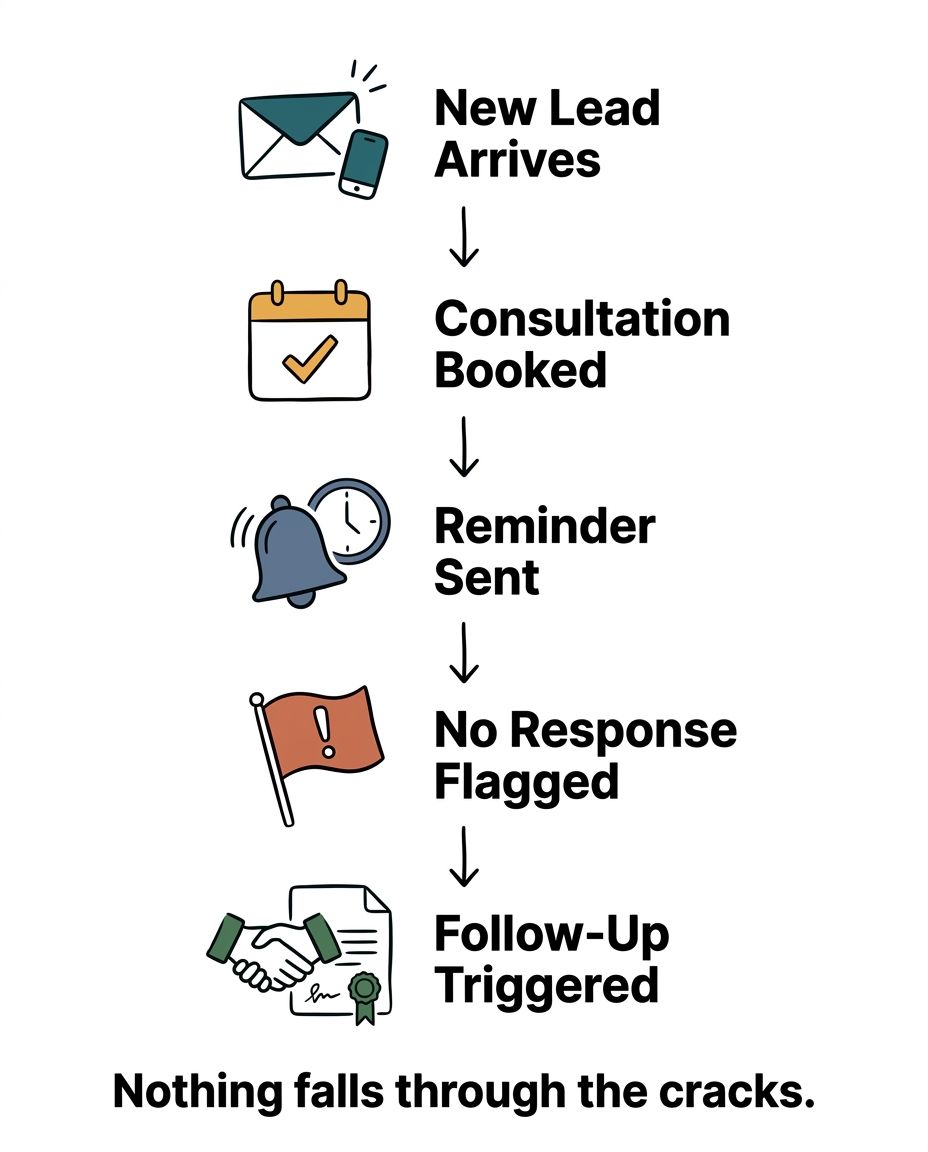
The goal is that nothing falls through the cracks because someone was busy or assumed someone else was handling it. GoHighLevel and HubSpot both do this effectively for law firms. Although the specific platform matters less than having a process where every prospect is tracked through every stage, and gaps surface automatically.
What the CRM can't do is replace the quality of the human interactions within that process. The system keeps things from being missed. The training determines whether what happens in those interactions actually converts.
Training: The Ongoing Investment
Intake coordinators are, in many respects, the most client-facing role in a law firm and often the least invested in. They're frequently junior, without deep training in what a high-converting intake call looks like, and without regular feedback on how they're performing.
What effective intake training looks like in practice:
Clear documentation of the process. Not just what to do, but why. An intake coordinator who understands the goal, helping the prospect feel the search is over, will navigate unexpected situations better than one following a rigid script.
Call recording and regular reviews. Listening back to calls is vital, both to identify what could be improved going forward and to highlight what worked well. This is the fastest way to raise the standard and keep it there.
Objection handling practice. Running through the common concerns, cost, likelihood of success, and timeframes until coordinators feel confident addressing them. When people hesitate on these points, you can hear it, and it weakens the confidence the call is meant to build.
Subject matter familiarity. Not legal expertise, but enough knowledge of each practice area to speak credibly about the firm's capability and what clients can expect. This is particularly important for firms with multiple practice areas where different matters require different responses.
Remember, intake quality tends to slip without ongoing attention; training is not just a one-time event. Monthly call reviews, regular feedback, and clear performance metrics are all things that maintain standards.
The Relationship Between the First Call and Everything That Follows
A well-run intake process doesn't just convert more leads; it changes the character of the client relationships that follow. Clients who arrive at their first appointment feeling confident and well-prepared are more pleasant to work with, more likely to follow through on instructions, and more likely to refer others when the matter concludes.
The first call sets a tone. For firms where intake is primarily a filtering mechanism, that tone is transactional. For firms where intake is the beginning of a genuine relationship, that tone is partnership.
In other words, the way you handle intake shapes not just who becomes a client, but what kind of client they become.
If your firm is generating enquiries but too many aren't becoming signed clients, the gap is almost always in the intake process, not the quality of your legal work. Leadtree works with Australian law firms to audit and rebuild intake systems: from first-call frameworks and objection handling through to CRM automation, reminder sequences, and conversion tracking. Book a free 30-minute call to find out how your business can turn more enquiries into confident, committed clients.