
The Meta ad campaigns we take over from other agencies right now share one feature in common. They’re set up how Meta used to run its ads, as far back as 2022.
The strategy relied on tight geo-targeting and layered interests, with a few creatives running for months across multiple campaigns optimised for the same goal, with lookalike audiences driving most of the results. Although this approach is not inherently wrong, it no longer aligns with how Meta’s systems perform best.
Andromeda, Meta's AI-driven ads retrieval engine, finished its global rollout in October 2025. It’s the layer that runs before bidding and ranking. It filters all available ads into a small, relevant selection for each user when they open their feed.
The way you set up a campaign now decides whether that retrieval layer has the data it needs to select your ad.
This article is essentially an explainer for those Australian service businesses that are still wondering what changed and why their old setups have stopped scaling.
What Is Andromeda?
Andromeda is the first half of a two-stage AI retrieval and ranking system. Meta's engineering team initially published the architecture for it in late 2024. When a user opens Facebook or Instagram, Andromeda scores millions of eligible ads against that user in real time using deep neural networks. A separate system, Lattice, then ranks what remains.
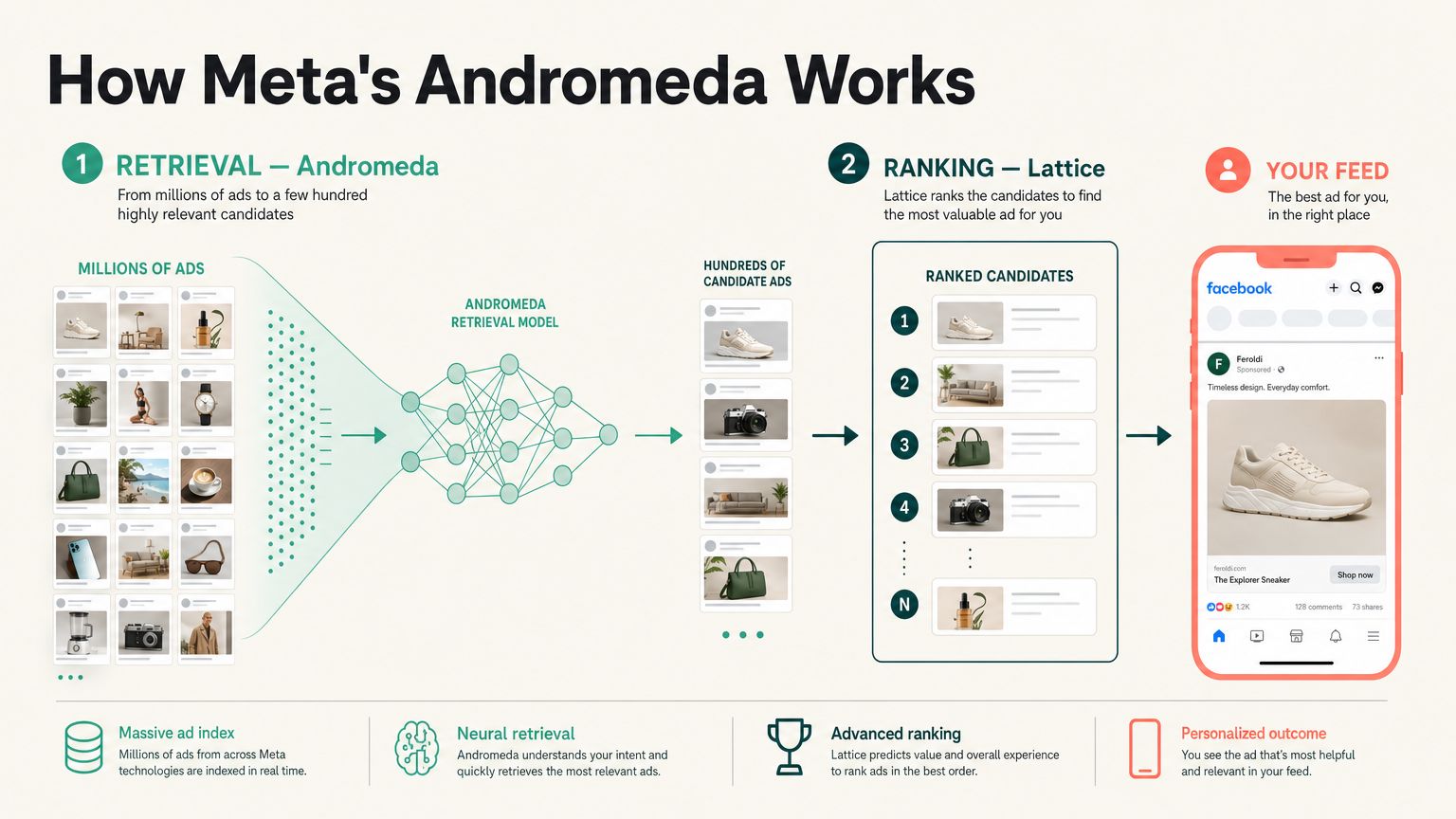
Sitting on top of both is GEM (Generative Ads Recommendation Model), the pattern-recognition layer that feeds Andromeda’s predictions about what is likely to perform next. Meta reports Andromeda is 4x more efficient at driving ad performance gains versus the previous ranking model.
Two pressures forced the rebuild. The first was creative volume. Over one million advertisers produced 15 million ads in a single month using Meta's generative tools, and, put simply, the legacy retrieval stack would’ve collapsed under the load.
The second was signal loss. After iOS 14, traditional interest and lookalike targeting became progressively less useful. Meta's bet was to read the creative directly, match it to people based on what is in the ad, and let the audience emerge from there.
The single most important shift: the creative is the targeting now.
How Andromeda Reads Your Ads
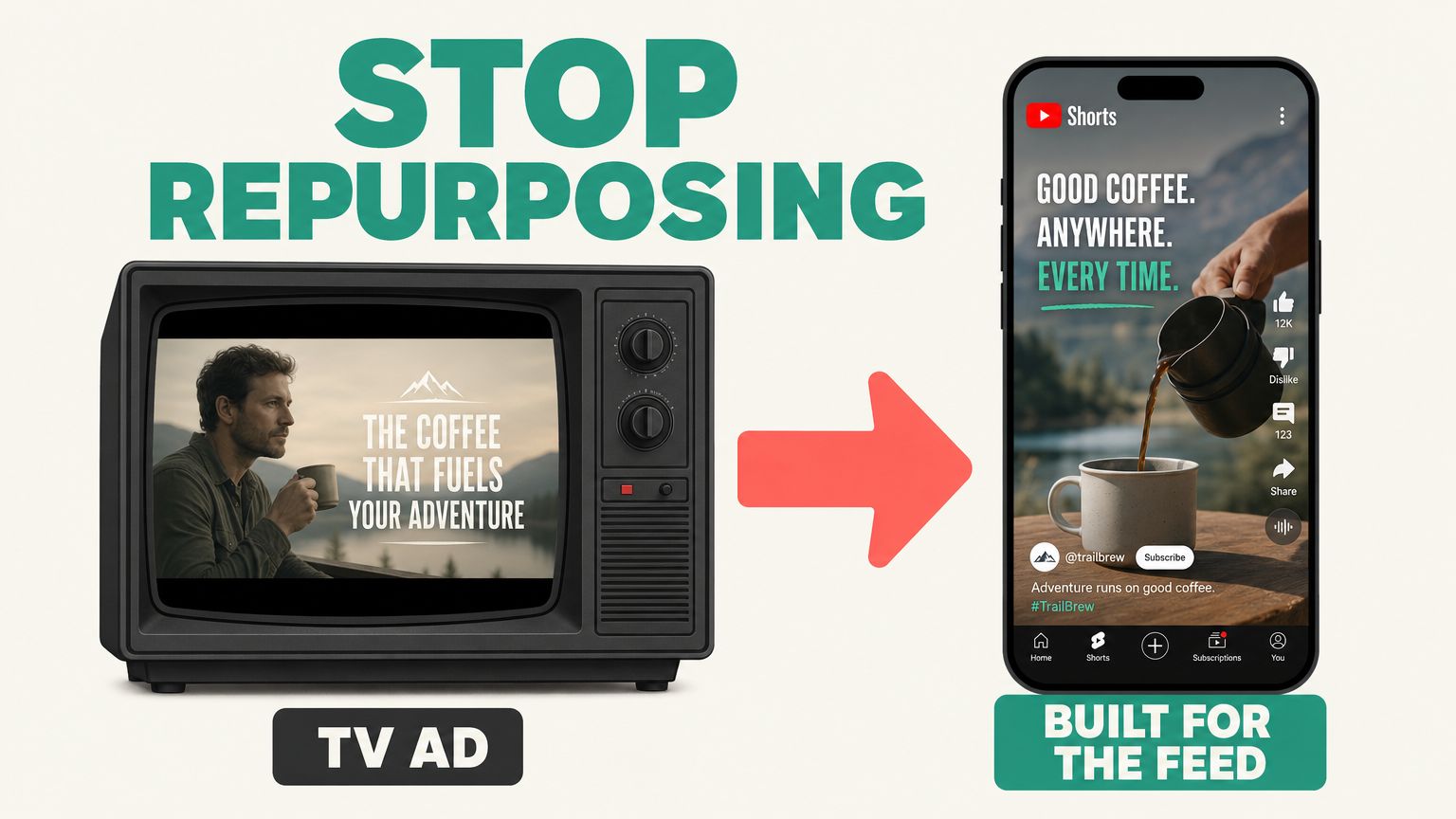
Andromeda runs computer vision and semantic analysis on the creative itself. The first three seconds of the video are scored separately from the rest. On-screen text is detected and weighted, while audio is processed. Finally, the static images are read for visual signals.
The recent updates added more granular creative analysis on each of those layers, building on Q3 2025 changes that delivered a 14% improvement in ad quality.
What does this mean in practice? If your unfair dismissal ad does not say 'unfair dismissal' in the primary text, and the visual does not anchor the topic, Andromeda has less to work with. Strong copy, clear naming of the offer, and a topic-anchored visual are not just creative polish anymore. They are how the retrieval layer figures out who the ad is for.
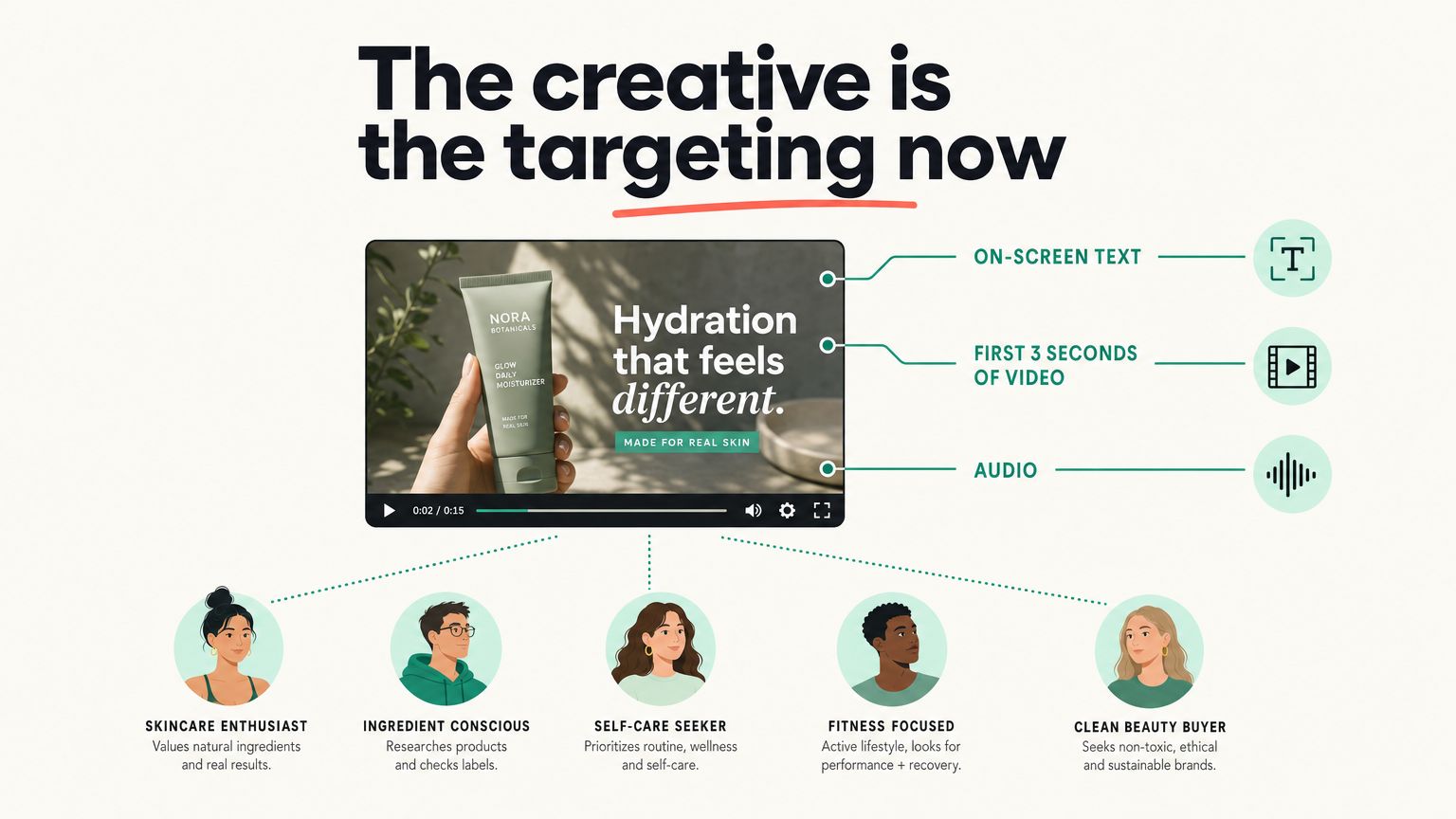
The ads we set up in this style are the ones we see working right now. Those we take over, prior to rebuilding, are usually working against the engine, not with it.
The Volume Question
Half of the Andromeda content online tells advertisers to run 15 to 50 ads per ad set. That number gets parroted everywhere, and it’s not wrong exactly. The trouble is that it’s just widely misunderstood.
Meta now lets you load up to five variations each of primary text, headline, and description within a single ad. Multiply that across a handful of creatives, and your nominal ad count inflates fast, without ever having a proportionate number of distinct concepts. That is not what the algorithm is asking for, and chasing the count burns money.
Andromeda also clusters similar creatives into a single Entity ID. Ten variations of the same product photo with minor copy tweaks count as one creative entity, not ten.
Practitioner consensus puts the Creative Similarity Score retrieval-suppression threshold around 60%, with sub-40% the recommended target across active assets. That figure is agency-derived rather than published by Meta, but it lines up with what we’ve seen in practice.
For an Australian service business, the effective range is closer to six to ten genuinely distinct ads per ad set. These should vary in angle and format, including a mix of video and static content, as well as review-led and education-led messaging. The aim is to cover different stages of the funnel, rather than produce multiple variations of the same hook. This is the part most operators overlook.
A review ad that features a testimonial might not show up as a strong performer in the dashboard, especially if you’re only looking at conversions. However, that doesn’t mean it’s not doing important work. The system may still be delivering that ad to people who are partway through the decision-making process, where its role is to build trust rather than drive immediate action.
If you remove it simply because it appears to have low conversions, you risk breaking the sequence the system has been using to move people towards a final decision.
Fatigue Cycles Have Compressed
The old wisdom on creative refresh was every six weeks. Under Andromeda, fatigue windows have compressed to roughly two to three weeks for top performers. The engine scales winning creatives aggressively, which accelerates burnout.
Refresh cadence depends on budget and audience size. For a national service business at scale, two to three weeks is realistic. For a local firm spending $1,500 a month, around every 4 weeks is usually fine. The point is that 'set and forget for two months' is no longer a viable creative strategy, regardless of budget.
The Most Expensive Mistake Australian Service Businesses Are Making
The error is essentially splitting the campaigns up too much. We see this on almost every account we audit.
Old-school setups often run four or five campaigns chasing the same goal, often with separate ad sets for retargeting that overlap heavily with prospecting. Each one sits below the conversion threshold that the algorithm needs to learn.
In the end, Andromeda never gets enough data to make confident retrieval decisions, resulting in wide audience drift, low-quality reach, and wasted spend.
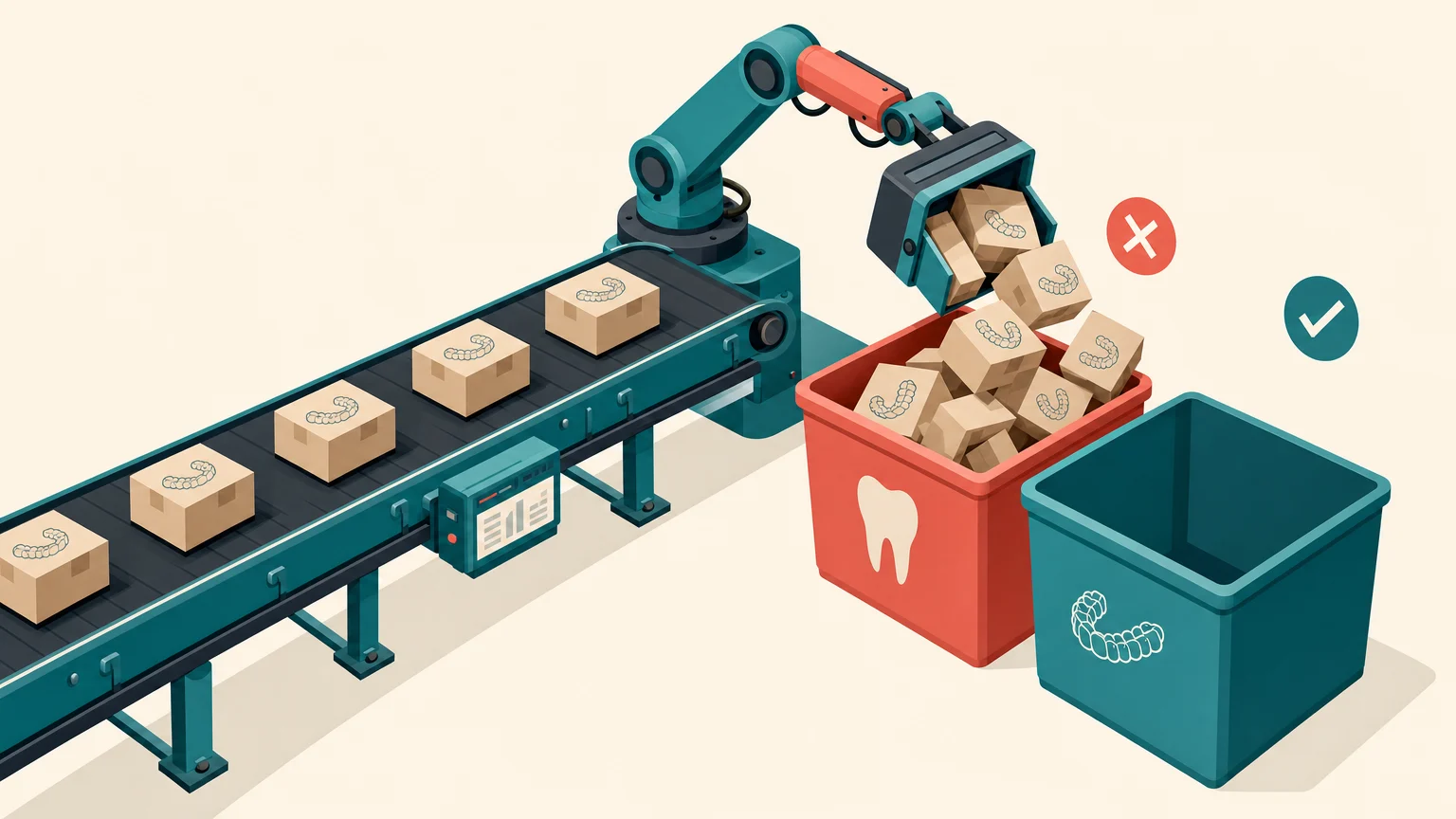
Consolidation is the fix. This means using broader audiences and fewer ad sets, and allowing the system to allocate delivery more effectively. And the data support this approach: a controlled test cited in Confect's 2026 Andromeda study found that a single ad set with 25 diverse creatives produced 17% more conversions at 16% lower cost than a traditional five-ad-set structure. We are seeing the same in our own accounts across legal, financial services, and property.
The second most expensive mistake is bad tracking. If you’re running Meta lead forms, build qualifying logic into the form so unqualified leads get screened out before they hit your CRM.
If you’re sending traffic to a landing page or to the phone, get Meta's Conversions API wired into a CRM like HubSpot or Go High Level so qualified-lead status comes back to Meta.
Optimising for form submissions trains the algorithm to find more people who complete forms. Optimising for signed clients trains it to find more people who actually convert.
Also read: Conversion Tracking in 2026: Why Your Campaign Data Matters More Than Ever
What's Overhyped, and What's Held Up
A fair bit of the Andromeda content online suggests nothing from a year ago is relevant. We don’t buy it. Strong video creative still wins. A clear visual aesthetic still wins. Triple Whale's 2026 analysis makes a related point: many issues attributed to Andromeda are actually problems with GEM, attribution, or Advantage+ defaults.
Trends evolve, but the fundamentals of what makes a Meta ad work were established before Andromeda fully kicked in, and they have not gone away. The algorithm just punishes bad fundamentals harder than it used to.
What Good Andromeda-Era Setup Looks Like
A working setup for an Australian service business in 2026 will hit most of these marks:
- One or two campaigns per goal, not four or five.
- Broader audiences, often the whole of Australia or an entire state, with the creative doing the qualifying.
- Six to ten genuinely distinct concepts, refreshed every two to three weeks at scale.
- Creative that clearly names the offer, in copy, on-screen text, and within the first three seconds of a video clip.
- A mix of formats and angles, spanning education, testimonials, and direct offers.
- Conversions API is integrated with the CRM, so qualified lead status feeds back into Meta.
- Lead form logic that filters out poor-quality leads before they take up space in the CRM.
The accounts we run this way are producing pre-qualified Meta lead-form CPLs that sit at or below the cost-per-click on the equivalent Google Search auction. Across the firms we work with, Leadtree's marketing systems have produced over $27M in projected fee returns.
One Queensland personal injury law firm we work with went from 47 monthly client appointments in 2023 to 258 today. The marketing system behind that result is built around exactly this kind of paid-media operating model.
If your Meta campaigns are still set up the way they were in 2022, the engine is working against you. We've rebuilt Meta accounts for Australian service businesses across legal, financial services, and property, and the same patterns show up on every account we audit.
- Too many campaigns.
- Tracking that misses real conversions.
- Creative that does not name the offer.
Each one of these issues is fixable. The audit takes about thirty minutes. We pull your account, walk through the structure, identify the highest-impact changes, and show you the before-and-after benchmarks from clients in your industry. There’s no commitment to engage afterwards.
Book a free strategy call: https://www.leadtree.agency/product/book-call.