
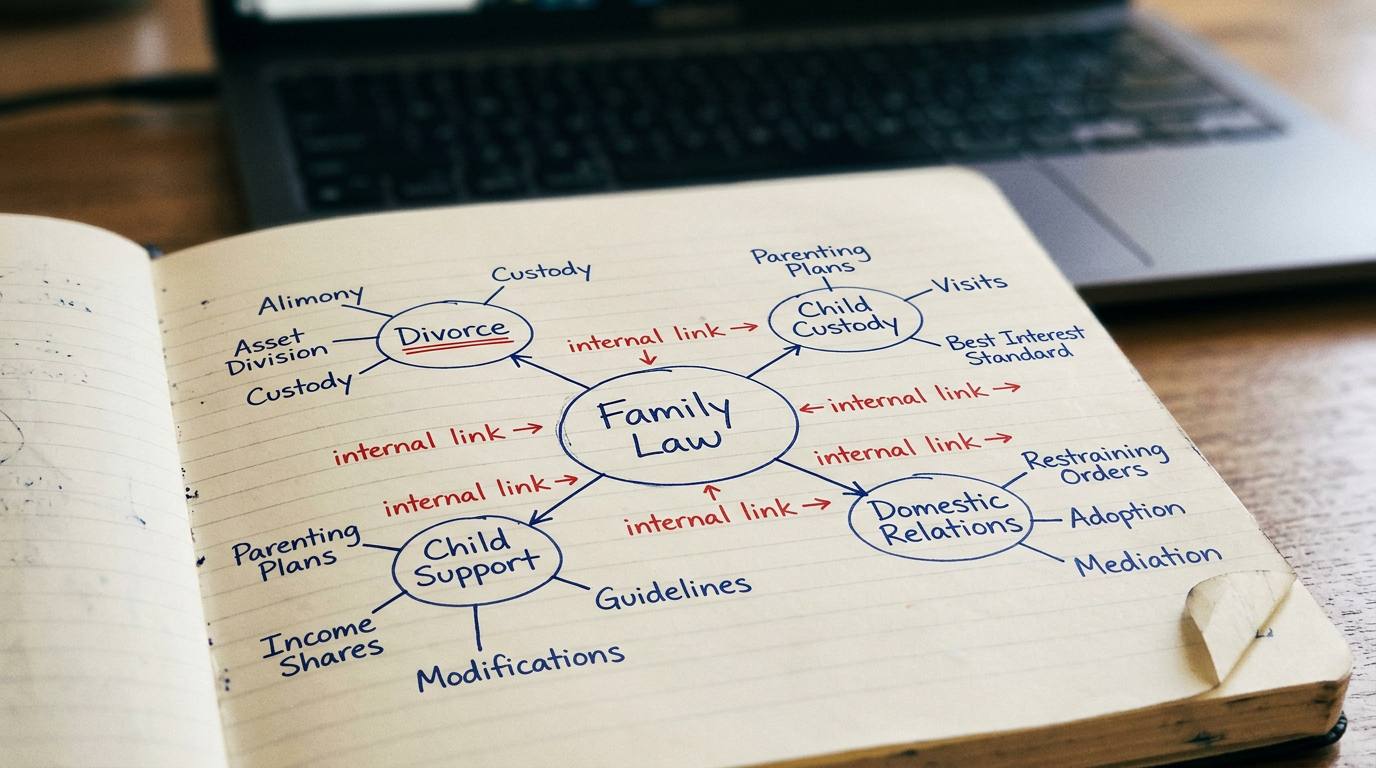
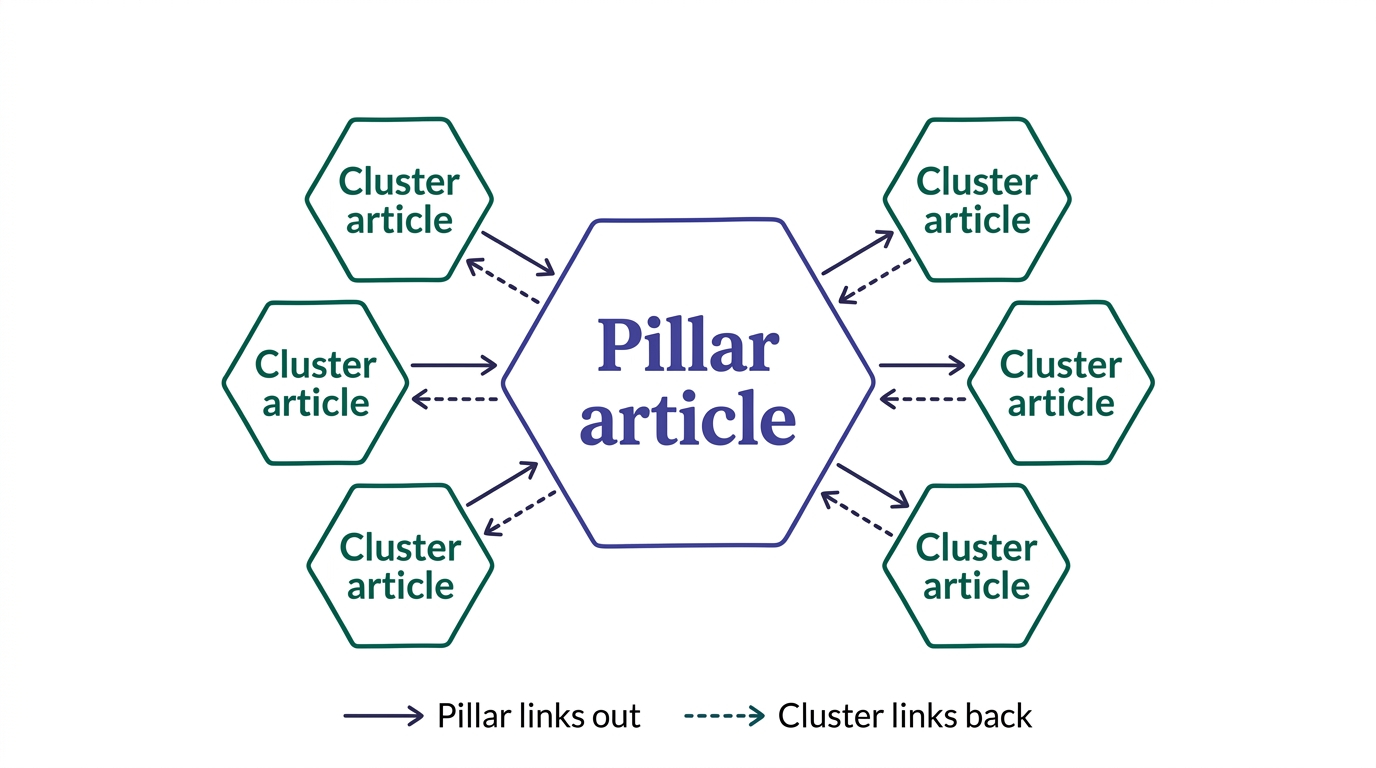
A pillar-cluster content strategy organises a core service topic into a useful main guide and related articles that answer specific questions. The links between them help readers find the next answer and help search engines discover your content.
For law firms, financial advisers and healthcare businesses, the structure needs to support accurate information and genuine expertise. This guide covers how we plan those topics, connect the articles and make authorship clear.
What Topical Authority Actually Means
In SEO, we use topical authority to describe a site becoming a credible, useful resource on a subject. It is a content strategy concept, not a public Google score or a guarantee of rankings.
It's not about having one excellent article on a topic. It's about demonstrating, across an interconnected body of content, that you understand a subject deeply enough to cover it from multiple angles, foundational concepts, nuanced subtopics, practical applications, common questions, and edge cases.
Think of how you assess expertise in a person. You look at whether their explanations are accurate, how they handle nuanced questions and whether they can back up what they say. Use that same scrutiny when reviewing your content.
Google gives greater weight to signals of reliable content on Your Money or Your Life (YMYL) topics, where poor information could affect health, finances or safety. Its public guidance does not establish a new author-schema requirement from the December 2025 update.
The Three Mistakes That Undermine Topical Authority
Before getting into the framework, it's worth naming the patterns we see consistently undermining authority across law firms, financial advisory practices, dental clinics, and healthcare businesses.
Mistake 1: Publishing content that doesn't form a coherent whole
A family law firm publishes an article about property settlements one month, something about social media trends the next, then a piece on tax law, despite not offering tax services. Over time, the site accumulates content that doesn't reinforce anything. Google struggles to understand what the site is genuinely about.
A library of unrelated posts can leave visitors unsure which questions your business can help with. Review whether each article serves your audience and core services before adding more.
Mistake 2: Thinking one good article per topic is enough
It's common for firms to identify a topic they want to rank for, publish one article, and consider it done and dusted. But for competitive, high-stakes topics, such as family law, investment advice, cosmetic dentistry, and personal injury, one article is rarely sufficient to establish authority.
The practices building sustainable rankings go deep: covering the primary topic, then building out the sub-questions, the nuanced variations, the practical applications, and the comparisons.
A family law firm doesn't need one article on property settlements. It needs a pillar article that covers property settlements comprehensively, plus cluster articles on: how superannuation is treated in divorce, what happens to a shared business, how property settlement interacts with parenting arrangements, and what self-represented litigants need to know.
The cluster gives readers a clear route through related questions. Each article still needs to earn its place with a useful answer, rather than repeat the main guide.
Mistake 3: Publishing without proper author attribution
If an article is attributed to “admin”, readers cannot tell who is responsible for it. Use a truthful byline and give readers relevant background on the person or organisation behind the content.
We combine visible author information with Article and Person structured data. The markup helps describe who wrote a piece and links to their profile; the supporting evidence belongs in the content and biography. Google’s Article guidance explains the author fields.
For example, an accurate solicitor biography can show relevant practice experience and link to a professional profile that readers can check. Use real qualifications and current details; a name or schema tag alone does not establish trust.
The Pillar-Cluster Framework
Here's how we build the pillar-cluster framework with our clients.
Step 1: Define your content pillars before you put pen to paper
The most common error is starting with a topic and writing an article. The better approach is to start with your core service areas and define the content pillars that support them.
A pillar is the central, comprehensive piece of content that covers a topic in its entirety. It sits on its own URL (ideally something clean like /family-law-property-settlement/ or /invisalign-melbourne/), is thorough enough to serve as the definitive resource on the topic, and links out to related cluster content as that cluster is built.
For a family law firm, content pillars might be:
- Property settlements in divorce
- Child custody and parenting arrangements
- Spousal maintenance
- Domestic violence and legal protection
For a dental practice:
- Invisalign and clear aligners
- Dental implants
- Teeth whitening and veneers
- Emergency dental care
Each represents a significant search topic and a core service area. The pillar article covers it comprehensively: what it is, how it works, typical costs, what the process looks like, who it's right for, and the most common questions.
Step 2: Map your cluster topics before building the pillar
Counter-intuitively, we find it more effective to map the full cluster before writing the pillar. Understanding what the cluster will contain allows you to structure the pillar article correctly, knowing what you'll link to, what depth each section requires, and what can be addressed in more detail in individual articles.
A cluster for 'dental implants' might include:
- How long do dental implants last?
- Dental implants vs. dentures: which is better?
- What is the recovery process after dental implant surgery?
- How much do dental implants cost in Australia?
- Same-day dental implants: what you need to know
- Am I a good candidate for dental implants?
Each article addresses a distinct question someone might search for. Link back to the main guide using descriptive wording, and link from the guide to the articles where they add useful detail.
Step 3: Apply internal linking intentionally
Internal linking is the mechanism that makes pillar-cluster architecture work. It signals the relative importance of pages (the pillar, which receives many internal links, is understood to be the priority page) and creates a structure for both users and crawlers that can be navigated with ease.
The approach:
- Every cluster article links back to the pillar using descriptive wording that fits the sentence
- The pillar links out to all cluster articles with descriptive anchor text
- Cluster articles link to related articles where the next page helps answer the reader’s question
- Service pages link to relevant pillar articles for deeper reading
This needs to be done with intention. Simply sprinkling internal links here and there, or only linking new content back to older posts, will not have the same impact. What really makes a difference is a thoughtfully planned internal linking structure that guides readers naturally and adds real value.
Step 4: Make authorship clear and support it with schema
Show who wrote the article and who reviewed it, if a review actually took place. Link to a biography with the person’s relevant experience, qualifications and professional profiles.
Reflect the visible byline in Article structured data, using the real author’s name and profile URL. Google supports both Person and Organization authors; do not assign a solicitor as author solely because their credentials fit the topic.
Where an expert reviews a draft prepared by someone else, describe that contribution accurately. Structured data must match the page; it does not verify credentials or promise a ranking improvement.
What to Do With Old Content
If your site has accumulated years of blog posts, some relevant, some not, a content audit is worthwhile before building out new clusters.
The process we use:
- Export all blog posts with organic traffic data from Google Search Console
- Flag anything that hasn't driven meaningful organic traffic in the past six months
- Review flagged content: Is it relevant to your core service areas? Could it be updated and improved, or is it clearly off-topic?
- Content that no longer serves a useful purpose: consider removal after checking traffic, links and reader needs. Redirect only to a relevant replacement; do not send unrelated articles to the homepage.
- On-topic but thin or outdated content: update and expand to bring it to the current standard
- Strong content: integrate into your pillar-cluster structure with appropriate internal links
The goal is a library that helps readers understand your services and make informed decisions. Keep useful older pages, improve inaccurate or incomplete answers, and consolidate only where articles serve the same intent.
What Results to Expect, and When
Content strategy results aren't always immediate. Clients typically start seeing meaningful ranking movements within three to six months of implementing a proper pillar-cluster structure, with compounding results over 12 months.
A civil law practice we worked with saw a 135% increase in leads over 12 months through this approach. What made the result particularly notable was that it happened during a period when overall organic traffic to informational content was declining, because AI Overviews were absorbing clicks on knowledge-type queries.
Their total organic traffic numbers dipped slightly, but the quality improved substantially. Higher-intent visitors, more relevant searches, better conversion rates. The shift to topical authority changed not just how much traffic they received, but who was finding them.
That's the real value of topical authority: you stop attracting visitors looking for general information and start attracting visitors actively seeking what you offer.
Where to Start
If you're building this from scratch, here’s a sequence that works:
Month 1: Audit your existing content. Identify your three to five core service areas. Map your content pillars and the first cluster for your highest-priority pillar. Set up author attribution and schema for your main contributors.
Month 2: Write your first pillar article. Write two to three cluster pieces. Build the initial internal linking structure.
Month 3 onward: Continue adding to the cluster. Expand to your second pillar. Monitor Search Console data for movement in the initial cluster.
A useful cluster can grow as you answer more of your audience’s questions. Keep the information accurate and improve the links as the library develops; neither age nor author schema creates authority by itself. Google uses many ranking systems, including freshness systems for queries where recent information matters.
Build around the questions your clients actually ask. Publish a separate article when it needs a distinct answer, and strengthen an existing guide when that would serve the reader better.
If your site has years of content but is not ranking for the topics that matter, review search intent, accuracy, overlap, internal links and technical access together. Leadtree works with Australian law firms, financial advisers and healthcare businesses on pillar-cluster content strategies built around their services.
Book a free 30-minute call to discuss what a content architecture that performs could look like for your sector.