

From what we see, day in and day out, most business owners are chasing the wrong numbers. They want the cheapest possible cost per lead and they’ll go to any lengths just to get it, even if it means switching agencies.
Here is the problem. Cost per lead tells you almost nothing on its own. A $15 lead that never becomes a client is more expensive than a $200 lead that signs. The number that actually matters is what a client is worth to you, and therefore what you can afford to pay to win one.
This is the calculation that separates businesses that scale profitably from businesses that just generate activity. Let’s walk through how this works in practice.
Why the Cheapest Leads Often Cost the Most
When you tell an ad platform to maximise conversions, it does exactly that, for whatever you told it to count. If the thing you count is lead-form submissions, Google Ads or Meta will go and find you the most form submissions for the lowest cost. Nothing in that instruction says anything about quality.
So, what happens is that the platform optimises towards the cheapest leads it can find, and the cheapest leads are rarely the best ones.
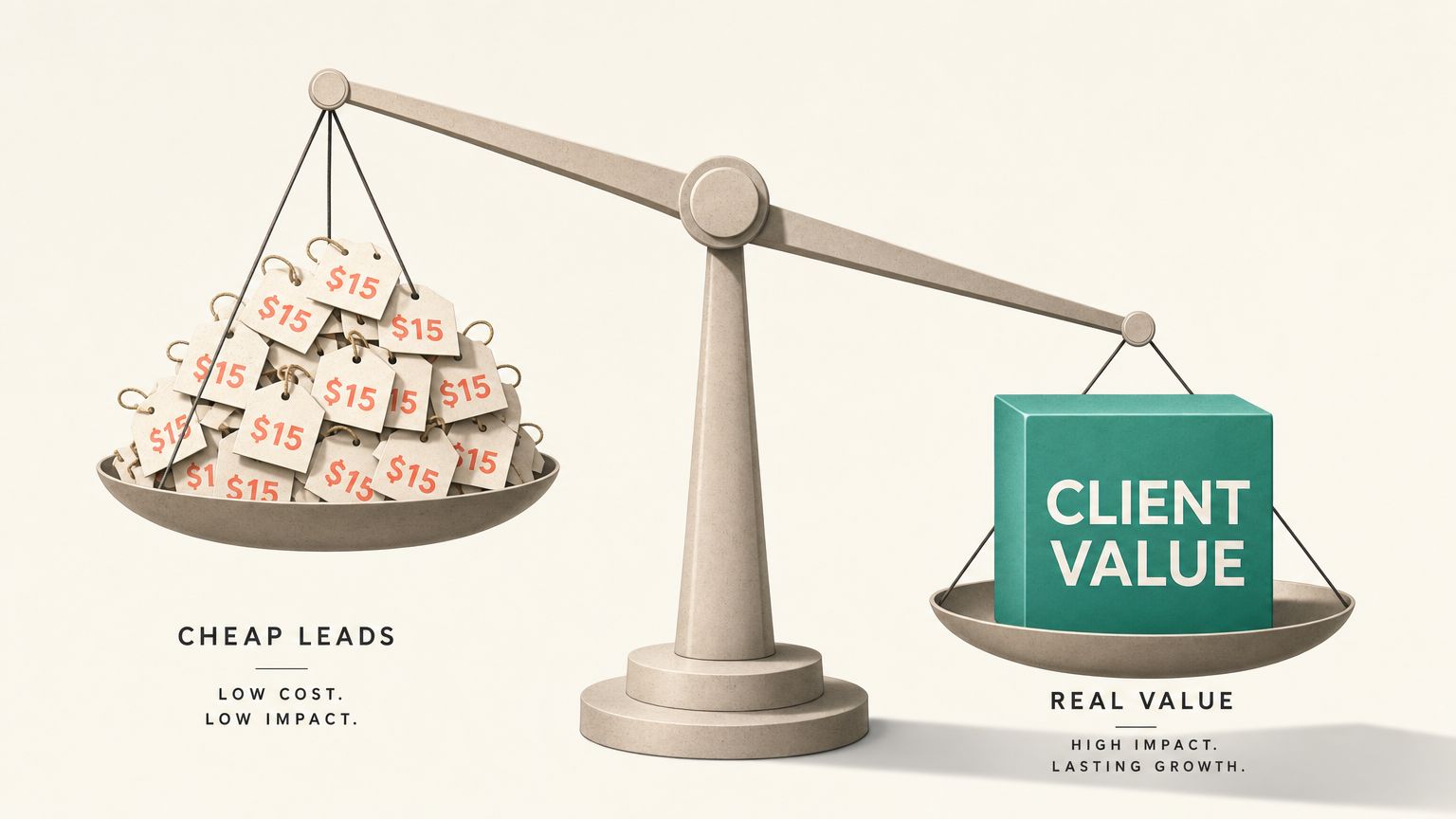
Picture your cost per lead dropping from $30 to $15. It looks like a win. But if it happened because the platform found a cheap, high-volume search term irrelevant to what you do, you are now paying for leads that will never convert.
Sadly, this kind of thing is happening across the board. Since Google merged broad-match-modifier behaviour into phrase match in 2021, it now shows your ad for any query that carries the meaning of your keyword. You might think you are bidding on ‘family lawyers Sydney’ and discover, in the Search Terms report, that you are showing for ‘free legal aid’, for example. High search volume, few advertisers competing, almost no commercial value. The leads are cheap because they are worthless and you only find this out when you pick up the phone.
The Number That Actually Matters
Forget cost per lead for just a moment. The figure to work towards is your allowable cost per acquisition: the most you can profitably pay to win a client. You build it from three things you already know, or can estimate.
| Step | Question | Example |
|---|---|---|
| 1. Close rate | From our genuine leads, what share becomes paying clients? | 1 in 4 signs → 4 leads per client |
| 2. Client value | What is a client worth over the whole relationship, not just the first job? | $3,000 contribution before acquisition costs |
| 3. Work backwards | What can you afford per lead and still make your margin? | See below how we work this out |
Most owners undercount badly at Step 2. We’ll come back to why in a moment.
An Illustrative Example
For this illustration, assume each client provides $3,000 in contribution after service-delivery costs but before acquisition costs, and one in four genuine leads becomes a client. The break-even figures below are ceilings for total acquisition cost; allow for sales time, tools and other acquisition costs before setting a media budget.
| Measure | Calculation | Result |
|---|---|---|
| Leads per client | 1 ÷ 25% close rate | 4 leads |
| Break-even spend per client | $3,000 contribution before acquisition costs | $3,000 |
| Break-even cost per lead | $3,000 ÷ 4 leads | $750 |
| Allowable CPL (for a healthy margin, not break-even) | chosen budget below the ceiling | say $100 |
Under these assumptions, a $40 lead leaves room for other acquisition costs and margin. Change the close rate, client contribution or sales costs and the answer changes. Compare channels using the same definitions and a time period long enough for leads to become clients.
Why Lead Value Isn't Simply One Number
Client value varies enormously, and lumping it into a single figure is where a lot of campaigns quietly lose money. In law, the spread is dramatic:
| Type of work | What to watch | Implication |
|---|---|---|
| High-value, one-off (e.g. personal injury, 'car accident lawyer Sydney') | Clicks can run to a couple of hundred dollars | Must return a profit straight away |
| Lower-value services | $10–$20 a click | The right bid is completely different |
| Compounding (e.g. family law) | Modest initial deposit, much higher value as the matter runs | Judge on lifetime value, not first job |
| Loss leaders (e.g. a simple will) | Little or no profit up front | A winner if clients return for broader legal needs |
The lesson: know which lens applies before you decide what a lead is worth. Judged on the will alone, the campaign looks unprofitable. Judged on the client, it’s a winner.
How to Make the Platforms Chase Value, Not Volume
Knowing your allowable cost per acquisition is only half the job. You also have to make the ad platforms optimise towards value instead of cheap volume.
There are two ways. Here’s how to start simple:
1. Qualify at the Form (the Quick Win)
Add two or three screening questions to your lead forms, on your website or as Meta instant forms, and rule out the obviously irrelevant enquiries before they ever count as a lead. Meta supports this through its Higher Intent form and custom questions; Google offers it through the more qualified leads setting and qualifying responses.
Useful screening can reduce unnecessary intake work. It does not automatically tell an ad platform which people to avoid. Check which events the form and CRM actually send and which conversion goal the campaign uses.
We added qualifying questions to a client's forms and more than tripled the number of sign-ups for the same budget. On a recent employment-law campaign with strict eligibility criteria, getting those questions right in the initial form and signalling the qualified leads straight back to the platform made an enormous difference.
2. Feed Real Outcomes Back (the Proper Fix)
The more advanced step is to connect your CRM, like HubSpot or GoHighLevel, and push real outcomes back to the ad platforms. Using Google Enhanced Conversions for Leads or Meta's Conversions API, you tell the platform when a lead becomes an appointment or a signed client.
Validate the events, their values and the campaign’s bidding goal before assuming it is optimising for client outcomes. Event upload alone is not enough. This is the tracking foundation we cover in our Google Ads self-audit article.
What Good Looks Like
We believe that a business that’s doing this well is not constantly asking the question, ‘How much does each lead cost?’ It talks about the cost per client and the margin on that client.
- It knows its close rate and its client value, including lifetime value.
- It has worked out what it can afford to pay.
- It has set its campaigns up, through qualification and real-outcome tracking, so the platforms hunt for value rather than the cheapest possible form fill.
Get there and the whole conversation changes. You stop trying to pay less for leads and start being willing to pay more for the right ones, which is exactly how you outbid competitors still chasing the cheap number.