Years ago, in an in-house marketing role at a law firm, we turned off all of our paid advertising.
The brand-building half was paid social. Awareness campaigns (early-form by today's standards) were reaching a large audience every month. However, in direct tracking it generated almost no leads, which is precisely why it looked like the obvious line item to cut.
We also ran Google Ads, but those were text ads against high-intent searches. Low volume, high purchase intent, and doing nothing at all for mass awareness.
Everything else came through organically. We had forty to fifty thousand visits a month and climbing. This consisted of traffic, leads, and most of the clients who actually signed.
So the case for cutting paid ads was easy to make, and I did not fight it at the time.
For the first fortnight, nothing happened. New clients arrived at the usual rate. If you had asked me at the three-week mark, I would have said we had found free money.
At about three weeks, a slow decline started.
By the end of three months, new client sign-ups were down by more than 70%.
Yet, organic traffic had risen over the same period.
The Part I Could Not Explain At The Time
Some of that 70% was the Google Ads text campaigns switching off, and that portion was easy to attribute. It was nowhere near the majority.
Most of the decline showed up inside the organic traffic. Same rankings, same click-through rates, more traffic arriving than before, and a steadily shrinking share of those people doing anything once they got there.
They were still finding us, but there was no will to pick us.
Whatever was happening looked psychological more than mechanical. Something along the lines of "I have heard of these people" had been quietly doing work in the background, consciously or not, and when it stopped, so did the confidence to make the enquiry.
Here is the uncomfortable part, and it is the reason I am still telling this story years later: The campaign we cut was the one whose own reporting said it did almost nothing. It reached a very large audience every month and was credited with barely any leads. On a dashboard, it looked like waste.
I did not expect brand to be carrying that much, especially given we were not doing a huge amount of it. The scale of the drop genuinely surprised me.
What Les Binet Argued At Google Marketing Live
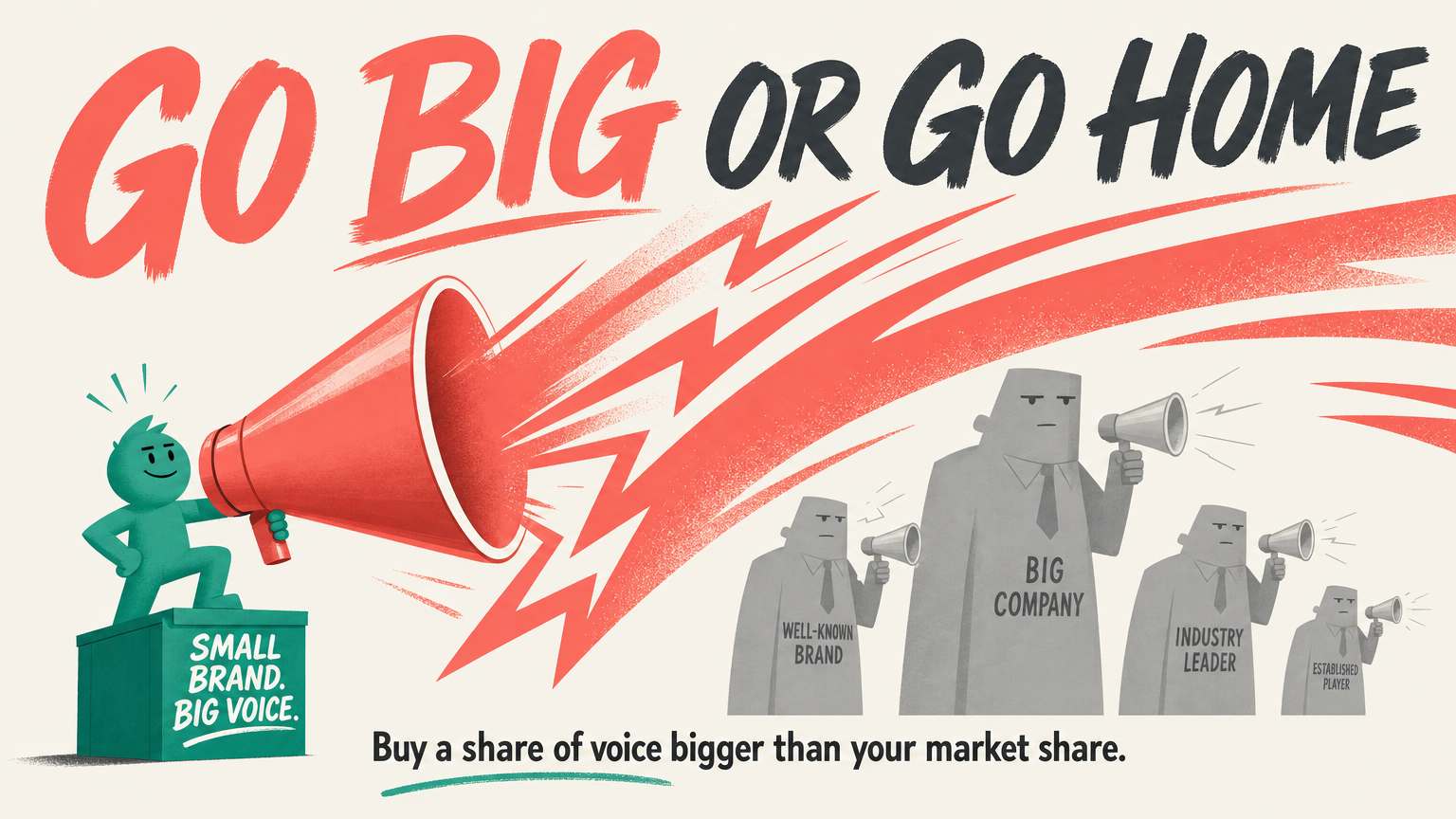
Les Binet closed out Google Marketing Live this year, and it was comfortably the least product-pitchy part of the day. He was presenting Go Big or Go Home, a report written with Will Davis for the IPA.
The argument is that our industry has become obsessed with doing more with less, and that this obsession is destroying the thing it claims to protect. He has since described the same dynamic to an Australian audience as an advertising arms race, which is the framing I find most useful, because an arms race is relative. You are not trying to spend a lot. You are trying to spend more than the people you actually compete with.
Three numbers carry it:
Budget is roughly eight times more important than ROI. Looking at how profit actually varied across IPA Effectiveness Award case studies, ROI explained just 11% of the variation in payback, and budget explained 89%. Binet's line was that the single most important decision in marketing is how much to spend.
Marketers believe close to the opposite. In the accompanying survey, 65% named ROI as the biggest contributor to effectiveness. Only 35% said budget.
And efficiency has gone up while effectiveness has gone down. Since the pandemic, ROI has improved by about 4%, while the net profit generated by advertising has fallen 11% in real terms.
Read those together, and you get the finding that should make everyone uncomfortable. We got better at the thing we measure, and worse at the thing that pays us.
Why The Conventional Wisdom Exists
I do not think anyone chose this. I think the tooling chose it for us.
Efficiency is legible. Cost per lead sits on a dashboard, updates daily, and can be improved by a person on a Tuesday. Effectiveness shows up quarters later, tangled with seasonality, referrals, reputation and whatever your competitors happened to do.
So when a business owner asks "is this working?" the honest answer is slow, and the available answer is fast. Everyone reaches for the available one.
Narrow your targeting, and your cost per lead improves, so you narrow it again. Binet's warning is that this ends up pointing your entire budget at the small slice of the market that is already in-market and ready to act, which the IPA calls the beginning of a death spiral. Efficiency improves a bit. Effectiveness falls a lot.
You do not notice because every individual decision looked correct.
Where I Agree, From The Account Side
I see the mechanical version of this in ad accounts constantly, and it is worth naming precisely because it is invisible in the reporting.
When you run tightly targeted, algorithmically optimised campaigns on one or two platforms, the algorithm does exactly what you asked. It finds the people most likely to convert right now. Then it finds a slightly narrower version of those people. Then narrower again.
You end up not with your niche, but with an efficient niche inside your niche. It is also a ceiling you cannot see from inside the account, because every metric on the screen is improving even as the business stops growing.
"That's Great, But I'm Not Telstra"
This is the objection I had sitting in the room, and it is the right one. Binet's evidence base is Effie and IPA award winners. His examples are big brands with big budgets and marketing departments.
If you run a six-partner firm turning over a few million, "go big" sounds like advice for somebody else.
Here is the finding that actually answers it, and it is Australian:
Advertising Council Australia's To ESOV and Beyond research, produced with ThinkTV, found that extra share of voice, not absolute media spend, is what drives campaign effectiveness. Even small-budget campaigns move mental availability and business metrics when their share of voice is positive relative to their market share.
That reframes the whole thing. The question is not "can I afford to spend like a big brand?" It is "Am I spending more than my size in the market I actually compete in?" and that market is usually far smaller than the national picture.
A family law firm in one metropolitan area is not competing with Telstra. It is competing with maybe a dozen firms advertising in that city, and being loud in that pond is an achievable target.
What "Extra Share Of Voice" Actually Costs
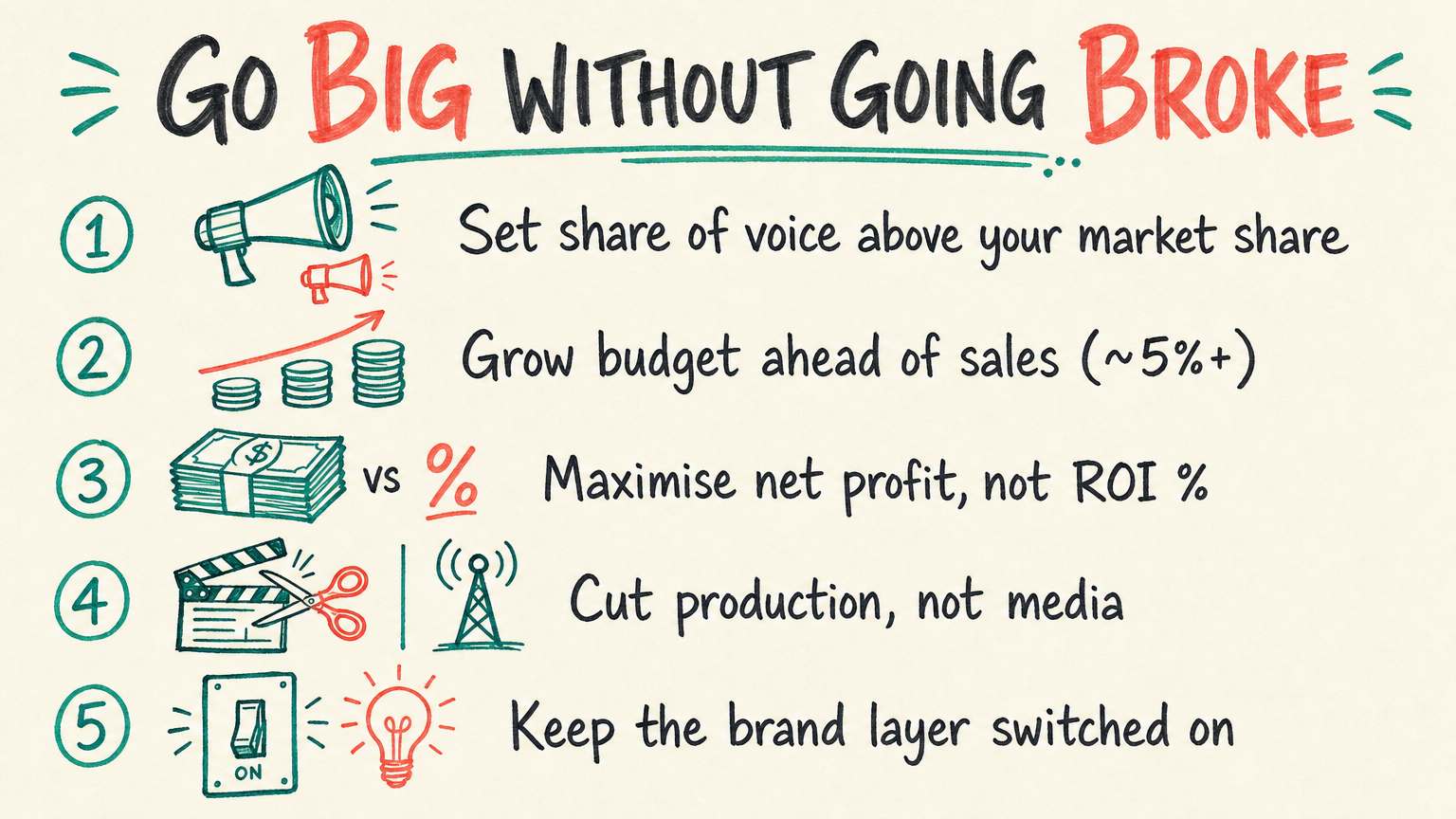
Binet's rule of thumb, and the one most people quote without checking, is that roughly 10 points of extra share of voice buys about 0.5 market-share points of growth a year. It varies a lot by category and is a direction, not a promise.
That is theory. Here are two ways to make it a number you can act on this week:
Method one: the advertising-to-sales ratio
The blunt version Binet gave on stage is that you typically need to be spending around 5% or more of revenue to grow and that small brands can grow on small budgets provided the budget grows ahead of sales.
| Annual revenue | Maintenance territory (~3%) | Growth territory (~5%+) | Growth budget, per month |
|---|---|---|---|
| $1M | ~$30,000 | $50,000+ | ~$4,200 |
| $3M | ~$90,000 | $150,000+ | ~$12,500 |
| $5M | ~$150,000 | $250,000+ | ~$20,800 |
| $10M | ~$300,000 | $500,000+ | ~$41,700 |
The 5% growth threshold is Binet's stated rule of thumb. The 3% maintenance column is our own working assumption, not a published figure, and every category sits somewhere different. Use this to find out which conversation you are having, not to set a budget.
The value of this table is that most owners have never once compared their marketing spend to their revenue as a percentage, and the number is often startling when they do.
Method two: estimate your share of voice from Auction Insights
Most people treat share of voice as unknowable without buying research. In paid search, you have a decent proxy sitting in your account already.
Open Google Ads, go to your main campaign, and open Auction Insights. It shows your impression share against the competitors bidding on the same terms. That is not a perfect share-of-voice figure, but for a local service business where paid search is the main battleground, it is close enough to reason with.
One gotcha worth knowing before you go looking: the report will not show a competitor at all if their impression share is under 10%. So the list you see is the serious players, not everyone, but that is usually the list you want anyway.
Worked example. Take a fictional firm, Maven Legal, doing family law in one capital city.
| Figure | Where it comes from | |
|---|---|---|
| Their search impression share | 18% | Auction Insights |
| Largest competitor's impression share | 42% | Auction Insights |
| Their estimated share of local matters | 8% | Owner's own estimate from enquiry and market data |
| Extra share of voice | +10 points | 18% voice minus 8% market |
| Expected growth | ~0.5 share points per year | Binet rule of thumb |
Two things fall out of that table, and they are both uncomfortable:
- First, +10 ESOV is a real position and it still only buys about half a share point a year. Brand building is slow. Anyone selling it as a fast lever is selling something else.
- Second, that position has to be defended as you grow. If Maven's market share climbs to 12% and their impression share stays at 18%, their ESOV has halved without anyone deciding anything. Budget has to rise ahead of revenue just to stand still, which is precisely the discipline that gets cut first when a quarter looks tight.
The Concentration Rule For Small Budgets
There is one more finding in the Australian research that changes what you do with the money, and I think it is the most actionable thing in this whole article.
For brands with small to medium budgets, the allocation of spend to video, not the number of channels used, had the greatest impact on business effects.
That is the opposite of how most small budgets get spent. The instinct when money is tight is to be present everywhere: a bit of searching, a bit of social, a bit of display, a bit of everything, so no box is unticked.
The evidence says that instinct is wrong and that concentration beats coverage when the budget is small. We went into the video side of this in more detail in our piece on why repurposed TV assets fail on YouTube.
Being genuinely present in two places beats being technically present in six.
The Question I Still Do Not Have An Answer To
I want to be straight about the part of Binet's argument I am not settled on, because it is the part that matters most for the businesses we work with.
Almost all of this evidence comes from large advertisers. And the modern version of "go big" increasingly means handing budget to an algorithm and letting it decide, whether that is Performance Max, Demand Gen or AI Max.
Those systems run on data volume. A brand with millions of conversions a year feeds them very well. A firm with forty enquiries a month does not. That is the same constraint we wrote about in why AI Max backfires for service businesses without the right tracking, and it is not a coincidence that it keeps coming up.
So the open question is whether this generation of tools genuinely lets a small brand punch above its weight, or whether it entrenches whoever already has the most data. I would like the answer to be the first one, however, I am not yet convinced it is.
What I am fairly confident about is that creativity is the variable a small brand can still win on. The Australian research is explicit that mental availability is driven by three forces: budget, media channels, and creative strength. You cannot outspend a national competitor, but you can be more distinctive, more specific, and genuinely more useful than they are, and that is not a budget line.
Handing the whole thing to Google is not going to differentiate a small firm from its competitors. Nothing in the automation does that job. That job is still yours.
What I Would Actually Do On A Small Budget
- Work out your advertising-to-sales ratio. One number, ten minutes. It tells you whether you are in a growth conversation or a maintenance one.
- Define the pond. Not "Australia." The suburbs, the practice area, the dozen firms you actually lose work to. Share of voice is only meaningful inside a market you genuinely compete in.
- Pull Auction Insights and find out how loud you currently are relative to them.
- Concentrate rather than spread. Two channels done properly, with video carrying real weight, beats a token presence across six.
- Protect a brand-building portion and do not touch it for at least two quarters. This is the hard one, because it is the line item with no attributable leads next to it. It is also the one whose removal I have personally watched take a business apart slowly enough that nobody connected the two.
- Judge it on total enquiries and cost per acquired client, not on channel-level cost per lead. Channel metrics will improve as you narrow. That is the trap, not the goal.
The Nuance
There is a legitimate version of staying efficient and small.
If you are at capacity, if the partners are working the hours they want to work, and if growth would mean hiring people you do not want to manage, then running a tight, efficient, in-market-only campaign is a perfectly rational strategy. Not every business should be trying to scale, and the industry is bad at admitting that.
The mistake is choosing the small-budget playbook while expecting the growth that only comes from the other one. That is the position most firms are actually in, and it is why the numbers stop moving while every dashboard says things are improving.
If you want to grow, the brand element is not optional, and it is not a luxury purchase for after the good year. It is the thing that makes everything else you are already paying for convert.
I learned that by watching it get switched off.
If you have never compared your marketing spend to your revenue as a percentage, that is a ten-minute job that usually reframes the whole conversation.
We are happy to run that number with you, pull your Auction Insights, and tell you plainly whether you are in a growth budget or a maintenance one. There is no pitch attached if the answer is that you are fine.
Book a time here: https://www.leadtree.agency/product/book-call