
These articles are inspired by myself (Richard) going to the Google Marketing Live event in Brisbane in June 2026. Articles are based around key info shared there and my opinions and tips relating to them.
Google's pitch for AI Max is simple, and on stage, it sounds almost rude to argue with it. Stop picking keywords, let the AI find the searches you'd never have thought of, and you'll get 27% more conversions than a manual campaign.
The product is now out of beta and rolling out globally, and from September, your old Dynamic Search Ads and broad-match campaigns will be upgraded to it automatically, whether you opted in or not.
Here's the part nobody on stage at Google Marketing Live said out loud. For a service business without proper conversion tracking, handing your keywords to AI Max is the fastest way to spend more money on worse leads.
I went to GML in Brisbane in June. I left genuinely impressed by AI Max. But I also left certain that it will slowly burn through any budget for one specific and fixable reason.
Why Google's Headline Case Study Works (and Why Yours Might Not)
The flagship example was Telstra. Their AI Max test reportedly lifted SIM orders by 52% and cut cost per order by 36%. Then, from the stage, the presenter put the click-through-rate gain at +74%. AI Max went out and found long-form, conversational, even multilingual searches that Telstra was never targeting and converted them.
It's a great result, but also a clue as to who this product is built for.
Telstra sells SIM cards. A sale is a sale. The revenue lands in the system, the cost per order is a real number to the dollar, and the algorithm gets fed clean, unambiguous outcomes to learn from. That's e-commerce, and AI Max is brilliant at it.
Now look at what AI Max optimises against in a typical service-business setup, and the picture changes.
AI Max is only as smart as the outcome you feed it. Feed it "purchase," it chases buyers. Feed it "form submitted," it chases form-fillers, and the cheapest form-fillers are rarely the ones who pay you.
How "Maximise Conversions" Becomes "Maximise Junk"
Most lead-gen campaigns are set to maximise conversions, where a conversion is a phone-button click or a lead-form submission. The algorithm's job is to get as many of those as possible, as cheaply as possible, for your budget.
Take the keyword control away, and it gets very good at the "as cheaply as possible" part.
Picture a Sydney family law firm. It thinks it's bidding on "family lawyer Sydney." AI Max notices there's a mountain of cheap, low-competition volume sitting next door in searches like "free legal advice" and "free legal aid." Nobody there is going to pay for a lawyer, and it may not even be family law. But the forms get filled, the cost per lead drops, and the volume is enormous.
So the algorithm does exactly what you asked. It pours more budget toward the cheap stuff, because on its scoreboard, that's winning.
Also, on the dashboard, it looks like a triumph with lots of leads and falling cost per lead. In the real world, however, the intake team is drowning in tyre-kickers, and the partners are asking why the phone isn't ringing with actual clients. This is the well-documented failure mode of broad, automated matching without strong feedback, and AI Max turns the dial up on it.
The One Thing to Get Right Before You Switch It On
The fix isn't to avoid AI Max. It's to stop feeding it junk and start feeding it the outcomes that actually pay your bills. That means closing the loop between your ad account and what happens after the lead lands.
There are three signals worth feeding back, roughly in order of value:
- A signed client. The gold standard. The algorithm learns to chase people who actually become clients.
- A marketing-qualified or pre-qualified lead. Someone you've spoken to and confirmed meets your key criteria.
- An appointment booked. A meaningful step that happens often enough for the system to learn from.
You push these back into Google using Enhanced Conversions for Leads, which connects your CRM to your ad account. It supports HubSpot and Salesforce directly through Data Manager, and Google's own data puts the median lift at around 10% over standard offline conversion import before you've changed anything else. Now the algorithm optimises towards revenue, not noise.
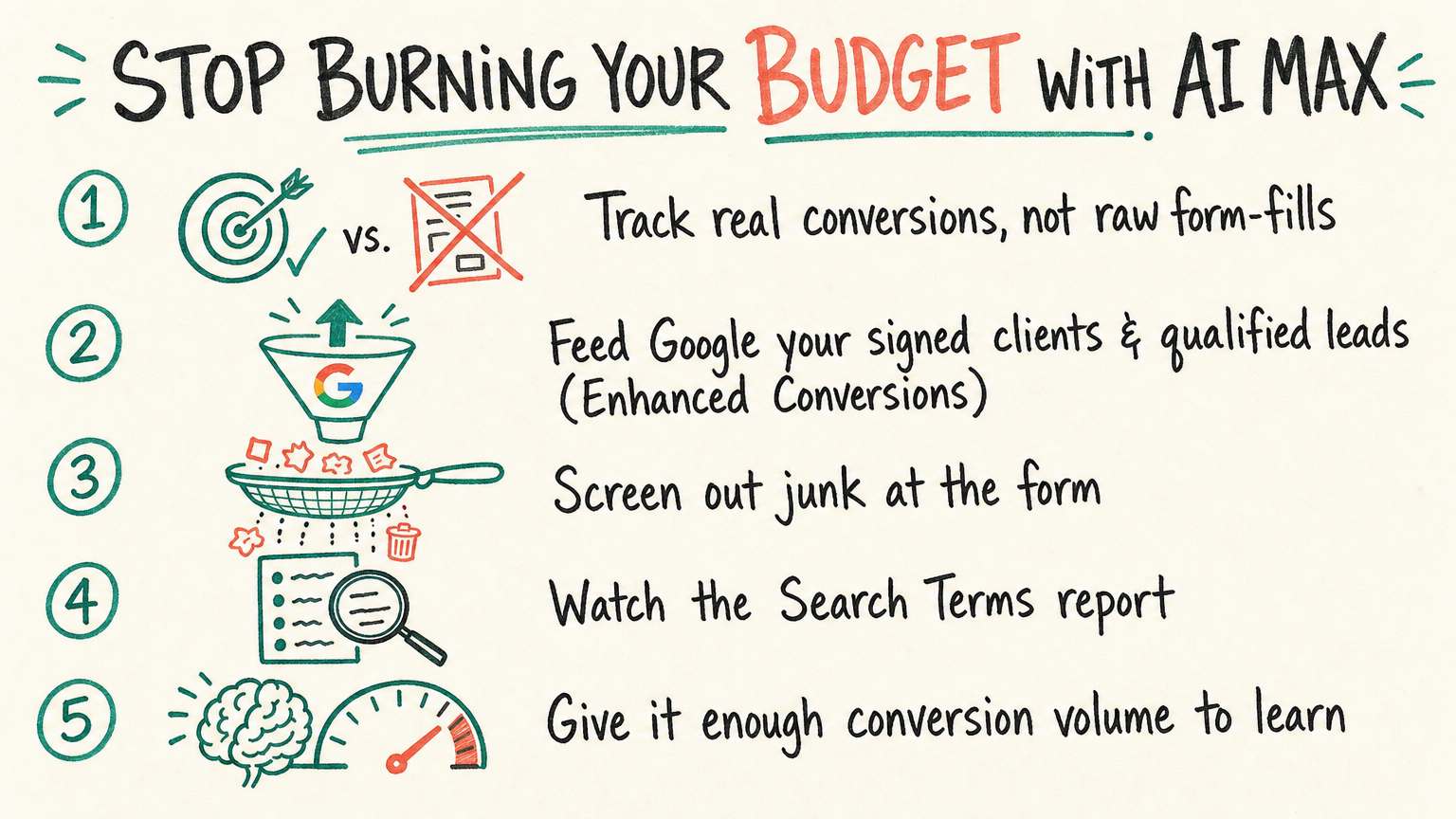
There's a quick win too. Add screening questions to your lead form and don't count a submission as a conversion unless it qualifies. Screen out the wrong-service and wrong-location enquiries before they ever hit your scoreboard, and the algorithm slowly learns to stop chasing them.
One caveat from experience is that the system needs a decent volume of conversions each month to learn properly. If you sign so few clients that "signed client" is too rare a signal, pick a meaningful earlier one, like "made full contact and confirmed they meet the key criteria." You want it aimed at the right kind of person, even if that person hasn't signed yet.
Also read: Google Ads for Law Firms: The 2026 Complete Guide
Your "before you switch AI Max on" checklist
Run through this before you or Google's September auto-upgrade hands over the keywords
- You can name your real conversion goal, and it isn't "form submitted"
- A CRM records what happens to every lead (signed, qualified, junk)
- Something flows from that CRM back into Google Ads (Enhanced Conversions for Leads)
- Your lead forms screen out obviously unqualified enquiries before they count
- You have enough monthly conversions for the algorithm to learn from
- Someone is actually reading the Search Terms report to see what it's drifting towards
If three or more of those are unticked, AI Max isn't your next move. You need to fix the tracking.
The Same Trap, Wearing a Reporting Hat
GML also announced a smarter way to measure, and it's genuinely useful: Campaign Type Attribution, which lets you toggle between your blended Google numbers and a Demand-Gen-only view. It's a fairer fight against social platforms that never split the credit, and Google rightly pointed out that only 40% of Demand Gen conversions land inside a 30-day window, so most people are undercounting it.
But a cleaner attribution view has the same dependency as everything else here. A perfectly de-duplicated report built on junk conversions is just junk, measured more precisely. Better attribution tells you which campaign earned the lead. It can't tell you the lead was worthless if you never taught it the difference. Get the conversion data right first, then the fancy reporting is worth having.
A Quick Word on the Creative Version of This
There's a creative twin to all this, called AI Brief. You describe your brand and your non-negotiables in plain language, and the AI writes the ad copy guidelines for you. It's the same trade as AI Max: hand over manual control, get speed in return.
I'm fine with using it. The catch is the same one we've seen every time these tools get loose without a hand on the wheel: the output drifts towards generic, and your points of difference get sanded off until you sound like every other firm. The AI can draft, but someone still has to keep the brand voice sharp and make sure it's saying something only you can say. That's the part you don't automate.
The Real Takeaway
AI Max is a genuinely strong product, and resistance is fairly pointless given the September auto-upgrade. The question was never whether to use it. It's whether you've earned the right to by setting up tracking that tells it what a good outcome actually looks like.
Do that, and AI Max finds you valuable searches you'd never have bid on. Skip it, and it finds you the cheapest possible way to look busy while your budget leaks. Same product, opposite result, and the only variable is your conversion data.
If you're not sure where your account sits, the tell is simple: ask whoever runs your Google Ads what the campaign is optimising for. If the answer is "conversions" and nobody can say what a conversion actually is, you've found the work.
That's the work we do for service businesses day in, day out, getting the tracking right so the AI chases clients instead of clicks. If your account is about to flip to AI Max and you'd rather not find out the hard way, let's go through it together before September does it for you.
Book a time here: https://calendly.com/leadtreemarketing/30min