Most agencies will happily show you a dashboard full of leads. Far fewer will ask what actually happened to them.
What we need to remember is that generating leads is the easy part, and that the money is made in what happens afterwards. This is the part that the industry quietly steps around.
But we’re going to step into it. Why? Because we’ve watched so many businesses pour money into extra traffic when their actual problem was sitting untouched in an inbox.
Why Agencies Stop at the Lead
The honest answer is incentive. An agency is judged on cost per lead and volume, so that is what it optimises. What happens to the lead afterwards is someone else's job.
In fact, falling for this trick is understandable. These days, it’s easy to live entirely inside Google Ads or Meta, optimising towards form fills and phone clicks, and never step back to ask the only question the business owners care about: ‘How much money did we actually see come in?’
Here is the gap, side by side:
| What the agency optimises for | What the business owner actually needs |
|---|---|
| Cost per lead | Cost per signed client |
| Volume of form fills | Volume of qualified enquiries |
| 'The campaign hit its target' | 'The phone got answered and the client signed' |
| Activity inside the ad platform | Revenue in the bank |
We have seen agencies present brilliant numbers while the owner says, flatly, ‘These leads aren't turning into clients.’ Both can be true at once. The platform hit its target. It just sent the wrong people. Minimal conversion.
And there is a practical reason agencies avoid this work: it’s genuinely hard and time-consuming. Some businesses are set up beautifully for it, with a dedicated intake team, a CRM like HubSpot, and staff trained to use it. Many are not. If there is no CRM and no appetite to give anyone visibility of what happens after the enquiry, the work gets harder for everyone.
Find out more on this topic in this article: Why 8 in 10 Australian Law Firms Question Their Paid Marketing ROI (And How to Fix It)
The Leak That Costs the Most
When we look inside a client's intake process, the biggest leak is almost always speed, or the absence of a system that allows for a speedy process.
The evidence is hard to argue with:
- Firms that contact an online lead within an hour are nearly seven times more likely to qualify that lead than those who wait an hour longer, and sixty times more likely than those who wait a day (Harvard Business Review).
- Call within five minutes instead of thirty and you are twenty-one times more likely to qualify the lead (MIT/InsideSales).
Often, the enquiry just sits there because nobody takes ownership. The responsibility is shared, which in practice means it belongs to no one.
In law firms, we see a specific version of this. New enquiries get shared among paralegals who are measured on billable hours. Taking time to handle a new client works against the very KPI they are judged on, so the incentive disappears.
That is not a paralegal problem. It is a leadership one. Owners have to make it explicit that nobody has a job without new clients, that talking to these people quickly is critical, and that it sits at the top of the priority list.
Learn more in our article on the cost of not responding to online leads quickly.
The Documentation Trap
Here is how invisible these leaks can be.
We started listening to a law firm's intake calls and noticed a pattern. On the very first call, prospects were being asked for specific information and documentation that almost nobody had to hand. The caller would say they would ring back once they had gathered it.
Most never did. A very large number of genuinely interested leads were being politely sent away before anyone had a chance to help them.
We changed one thing: the first call now captures the person and books the next step first, with the paperwork handled later. The result:
Same ads. Same budget. Same number of leads. Appointments and new clients rose nearly threefold. The only thing that changed was what happened after the phone rang.
Check out our article on this question: Is Your Law Firm's Intake Process Costing You Cases? A 7-Point Diagnostic
What a Real Handling System Looks Like
A handling system is not complicated, but it has to exist with a clear purpose. We’ve identified four parts that do most of the heavy lifting:
1. Near-Instant Acknowledgement
The moment an enquiry lands, fire off an automated email straight away. Instant is fine here; it provides them with the key information, sets out what happens next and when, and gives them something useful to look at while they wait.
The SMS is where a small tweak matters. Put it on a short delay, around two to three minutes, and write it so it reads as if it came from a person: ‘Hey, thanks for your enquiry. Someone from the team will reach out to you shortly.’ Why the delay? If it’s instant, it usually gives the game away. A near-instant one feels human, which is the whole point.
Either way, this buys you time, sets expectations, and stops the most common cause of a cold lead: silence.
2. A Persistent, Not Spammy, Cadence
Most leads need far more follow-up than they get. RAIN Group's research found it takes an average of around eight touchpoints just to land a first meeting with a new prospect. It’s also widely cited that roughly 80% of sales need five or more follow-ups, while nearly half of businesses give up after one.
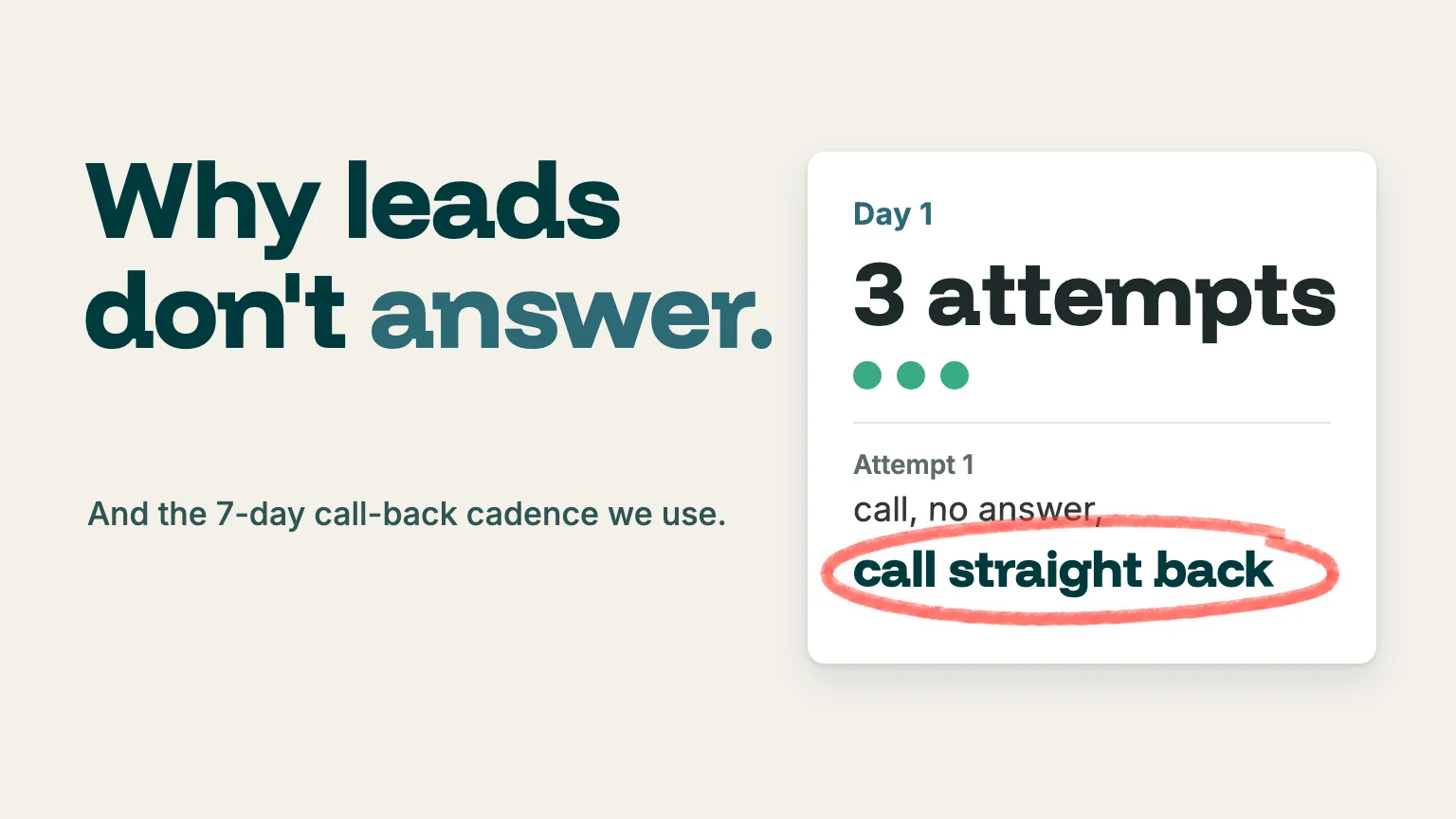
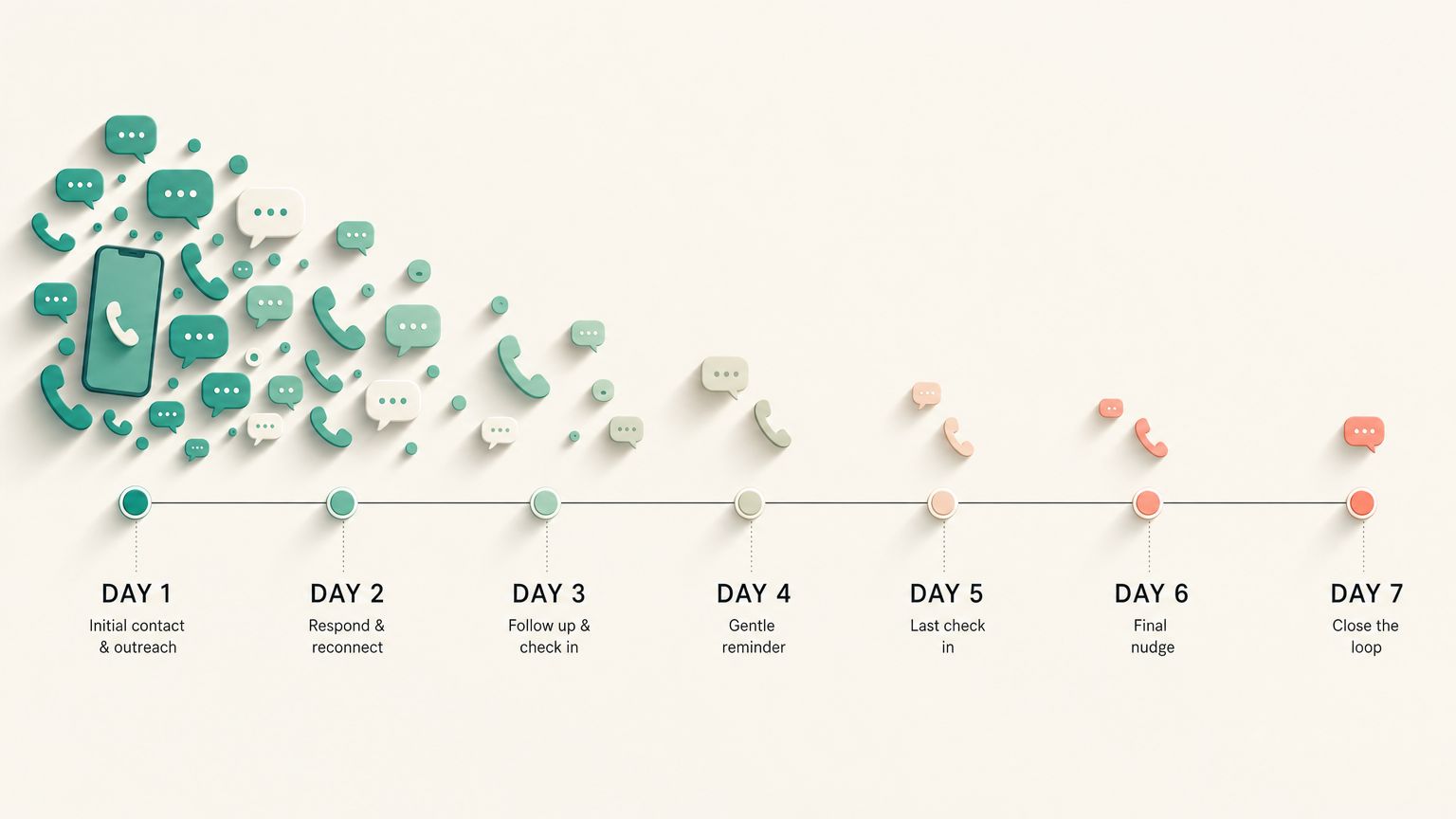
Here is the cadence we typically recommend. You can see that the bulk of the work is done on the first day:
| When | Phone | SMS / Email |
|---|---|---|
| Instantly | — | Auto-email with the key info |
| ~2–3 min | — | Auto-SMS, slightly delayed and staged to feel human |
| Day 1 | 2–3 call attempts | SMS after a missed call, not after every one |
| Days 2–3 | 1–2 call attempts/day | Light touch only |
| Days 4–7 | ~1 call/day, easing off | Final value-led message |
| After ~7 days | A silent lead is usually dead | Move to long-term nurture |
There is a balance to strike. We’ve had the occasional complaint from people who felt chased, so the trick is persistence without spam: call attempts can be frequent early, but you would not fire off an SMS after every single call. This is where it would start to feel relentless.
3. A CRM So Nothing Leaks
You cannot run that cadence reliably out of an inbox. You need a CRM that records every enquiry, prompts the next action, and makes it obvious when something slips through the cracks.
HubSpot is what we usually recommend. For smaller businesses without the budget for it, GoHighLevel is a strong, cost-effective second choice, and we provide access to it inside our retainer, so any client can set up nurturing campaigns without having to invest in their own platform.
4. Feed Real Outcomes Back
Once the CRM is in place, close the loop. Push real outcomes, like a booked appointment or a signed client, back into the ad platforms using Google Enhanced Conversions or Meta's Conversions API. Now the campaigns optimise towards clients, not form fills.
That is where lead handling and lead generation stop being separate jobs. The handling of data makes the generation smarter.
What Good Looks Like
Good lead handling is systematic:
- Every enquiry is acknowledged within seconds.
- Someone clearly owns the follow-up.
- The cadence is written down and actually followed.
- The CRM means nothing falls through the cracks.
If that sounds obvious, it is. It’s also the single most common thing we find missing when a business is convinced it has a lead problem. More often than not, it’s a handling problem dressed up as a lead problem.
The good news: this is fixable faster and far more cheaply than buying your way to more traffic. Often, the leads you need are already arriving. They are just not being caught.
If you suspect that this is happening in your business, we’ll be more than happy to look at what happens between the enquiry and the booked client, and help you to fix the gap.
Book a time here to see how we can help your business: https://www.leadtree.agency/product/book-call.