In 2018, a survey asked 1,500 drivers across New South Wales, Victoria and Queensland what their compulsory third party (CTP) car insurance actually covered. The results showed that two in three answered incorrectly. These findings became a news.com.au headline. According to Leadtree founder Richard Greenwood, the survey cost only around 15 cents per response.
Before working in marketing and communications, I was a journalist receiving media releases from businesses hoping to secure coverage. Having worked on both sides, I wish more businesses understood the active role they can take in creating a story worth covering. A well-designed survey that uncovers a surprising finding can be an affordable way to offer journalists something relevant to their readers.
Written with Leadtree founder Richard Greenwood.
Click here to see where we talk it through.
Why make your own news?
Short answer: Journalists need stories, and original data is a story nobody else has.
Many businesses wait for a reporter to contact them or for a relevant topic to enter the news cycle. The opportunity, however, may take time to arrive.
During our chat, I spoke about how businesses can take a more active approach to earning coverage. Journalists are always looking for interesting stories, and businesses can attract their attention by developing a story that offers something useful, timely or unexpected.
Media coverage can also build credibility. When a news outlet draws on your business’s knowledge or expertise, it gives audiences an independent reason to trust what you have to say.
Our view: This carries even greater value today than it did in 2018. The trust signals that influence recommendations in AI search include what others say about your business, making credible external coverage a valuable part of building your reputation.
It all started with a phone enquiry
When Richard was head of marketing at Smith’s Lawyers, before the firm became a Leadtree client, his team regularly received calls from drivers facing a similar problem. Another driver had hit their car and, although nobody was injured, they were left dealing with damage costing around $15,000.
Many of these callers had no insurance beyond the compulsory third party (CTP) cover included with their registration. They had assumed it would cover damage to their car caused by another driver, provided they were not at fault.
However, CTP covers personal injuries arising from motor vehicle accidents, rather than damage to vehicles or property. In Queensland, the Motor Accident Insurance Commission explicitly lists vehicle and property damage among its exclusions.
The same distinction applies to NSW’s Green Slip insurance and Victoria’s TAC cover. Third-party property insurance is a separate product that covers damage you cause to someone else’s vehicle or property.
These recurring conversations raised a question worth investigating: How many drivers believed CTP covered damage to their own car?
Richard estimated the proportion would be around 15 to 20 per cent.
As he recalled: “I actually thought it might be a fairly small amount of people, but still potentially newsworthy.”
What came back
The firm ran the question through Google Surveys.
Here's what insuranceNEWS.com.au reported from the results:
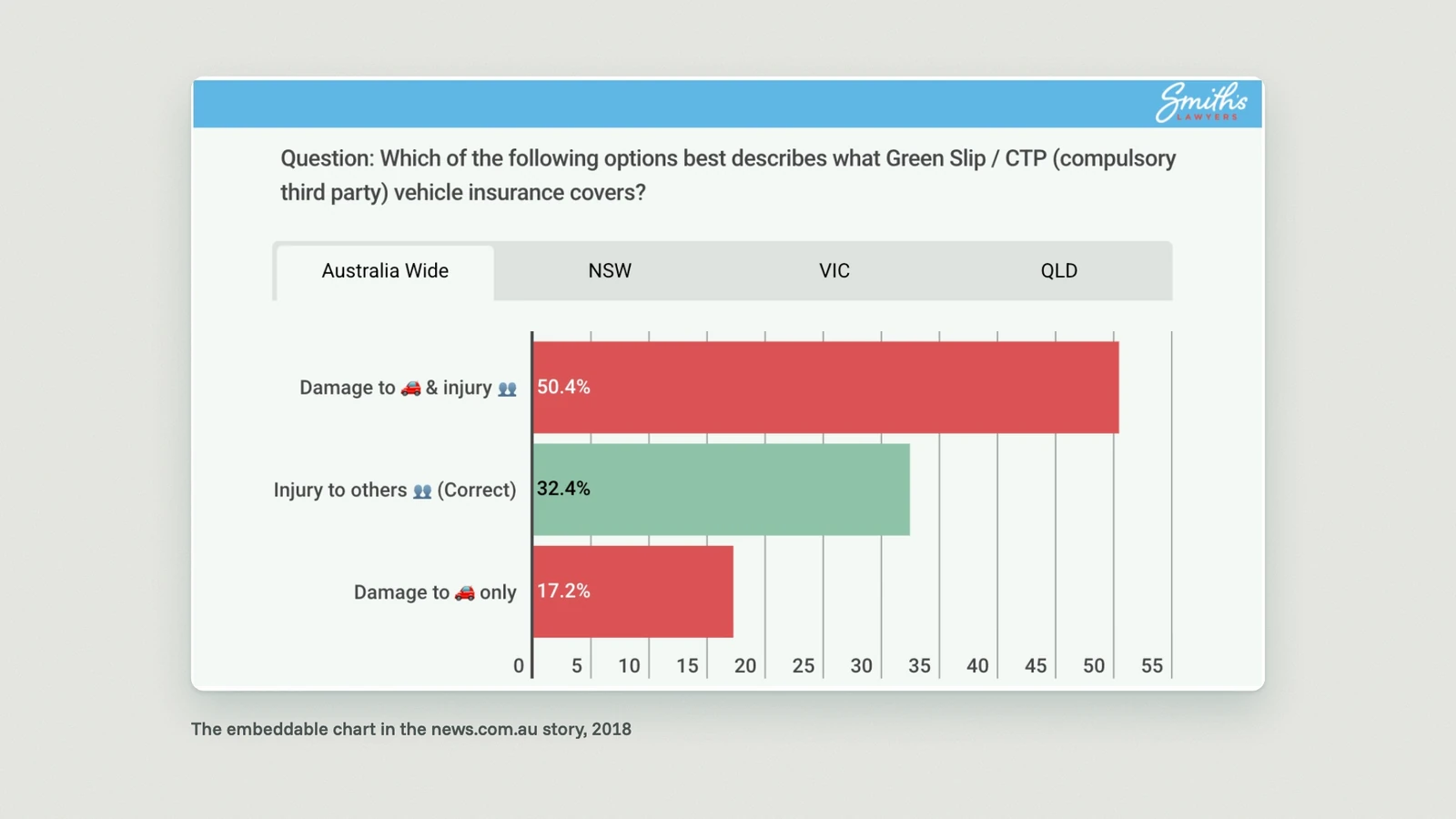
The survey found that roughly two in three drivers believed CTP would cover vehicle damage, well above Richard’s estimate of 15 to 20 per cent. Drivers aged 18 to 24 showed the lowest level of understanding, with Insurance Business reporting that just 19.4 per cent answered correctly—fewer than one in five.
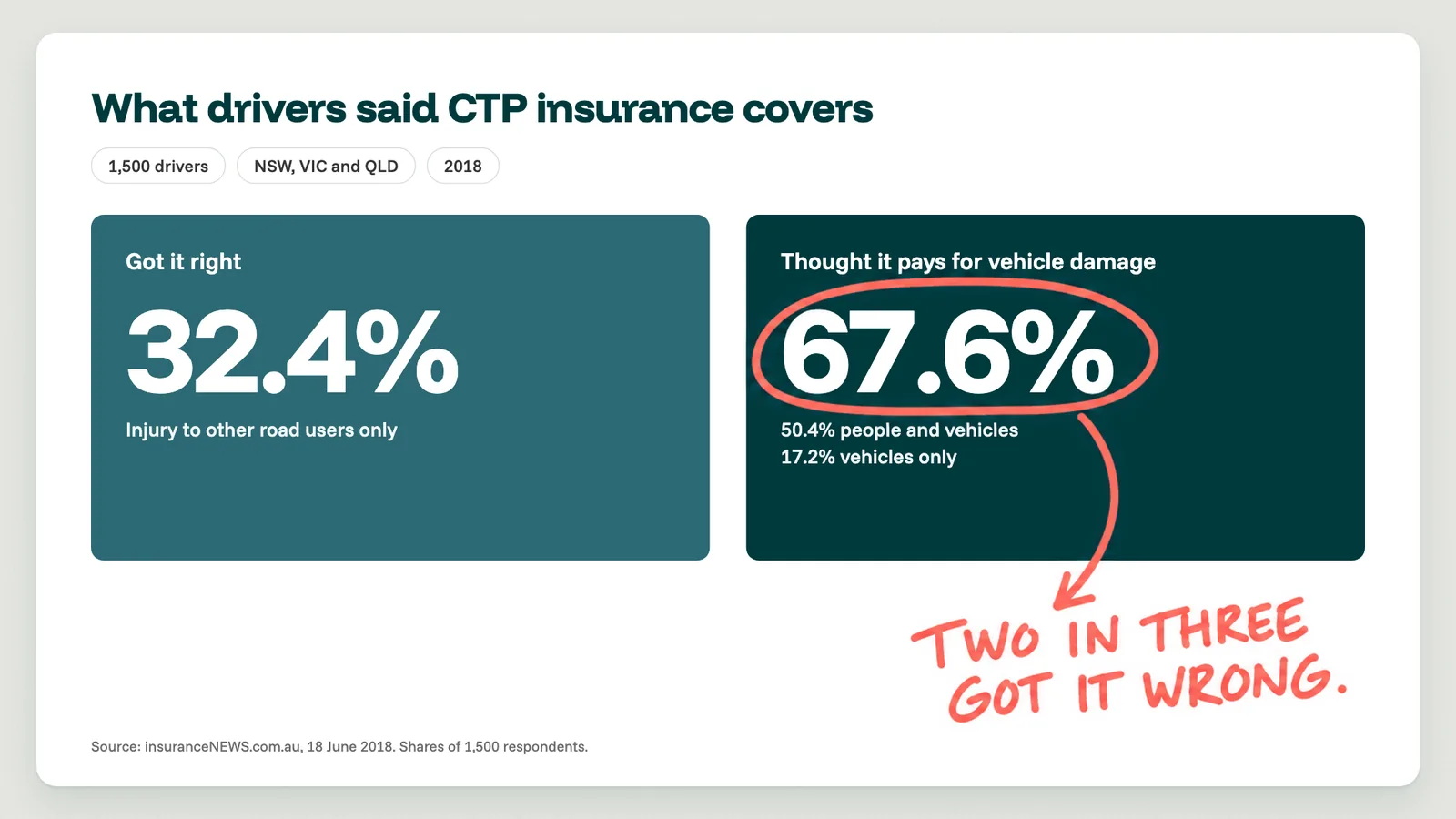
As Richard explained: “It was actually more dramatic than expected, which did make for a stronger headline in that particular case.”
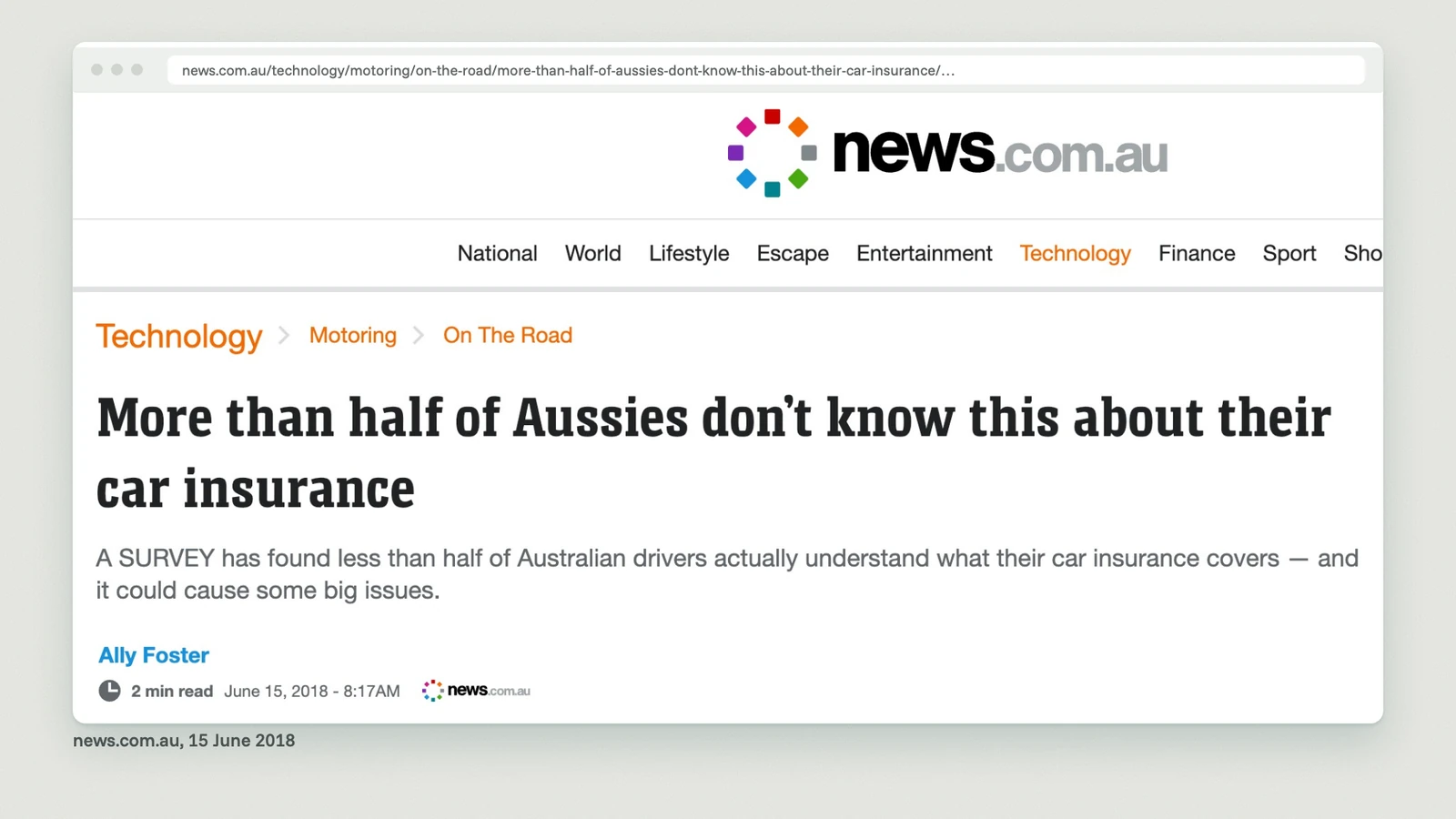
On 15 June 2018, news.com.au published the story under the headline “More than half of Aussies don’t know this about their car insurance”. Coverage also appeared in Insurance Business and insuranceNEWS.
Our view: The strongest starting point was the pattern Richard’s team had noticed in everyday client enquiries. Paying attention to those conversations helped identify a wider misunderstanding worth investigating.
How do you know if a survey idea is newsworthy?
Short answer: Think of the headline before you write the questions.
If you can't imagine a journalist running it, or people wanting to read it, don't run the survey.
When Richard asked me where a business should start, my advice was to “start with your main point, your headline.” Consider the story you want to tell and the expertise you want your business to be recognised for, then use those priorities to guide your survey questions.
Our view: Before investing in a survey, ask whether the idea could produce a finding that interests readers and supports what you want your business to be known for.
The example I shared on the podcast clip illustrates why a statistic alone is not enough to make a story. A survey showing an equal split of male and female staff offers little reason for a journalist to cover it without a broader finding or relevant context. The value lies in uncovering trends, comparisons or unexpected insights that give readers something new.
Richard made a similar point: Survey findings need to offer something beyond promotion for your business.
As he explained: “If it’s just going to come up with stuff that’s really boring or really niche or only serves to, say, promote your own company, that has no broader interest and it’s going to end up something sounding like an ad, then the odds of it being newsworthy are pretty low.”
Our view: Everyday experiences can provide a useful starting point. Richard suggested surveying drivers about the behaviours that frustrate them most, from tailgating to speeding, and ranking the results. Surveys that have attracted media coverage overseas can also offer inspiration, provided the topic has a clear connection to Australian audiences.
What does it cost to run your own survey?
Short answer: Costs can range from around a dollar per response to approximately $1,000 per question, depending on the research method and level of rigour required.
For the CTP study, Richard used Google Surveys, which he recalls costing roughly 15 cents per response, including demographic data. The platform is no longer available, following the closure of Google Surveys and Surveys 360 on 1 November 2022.
Our view: The right option depends on who you need to reach, the questions you want to ask and how the findings will be used. Here are the options we would consider today.
What is an omnibus survey?
An omnibus survey allows businesses to add a small number of questions to a broader survey run regularly by a research company, often weekly or monthly. Participating businesses share the cost of conducting the research, with demographic data included to help interpret the results.
As Richard explained: “It is a relatively cost-effective way rather than setting up your own full-blown market research survey if you only need to ask one or a handful of questions.”
Richard also favours an omnibus over a self-service platform such as Pollfish when credibility is a priority, pointing to the involvement of an established research company and its research panel.
Our view: A self-service platform can be useful for exploring whether an idea warrants further investigation. For findings you intend to release to the media under your business’s name, an omnibus is worth considering for its research support and methodology. In either case, assess how respondents are selected, whether the sample reflects your intended audience and how the questions are worded.
Step by step: From enquiry to headline
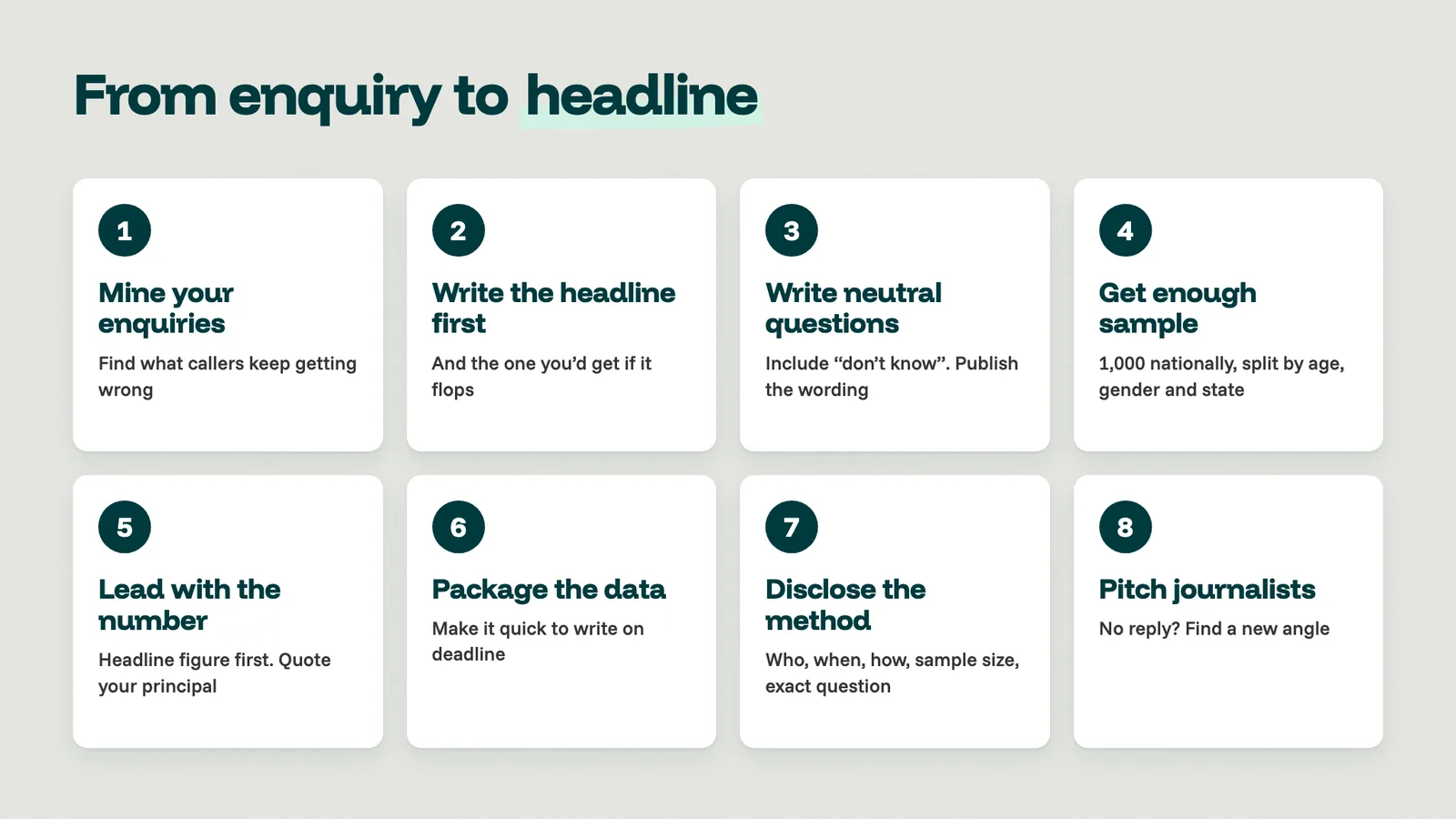
- Look for recurring misconceptions in customer enquiries.
Review call notes, enquiry forms and search terms to identify questions or misunderstandings that come up regularly. The CTP survey began with a pattern Richard’s team noticed in conversations with callers.
- Consider both surprising and predictable results.
Draft a potential headline, then consider how the story would read if the findings were less striking than expected. A worthwhile survey should provide useful insight across a range of possible outcomes.
- Keep questions neutral.
Avoid wording that steers respondents towards a particular answer. Provide balanced response options, including “don’t know” where appropriate, and retain the exact wording for publication alongside the results.
- Plan for the breakdowns you need.
A national omnibus survey commonly includes around 1,000 respondents, but individual demographic groups will be smaller. Request relevant age, gender and state breakdowns, and check whether those groups are large enough to support meaningful comparisons or local angles.
- Lead the media release with the key finding.
Put the strongest relevant statistic in the opening sentence and include commentary from your principal or an appropriate subject expert. The CTP coverage, for example, quoted the firm’s principal, Greg Smith.
- Make the data easy to use.
Supply clear tables, supporting figures and relevant visuals. Richard’s team created interactive tables that publications could embed, featuring the firm’s logo. He recalled that they were “still there years later”.
- Explain how the research was conducted.
Include who commissioned and conducted the survey, when and how it was run, the sample size and the exact question wording. The Australian Polling Council’s code of conduct provides a useful reference for transparent reporting. - Tailor your pitch to individual journalists.
Explain why the findings are relevant to their audience, then apply the approach outlined in the next section.
Presenting the findings clearly can make a considerable difference. As Richard explained, newsroom pressures leave journalists with limited time to develop stories. His team’s approach was to make the research easy to understand, assess and use within a tight deadline.
Our take
Our approach: Start with recurring questions or misunderstandings in customer enquiries. These conversations can reveal gaps in public understanding that are worth investigating and may lead to a compelling story. Consider the potential headline before developing the survey, invest in an omnibus when publishing findings under your business’s name, and clearly disclose the methodology. When pitching the results, respect a journalist’s decision not to respond and avoid repeated follow-ups.
What if a journalist doesn't reply?
Short answer: They've probably read it. Move on.
On the podcast clip, Richard asked whether businesses should use a newswire service or approach journalists individually. My advice was to start with any existing media relationships. For businesses without those connections, journalists’ professional contact details are generally accessible, making a direct, relevant pitch a practical option.
I also spoke about knowing when to move on. A lack of response does not necessarily mean your pitch went unread, and repeated follow-ups are unlikely to make the story more compelling.
Richard summarised the approach: “Assume they’ve seen it and not interested. Try again.”
Our view: Trying again should involve reconsidering the angle. A state breakdown, an age comparison or a finding relevant to another publication’s audience may offer a stronger story. Journalists may also identify an angle in the data that differs from your original pitch. Be prepared for coverage to reflect their editorial judgement.
A note for law firms and other regulated businesses
Our view: A media release published under your firm’s name should meet the same standards of accuracy as your other business communications. The ACCC’s guidance on false or misleading claims emphasises that business claims must be accurate and supported by reasonable grounds. Apply that standard to both your survey findings and how you present them.
- Represent the results accurately.
If 32.4 per cent of respondents answered correctly, report that figure. Describing it as “almost nobody” would misrepresent the finding.
- Include the methodology in the release.
Explain the sample size, survey dates, research provider, states covered and exact question wording.
- Keep the finding at the centre of the story.
Focus on what the research reveals and why it matters to readers. The CTP coverage centred on drivers’ understanding of insurance.
- Plan for unexpected or unfavourable findings.
Decide before conducting the survey how you will handle results that challenge your assumptions. Publication is a choice, but journalists may draw on any part of the findings you make available.
Our recommendation: Have media releases issued under a law firm’s name undergo the same internal compliance review as advertising. Review the claims, wording and presentation before publication.
Recurring misconceptions in customer enquiries can reveal where clearer information is needed. We help service businesses use those insights, together with their team’s expertise, to develop a content and marketing strategy and create content that earns links and trust.
Not sure what your enquiries are telling you? We'll go through your call and form data with you and show you the questions and misconceptions worth building content around.
Book a time here: https://www.leadtree.agency/product/book-call