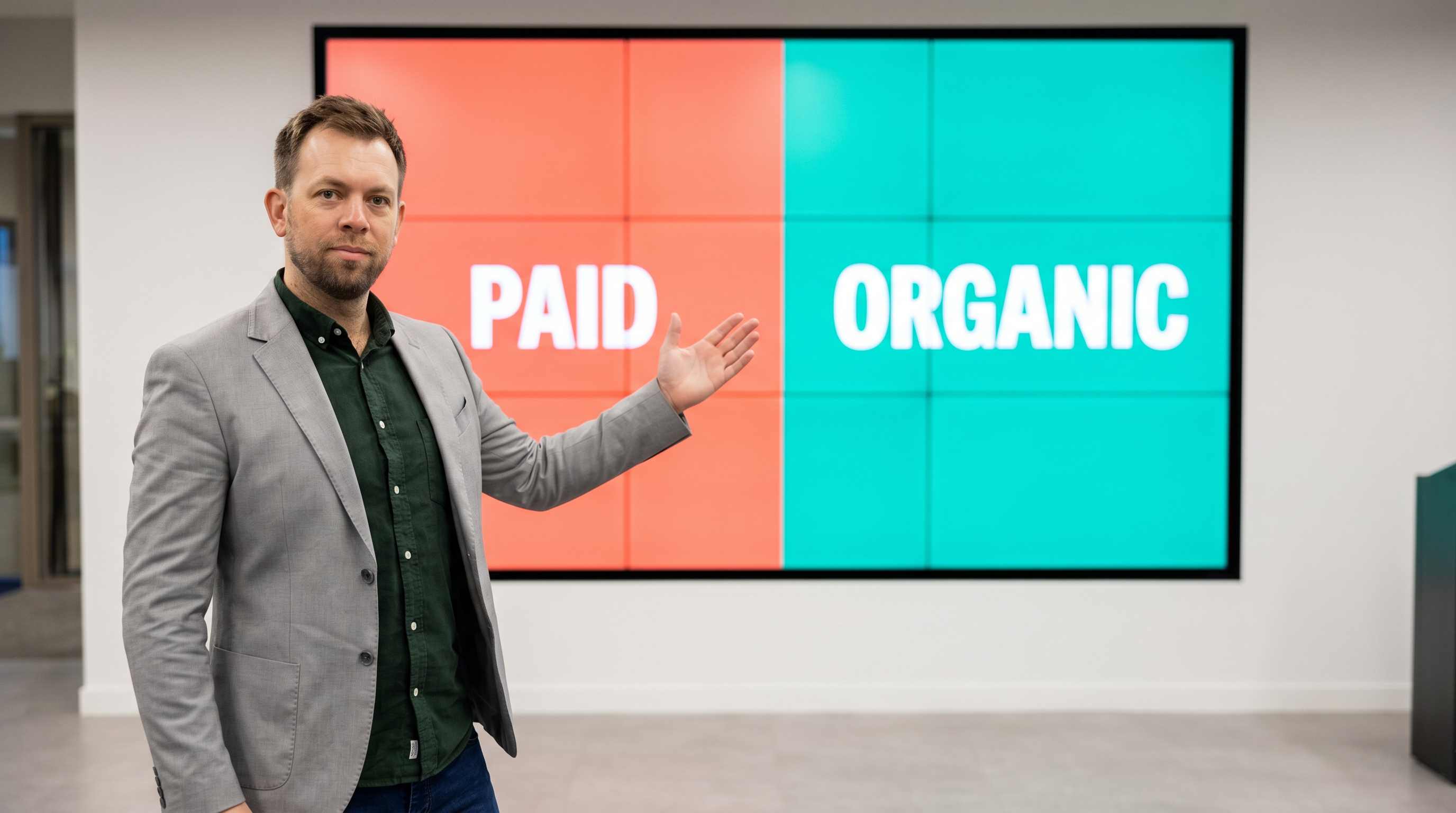
If you’re asking yourself what the better option is between paid and organic marketing, you’re actually looking in the wrong place. It is like asking whether a business should keep its existing customers or find new ones.
The honest answer is both are important, and the interesting question is how they feed into each other.
It’s still worth taking a closer look at the specifics of both because the two channels genuinely behave differently. Understanding those differences is what will help you decide where to start and how best to combine them.
The Honest Comparison
Here is how paid and organic marketing actually compare on the things that matter most to a service business.
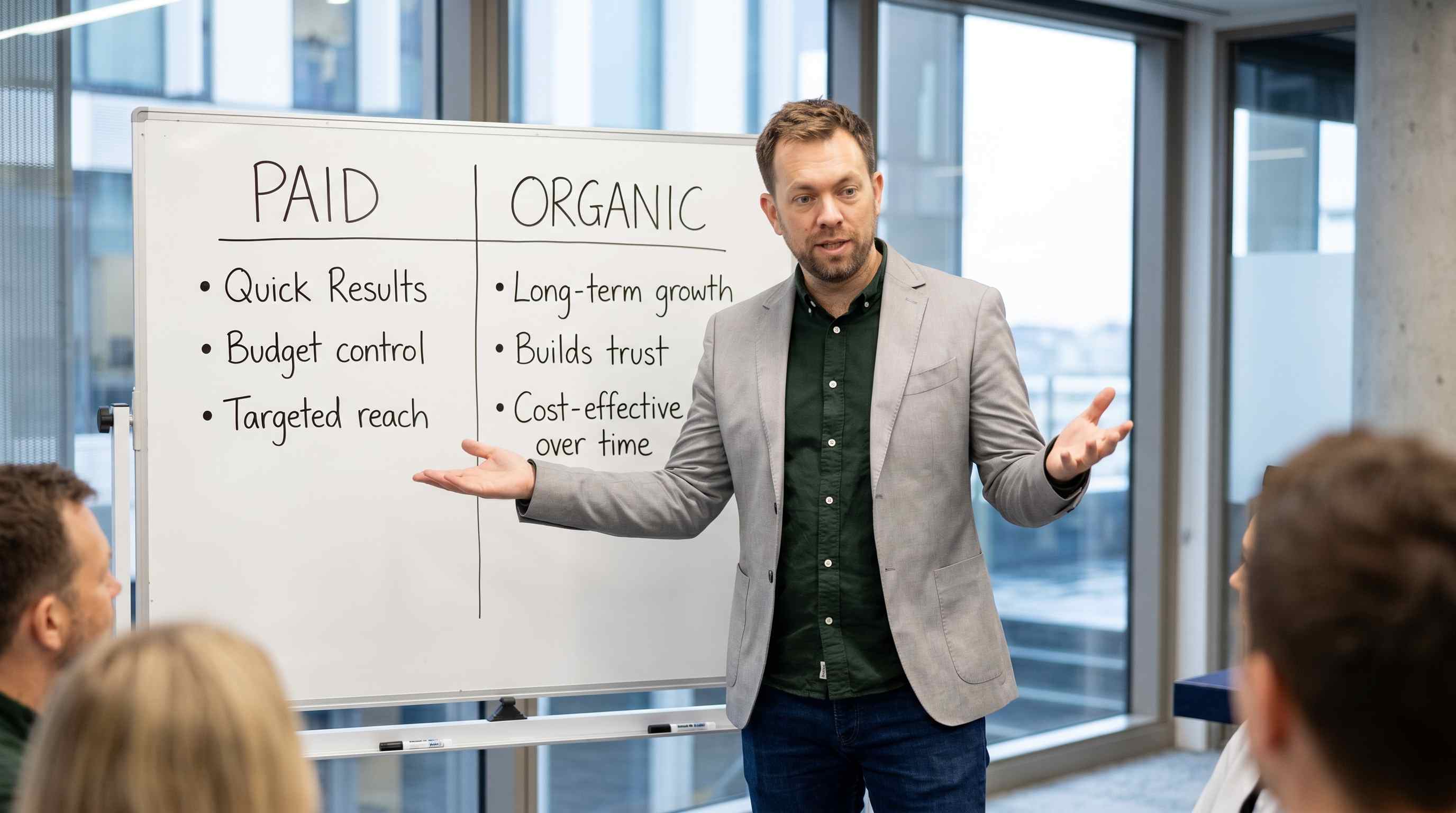
| Paid (Google / Meta Ads) | Organic (SEO + content) | |
|---|---|---|
| Speed | Wins. Qualified enquiries within days | Months to build traction |
| Cost | Ongoing ad spend + management | Lower media cost, but you pay in time |
| Trust | Gets you in front of people | Wins long-term, makes them believe you |
| Scalability/control | A dial you can turn up or down | A compounding asset you can't summon on demand |
| ROI timeline | Returns show quickly | A longer play; biggest gains go to those who commit |
The short version is that paid buys you speed and control, while organic compounds trust and visibility. One can’t replace the other.
Also read: Google Ads vs Facebook Ads for Australian Service Firms: Where to Put Your Next $10k
If You Can Only Start With One, Which is the Better Option?
When a business with a limited budget asks us which they should implement first, the honest answer is that it depends on their individual objectives and timescale.
- If they need results quickly, paid is usually the best way to begin, whether that’s Google, Meta or another platform. It requires investment in both the media and the management, but it works fast.
- If they have a long term outlook, organic can be done on a leaner budget and built up into something that compounds.
We always ask the same simple question to our clients: do you have the time to wait for organic to gain traction, and are you prepared to commit to it?
If the answer is yes, organic marketing is one of the best long-term investments a service business can make.
Why They Are Stronger Together
The real question isn’t about paid versus organic, it’s about what happens when you run them together, and the clearest lesson we’ve learnt on this actually came from getting it wrong.
We once worked with a law firm where we used paid social media advertising, mainly for brand awareness. For about five months, budget pressure meant we switched the paid media off entirely while continuing to invest in organic content.
The organic traffic climbed month after month, and for the first couple of weeks conversions held firm. Then something strange happened: even as organic traffic continued to rise, leads started to fall from about the one-month mark, and kept falling every month after that.
People were still clicking through to the site, but they weren’t taking action like they had done before. The missing ingredient here was brand awareness; without it, the same traffic wasn’t converting as well, and the decline compounded the longer the brand activity remained off.
That was a formative lesson. Brand-building is the first thing cut and the last thing credited; it’s hard to track and rarely shows its return clearly. However, it makes everything else convert at a higher rate.
With a law firm client we worked with recently, running paid, organic and branded campaigns alongside each other raised conversion rates across the board for exactly this reason.
Where AI Changes the Organic Side
There has been a real shift on the organic side, and it is worth discussing briefly.
For informational queries, Google's AI Overviews increasingly answer the question on the results page, so people find out what they need to know without clicking through.
Pew Research Center found that users click a traditional result on about 8% of visits where an AI summary appears, compared with 15% where it doesn’t.
This makes it that much harder for organic to earn direct revenue, which is part of why having a paid component is now close to being essential. It does not completely kill organic, however.
Those who are investing in a strong volume of content on the specific topics their customers ask about are counteracting the decline, and new-client teams are reporting that people hear about their firm through ChatGPT or another AI tool more and more.
The content is what makes them the answer people are looking for.
One important nuance to keep in mind is that plenty of people have not changed how they search at all, and that varies by audience. A retirement-living client's customers, for example, are likely to still be using Google exactly as they always have done.
But even they cannot escape the effect of AI on Search and marketing because the AI Overview now sits on top of the results they were always going to see.
(We dig into this properly in our pieces on trust and on whether content marketing still works, so we will leave it there.)
The System That Catches Both
Whichever mix of paid and organic you choose to run, the leads from both channels need somewhere to land and something to nurture them. That means you need a good CRM.
HubSpot is our preferred option. For smaller businesses without the budget for it, GoHighLevel is a cost-effective alternative, and we provide access inside our retainer so the lead nurturing gets built either way.
The channel brings the lead in; the system makes sure it isn’t wasted.
Read our article on HubSpot vs GoHighLevel vs Clio Grow vs Monday for more info.
What Good Looks Like
The most successful service businesses we work with do not choose between paid and organic marketing. They use paid for speed and control, organic for compounding trust and visibility and brand to make both convert better.
If your budget only has room for one at the moment, start with the option that matches your timeline: paid for speed, organic for the long game. You should always have a plan to add the other, however. Each one makes the other work better, and the businesses that understand that are the ones quietly pulling ahead.
If you want help working out the right mix, explore our paid search services for demand capture and our content marketing services for building useful resources over time. We are happy to map out what fits your business now.
Book a meeting with us here: https://www.leadtree.agency/product/book-call