Within the next 12 to 18 months, the way people reach your business is going to change in a way that most service firms are yet to fully get to grips with. Right now, a prospect finds you, reads your site, and fills in your form for themselves. Soon, an increasing share of them will hand that job over to an AI agent and never have direct contact with your form at all.
I sat through Google Marketing Live in Brisbane in June, and most of the noise was about ad products. The thing that made me sit up and take notice, though, was something altogether quieter: the agent era. Okay, we all use AI for advice or to help us piece things together, but now, assistants like Gemini are actually capable of doing things for people, kind of like a secretary (getting quotes, sending messages, etc.). That shift will reshape how enquiries actually arrive and so have a big impact on your business.
Here are a couple of things that are on their way and what you can do now so you are ready instead of being caught out.
What ‘the agent era’ actually means
An AI agent is software that doesn't just answer your question; it takes action on your behalf. You tell it the outcome you want, and it goes off and completes the steps.
Currently, most of these asks fall under the banner of research. You ask Gemini or ChatGPT for ‘a good employment lawyer in Brisbane’, for example, and it hands you a shortlist. The difference is this: now, AI agents will be able to compare several firms, working out which one best fits your situation, and filling in the enquiry form for you. Maybe even booking the first consultation.
Agentic systems might seem pretty far-fetched, but they’re actually closer than you think. Google's AI Mode already has more than a billion monthly users, and AI Overviews more than 2.5 billion. The same companies are building the agentic layer that sits on top of search results and acts on what it finds, a shift the industry has started calling the agentic web.
So, how does this affect me? Basically, more of your future enquiries will be filled in by a machine, not a human. That has two consequences worth planning for.
Consequence one: your website has to be readable by agents, not just people
Here is the part we are already working on for clients, because it is the bit we can all control today.
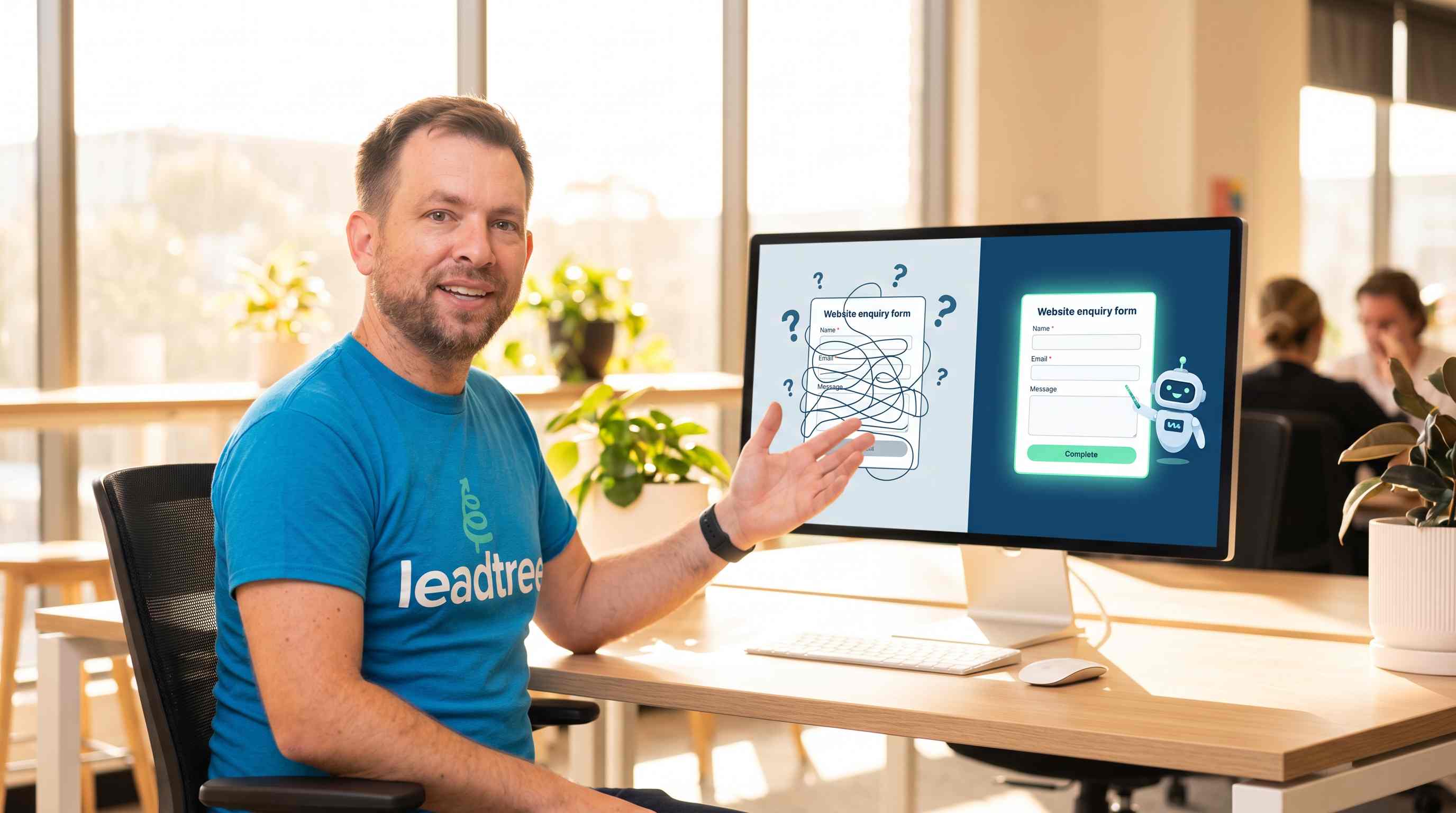
When an AI agent fills in a form right now, it’s doing it the hard way. It drives a browser like a person would, takes a screenshot, and tries to guess what each field wants. That works up to a point until it misses hidden fields, or it trips over conditional logic, the questions that only appear once you’ve picked out an option. Alongside this is a potentially incomplete form, and so missing must-have criteria for you to be able to judge the type of lead they are.
Luckily, there’s a better way, and it is the direction the web is moving. Instead of forcing the agent to squint at a screenshot, you can give it clean, machine-readable instructions about what your site offers and what a form needs. Two technologies do most of the heavy lifting here.
The first is structured data with schema.org, written in a format called JSON-LD. Think of it as a label layer behind your page that spells out what your business does, what services you offer, and what a given page is for. As Search Engine Land put it, ‘for AI agents, understanding content isn't enough. They also need to interpret and act on it.’ Schema is how they interpret. Parsing a messy screenshot is slow and error-prone; reading clean structured data is fast and reliable. The sites that are offering it are already one step ahead.
The second is the Model Context Protocol (MCP), an open standard introduced by Anthropic and now adopted across the major AI providers, including Google. In plain terms, MCP lets a site expose actions an agent can take cleanly, instead of forcing the agent to mime clicks through a browser like a human clicking a mouse. By March 2026, Anthropic reported over 10,000 public MCP active servers. Think of it as the plumbing layer that allows AI agents to securely connect with websites, apps, and services, giving them the ability to perform tasks instead of just retrieving and summarising information.
You don’t need to understand the code to be able to use it. You just need to understand the principle behind it: the more clearly your site tells agents what it offers and what it needs, the more reliably an agent can complete an enquiry on a prospect's behalf. Leave it to guesswork and you will lose the enquiries to firms whose sites are easier to act on.
That is the work we are planning and rolling out now: getting client sites agent-ready before the agents arrive in force.
Consequence two: Google is building the agent into the ad
The second thing that caught my attention was that a new Google ad format was announced at the event: Business Agent for Leads, one of a wave of conversational ad formats Google is testing for the AI era of search.
Here, instead of a static lead form sitting inside a Search ad, you get a Gemini-powered chat agent, grounded in your own website, where a prospect can ask it real questions. It answers using your site's content, so the answers stay on-brand rather than going off-script. The form only gets sent to the user, already populated, once the conversation has established that the person is a suitable prospect. Google describes it as a ‘conversational lead qualification experience on Search’ that delivers ‘high-intent prospects... to your sales teams.’
So instead of a one-way form, the prospect gets a conversation, and you get a screened lead. Here is how that compares to the form you are running today.
| Static lead form | Business Agent for Leads | |
|---|---|---|
| Prospect experience | Fill in fields, hope someone replies | Ask questions, get answers from your site content |
| When it works | Business hours, once a human follows up | 24/7, answers complex questions in real time |
| Qualification | None at the form, or a couple of tick-boxes | Conversation qualifies before the form fires |
| Answer quality | N/A | Grounded in your site, reducing off-script answers |
| What you receive | Every submission, good or bad | Fine-print, off-script answers |
That is a genuinely useful idea for service businesses, where the problem is rarely too few leads and almost always too many unqualified ones.
The honest caveats: what is confirmed, and what is not
This is where I have to be straight with you, because some of the early write-ups are getting ahead of themselves and going beyond what Google has actually committed to.
It is not available in Australia yet. Business Agent for Leads is in open beta in the US only, and the first verticals are automotive, education and real estate. At the event, the AU rollout was framed as ‘not too far away,’ but there is no confirmed date as yet. Treat it as a thing to prepare for, not a thing to switch on this month.
It reportedly needs AI Max for Search or Performance Max. Multiple PPC trade sources report that standard Search campaigns do not qualify. That detail is not spelled out in Google's own announcements, so confirm it with your Google rep before you build a plan around it.
Native appointment booking and CRM integration are not confirmed. This is the big one, and I have seen many people jump to conclusions here. Google's own materials describe the agent as qualifying and delivering leads to your sales team, not booking appointments inside the chat. No specific calendar or CRM integrations have been confirmed. My informed expectation is that common CRMs and calendar tools are the ones most likely to integrate cleanly once this matures, but that is my understanding, not a confirmed feature. Do not assume the agent will book a consult into your diary until Google says so.
So the headline stays accurate: the conversation qualifies, then hands a screened lead to your team. Moving from this point to actually booking the appointment is where things are heading, but it is not quite a reality just yet.
Is your site agent-ready? A quick checklist
You cannot control Google's beta timeline, but you can control how ready you are.
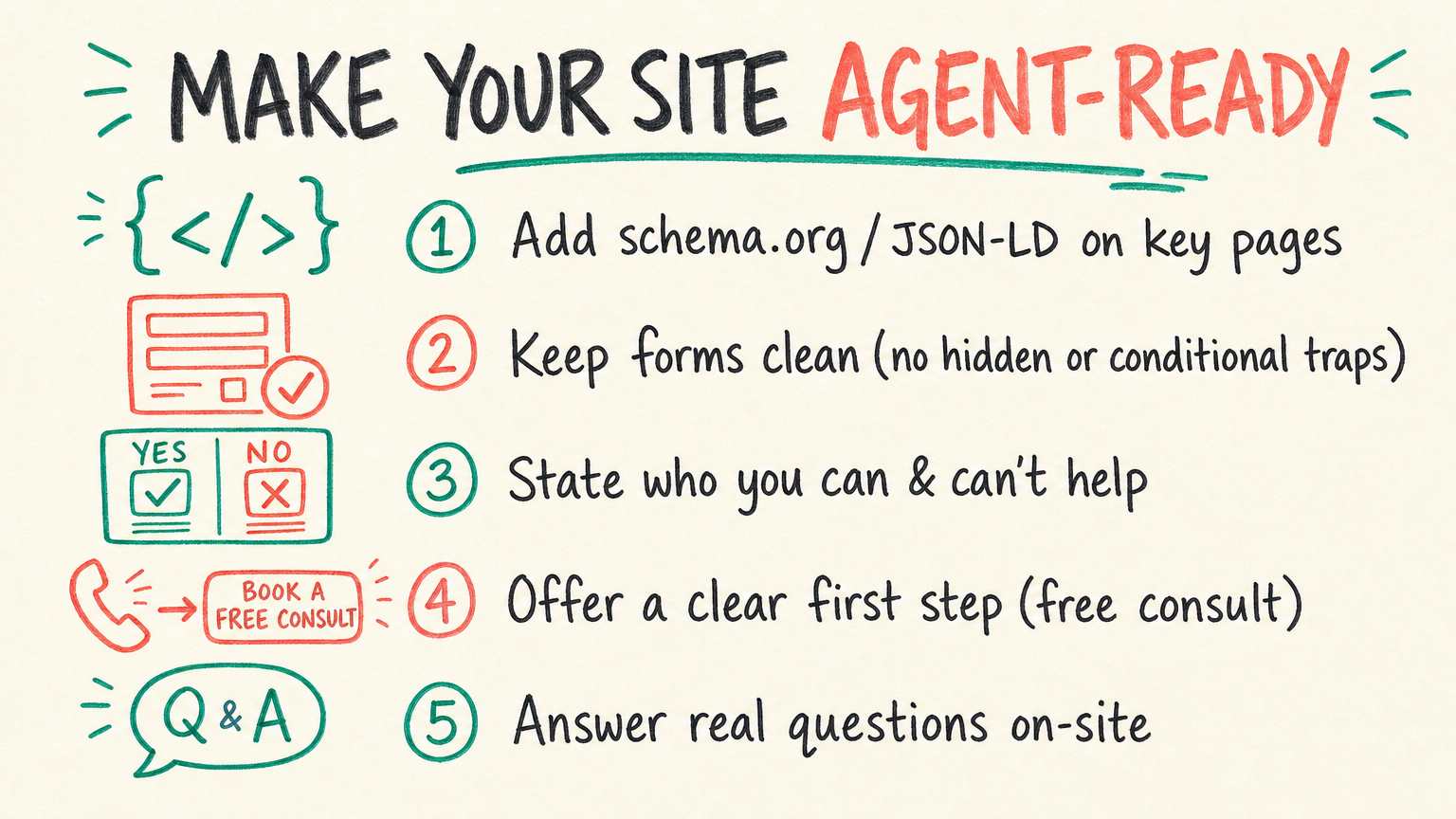
Here’s a checklist for you to understand how ready you are for the coming storm:
- Structured data. Does your site use schema.org JSON-LD on your key pages, describing your business, your services, and your FAQs? We suggest prioritising depth on your most important pages over thin markup everywhere.
- Clean, simple forms. Are your enquiry forms free of hidden fields and surprise conditional logic that an agent (or a tired human) would trip over?
- Stated qualification criteria. Have you written down, in plain language on the site, who you can and cannot help? That is exactly what lets an agent pre-screen a prospect for you.
- A clear first step. Is there an obvious, low-friction next action, such as a free initial consult, that an agent could one day book? We recommend setting this up so it’s crystal clear what you’re screening for.
- On-site answers. Are the questions prospects actually ask answered clearly on your site, so an agent grounded in your content has good material to work with?
If you put your qualifying criteria where an agent can read them, you screen out the wrong people before they ever cost you time or money. That is the same logic whether the screener is Google's agent, a prospect's own Gemini, or a human reading your site.
What to actually do about this now
First of all, don’t panic; these things are not as complex as they first may seem. Second, know that there’s no need to wait for the beta to reach Australia. Establish the foundations right while it’s early, because every one of them will also help your business now, not only when the agentic revolution comes fully into force.
Make your site genuinely readable, by people and by machines: clean structure, real schema, clear answers to real questions. Tighten your forms. Write down who you help and who you do not. Decide on your ideal first step and make it easy.
Do that and two things happen: your site converts better for humans and when AI agents become widespread, your business is one they can actually act on rather than one they skip because your form was a guessing game.
This theme also features heavily in our companion piece on showing up in AI search and the deeper Trust Stack work we’ve been doing. To put it simply: visibility and trust are the starting point. The next challenge is becoming actionable.
Getting a site agent-ready is exactly the kind of work we are carrying out for clients right now, and it’s easier to do before the rush than during it.
If you want a straight read on how ready your site is for the agent era, and the two or three changes that would make the biggest difference, we are happy to take a look and tell you what we see.
Book a time here for a free consult: https://www.leadtree.agency/product/book-call.