
Plenty of business owners are quietly asking the same question right now. ‘If ChatGPT answers everything and Google now often writes its own AI summaries at the top of the page, why would anyone pay to publish content nobody clicks on?’
It’s a fair question that companies across the globe should be asking. So, first, let’s take a look at what there is to worry about before looking at why the concern might be a little premature.
The Case That Content Is Dead
Here is the strongest version of the argument and there’s real evidence there to back it up:
- When Google shows an AI summary at the top of the results, far fewer people then continue to the actual website containing the information. Pew Research Centre found users clicked a traditional result on just 8% of visits where an AI summary appeared, compared with 15% where it did not. They clicked a link inside the AI summary itself only 1% of the time, which makes sense.
- But this is where things look a little grim. Google referral traffic to publishers fell by around a third globally through 2025, according to Chartbeat data reported by Press Gazette. This means a growing share of searches now end without a click.
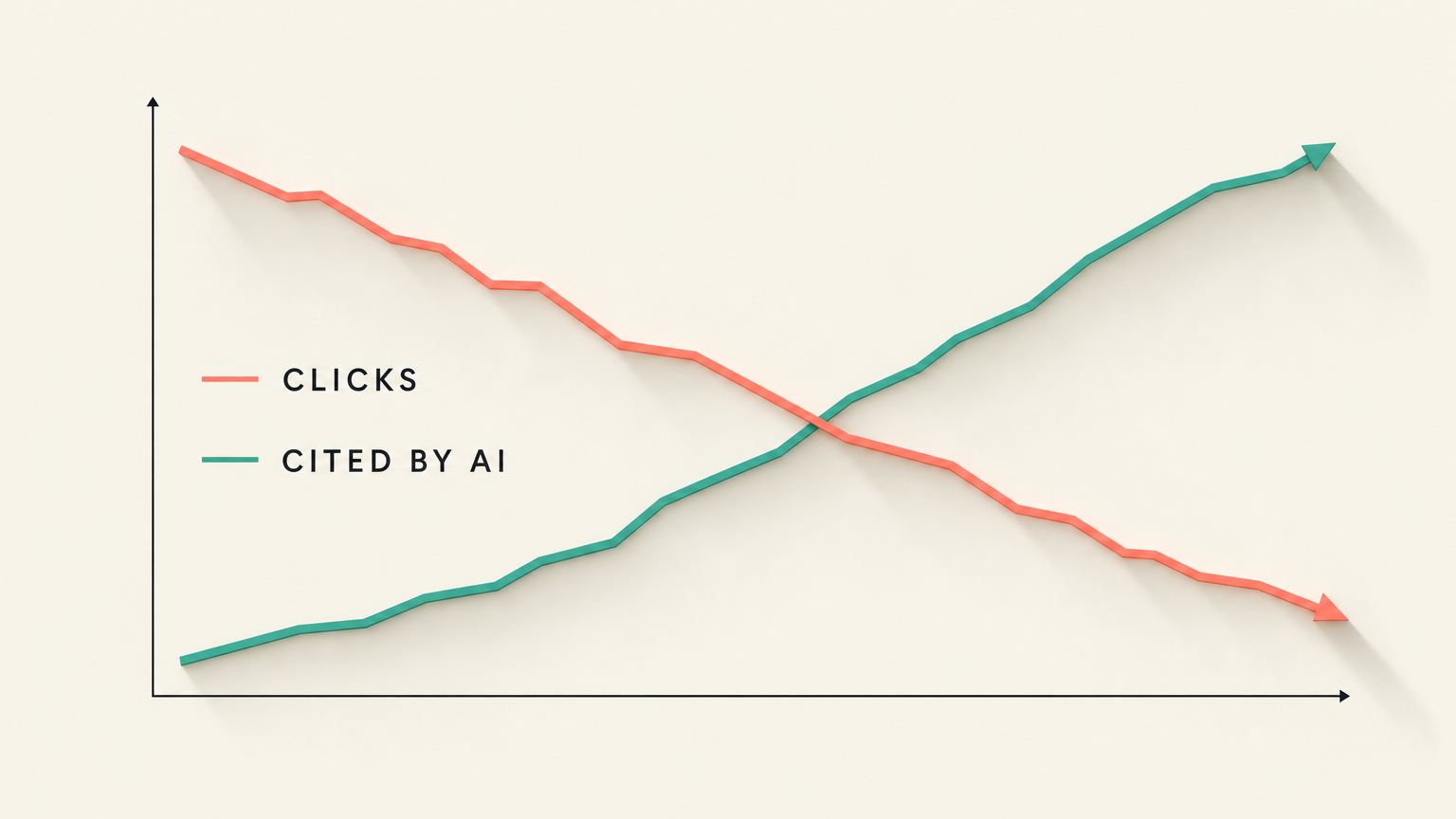
So, if your only definition of successful content is ‘how many people clicked through to my site,’ yes, that number is under pressure. Actually, the pessimists are right about that part.
However, a lot of it comes down to what we measure.
What the ‘Content Is Dead’ Take Misses
First off, the click was always a proxy. What a service business actually wants is to be the one a buyer chooses. Clicks were how we counted progress towards that, not the progress itself. As the click weakens as a measure, two things matter more, not less.
1. Being Referenced, Not Just Clicked
People search differently now. Instead of broad terms, they ask niche, specific questions, the kind a real prospect has. And when an AI system answers one of those questions, it pulls in sources that make a genuine effort to cover that topic with legitimate information.
You may not get the click. But being the source the answer is built on is its own kind of win. It puts your name, your framing, and your expertise into the moment a decision is forming.
Simply put, the game is shifting from being clicked to being cited. Thin, generic content was never going to win that game. Deep, specific, useful content does.
2. Volume and Consistency Still Move Clicks
For the clicks still up for grabs, consistency is king. The sites that keep publishing fresh, high-quality content are the ones holding and growing their organic presence, while the others fade into the background.
And we’re not talking about a token blog post once a quarter. Some of the businesses we work with are publishing ten to twenty high-quality pieces a month, each targeting the real questions their customers ask. That cadence is part of why they are growing while the broader trend points down.
Also read: The Content Volume Trap: Why More Content Creates Fewer Quality Leads
The content didn’t stop working. The bar for what counts as content worth publishing went up.
What We Are Actually Seeing
If content marketing were dead, we would expect to see that process playing out in the accounts we manage. We see the opposite.
| Anonymised client | Organic traffic (Jan–May 2026) | Enquiries from organic |
|---|---|---|
| A criminal defence firm (NSW) | Up by roughly half, against an industry-wide decline | Climbing month after month |
| A personal injury firm (QLD) | Broadly flat (a quiet win in a shrinking market) | Up by more than 80% |
These businesses are getting both: more visibility and more real enquiries, while the headlines say organic is finished. They are not bucking the trend by accident; they are publishing deep, consistent, genuinely expert content on the specific things their clients search for and, as far as our data shows, it’s working.
The New Thing You Can Finally See
Until recently, a frustrating part of this was that you could not really see the AI effect in your own analytics. That is starting to change.
In May 2026, Google added a native AI Assistant channel to Google Analytics 4. It automatically recognises traffic arriving from AI sources such as ChatGPT, Gemini and Perplexity, with no setup required.
It rolled out gradually through May and June, so most accounts can now see it. For the first time, the AI-referred slice of your traffic shows up as its own line, and we’re already seeing it appear, small but real, in our clients' accounts.
But if you’re new to this latest way to analyse your business, like most are, it’s important not to see it as the full picture. Here’s why:
- It counts forward only. It does not reclassify historical traffic, so you cannot compare it to last year.
- AI Overviews and AI Mode are filed under Organic Search. AI search traffic is often hiding in organic search numbers because tools usually classify AI-generated Google results as normal search visits.
- Referrals without a referrer land in Direct, an in-app browser or a copy-pasted link. So the real AI footprint is always larger than the channel reports.
There is an encouraging signal underneath all this. Early vendor analysis suggests that where AI-referred traffic does convert, it converts well. Semrush's June 2025 study put it at around 4.4 times the conversion rate of standard organic for consideration-stage queries, with other vendors reporting figures broadly in the three-to-five-times range. This is early, single-source data with real sample-size limits, so treat it as an indication, not a benchmark. But it fits well with what we see: AI tends to send fewer, warmer visitors.
But this is what the ‘click counters’ miss entirely: a lot of the value never shows up as a trackable click at all. Someone asks an AI assistant for a recommendation, hears your name, and calls you directly. That is content working, and no analytics channel will ever attribute it. The work still pays off, as long as the content is high quality, genuinely authoritative, and relevant to what people are actually asking.
Also read: Trust Is the New SEO: How Service Businesses Get Recommended in the Age of AI
What Good Looks Like Now
So, if content isn’t really dead, what should a service business actually do, given that the rules have changed?
For us, these are things that separate a business that’s growing from one that’s fading:
- Go deep on the specific questions your customers ask, not the broad keywords everyone chases. The narrow, real question is what AI references and what genuine users are asking.
- Publish consistently. A steady cadence of high-quality pieces beats an occasional showpiece. It’s doing more of the heavy lifting than it did two years ago.
- Put a real, credible author behind your content. As trust becomes the deciding factor, content that demonstrably comes from a genuine expert earns more weight with readers and with the systems doing the recommending. Google's own guidance on helpful, people-first content points the same way.
- Stop judging content by clicks alone. Track enquiries, calls and booked work, and watch the new AI Assistant channel to lightly guide content strategy.
The businesses that do well in the next few years will be the ones being referenced and recommended, whether or not the click ever gets counted.
Content marketing is not dead. The lazy version of it is. The version built on real depth, consistency and genuine authority is, if anything, working harder than ever, and we have the dashboards to show it.
Our content marketing services focus on helping service businesses publish useful content with a clear purpose. If you want to know whether your content is positioned to be referenced and recommended, we’re more than happy to review where you stand.
Read more on the Leadtree blog, or book a time, and we’ll walk through your own numbers together.
Book a time here: https://www.leadtree.agency/product/book-call.