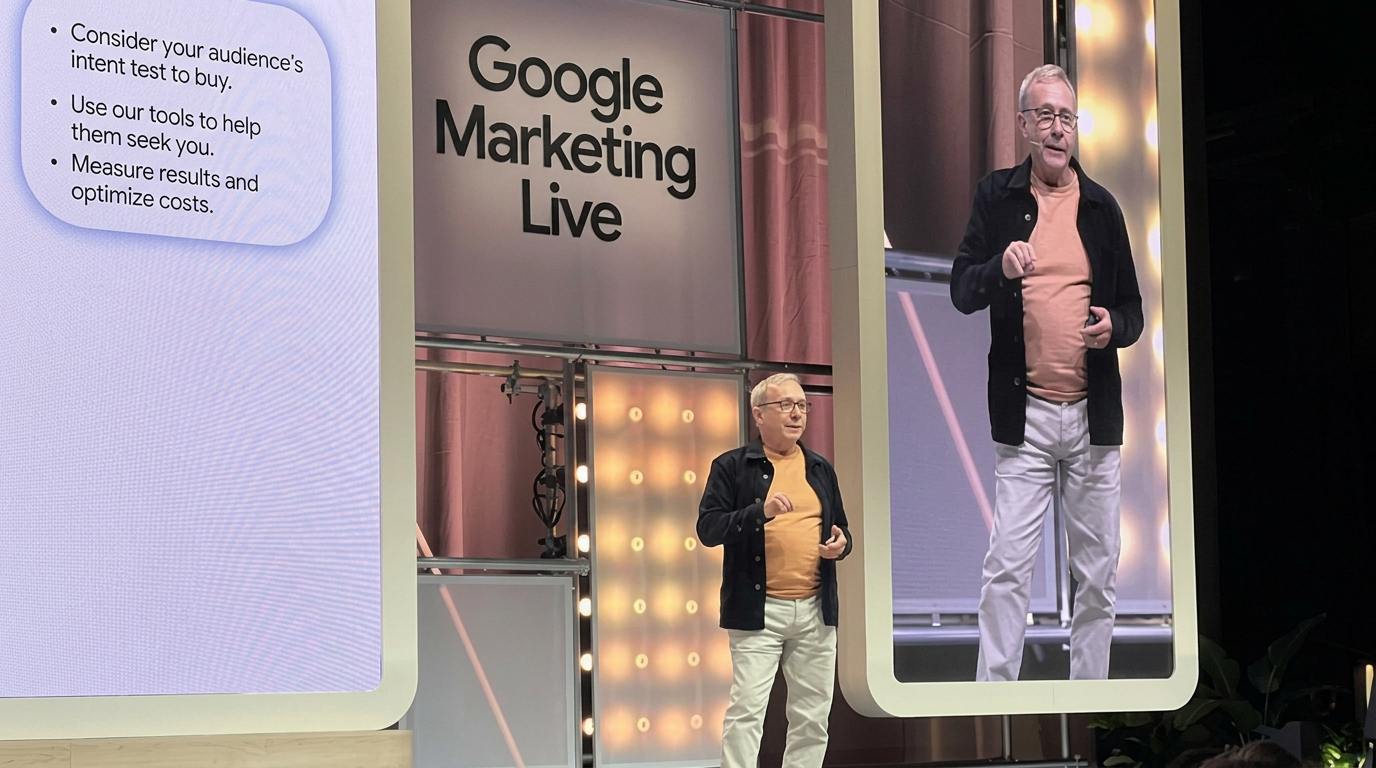
I recently left a Google Marketing Live (GML) event in Brisbane with a notebook full of product announcements, but there was one thing in particular I couldn’t stop thinking about.
It wasn’t a new ad format, it was actually something I heard in the search session: the way people search is now evolving beyond keywords, and the businesses that prosper over the next two years will be the ones publishing things that only they can say.
That sounds minor until you consider the numbers Google presented on stage. AI Overviews have now reached more than 2.5 billion monthly users, a figure Sundar Pichai confirmed at I/O 2026.
AI Mode, the full conversational search experience, has surpassed 1 billion monthly users, with queries more than doubling every quarter since launch.
This means that the audience is real and it is huge. The question on the lips of every service business owner at the event was a practical one: how do you actually show up there?
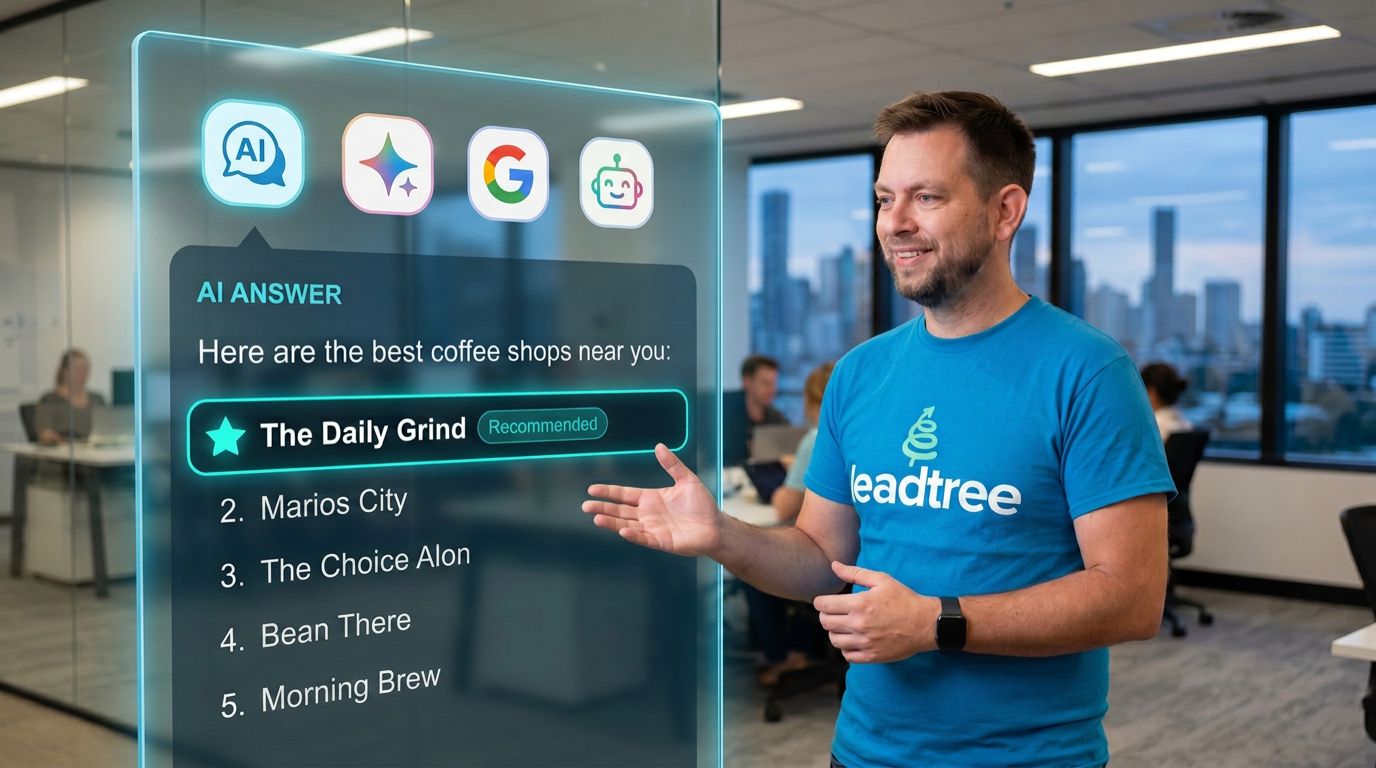
This article will discuss the answer to the question. Not the strategy layer (we cover that separately), but the production playbook of what to publish this quarter so an AI answer puts your name forward instead of a competitor's.
What "Beyond Keywords" Actually Means for You
Search was a guessing game about phrasing for two decades. You picked the keyword, you matched the page and you ranked.
But people no longer search that way. They ask longer questions shaped by decisions; the kind you would say out loud to a knowledgeable friend. Google's own data backs this up: the average AI Mode search is now triple the length of a traditional query (that figure is from Google's US data, but things are the same everywhere).
The most telling evolution is what those longer questions are for. Over the past six months, searches in the US starting with "which" have grown 40% faster than AI Mode queries overall, led by "which of" and "which one."
That is the language of someone who has done their homework and is ready to make a decision. People are no longer just asking Google to find things for them, they are asking it to help them decide. Google's own research has found that around 60% of users in the US who see an AI Overview say it makes the decision easier or less overwhelming.
If your content only answers "what is ," you are appearing for the research but missing the moment the decision gets made.
What Google Told Us to Do (and What It Left Out)
To Google's credit, the SEO guidance at GML was clearer than they usually make it.
It boils down to four points, and they’re in line with Google's official Search Central guide to AI features:
- Lead with what only your brand can say. Be specific and one-of-a-kind. Reviews, firsthand experience and expert takes are key. Avoid being generic.
- Write for customers, not algorithms. In Google's words: "don't try to write for AI algorithms."
- Think beyond text. AI search considers images and video. (Google noted that image searches are growing more than 40% month-over-month).
- Get your site ready for users, systems and agents. Well-structured, accessible, accurate listings in Google Business Profile, and Merchant Center for retailers.
The reassuring part is that because AI features run on Google's core ranking systems, your SEO fundamentals and your E-E-A-T (Experience, Expertise, Authoritativeness and Trust) are now more important. Nothing you have built goes to waste.
What Google left out is the how. "Lead with what only you can say" is great advice, but largely useless until someone tells you what it looks like for a law firm. That is the gap we fill for you.
The One Habit That Changes Everything: Stop Regurgitating
The uncomfortable truth about the content of most service-businesses is that most of it is a slightly reworded version of something that’s already been published countless times.
"What is a binding financial agreement?" "How long does a personal injury claim take?" These are useful questions, but generic answers already exist and have been absorbed by AI, so you are competing against thousands of other sources that have already said the same thing.
The content that does best is what the model cannot get anywhere else. Your opinions, case studies, reviews and client interviews are key, and what many firms completely overlook is unique data from your own datasets.
You already have information no competitor or AI has, so you need to turn it into content.
| Data you already have | Content only you can publish |
|---|---|
| Your closed-matter records | "What a [matter type] typically costs and how long it really takes," with real ranges from your own caseload, not a brochure estimate |
| Your intake notes across hundreds of clients | "The most common causes of [problem] we see," a breakdown from real cases, not a textbook list |
| Recorded discovery calls and consultations | The actual questions clients ask, in their words and answered properly (de-identified and aggregated) |
| Your inbox and enquiry forms | A genuine FAQ built from what people really email in, not what you assume they want |
| Your own results and reviews | Named, specific case studies and firsthand accounts (with the client's permission) |
None of that can be gleaned from somewhere else, which is exactly why it’s so valuable.
Generic vs Unique, Side by Side
If you only take one thing from this article, it should be this contrast:
| The generic version (skip it) | The version only you can write (publish it) |
|---|---|
| "Family law disputes can be stressful and costly." | "Across the matters we resolved last year, contested parenting cases took roughly 9 to 14 months. Here is what drives the difference." |
| "There are many causes of workplace injury." | "The three injury types behind most of the claims we run, and the warning signs that come before each." |
| "Choosing the right lawyer is important." | "We pulled the 12 questions clients most often ask in their first call. Here are honest answers to all of them." |
The rule of thumb: if a competitor could publish your sentence word for word, it is not pulling its weight.
How to Mine Your Own Data Without a Dedicated Team
You do not need a team of analysts, you just need to take your time and approach things carefully.
Where to look first:
- Closed matters or completed jobs. Pull the last 50 to 100 and tally up the basics: typical cost range, typical timeline and the most common type. That is three publishable stats before lunch.
- Call recordings and consultation notes. If you record calls (with consent), you are sitting on a goldmine. Skim 20 to 30 calls and note down every question that comes up more than twice. That list is your content calendar.
- Your enquiry inbox. The questions people email before they hire you are the questions everyone else is already asking an AI assistant.
The one non-negotiable: handle the data carefully. Only aggregate, never expose individuals.
This means no names, no identifying details, no confidential figures and always getting permission before using any named case study. Report patterns ("most contested matters settle before trial"), never an individual. If done properly, this is the most defensible content you can produce, because it is true, it is yours and nobody can copy it.
A few pieces of content like this will do more for your AI visibility than another fifty pages of reworded basics.
Build Content That Helps People Decide
Those "which" searches that are growing faster than everything else don’t have an answer from most service businesses.
People making decisions about who to go with are asking comparison and decision questions, and they are doing so via AI Mode. If your site has no decision content, the AI will make its recommendation from whoever does.
What good decision content looks like for a service firm:
- Honest "should you" pieces. "Should you handle a small claim yourself or get a lawyer? Here's how to tell." Take a solid position.
- Comparison content on the choices your clients face. Not you versus a rival, but the genuine forks in their decision: “this path versus that one, and when each makes sense.”
- "How to choose" guides. The questions to ask, the red flags, the trade-offs. These should be written like you actually want them to make the right decision.
This is the content that puts you front and center at the moment of decision, which is the moment you earn a client.

There Is No Fixed Ranking, and Why That's Good News
There’s one thing worth keeping in mind there is no settled ranking in AI search the way there was with the ten blue links that came before it.
If you ask the same question 100 times, the results, and the order they come in, will change. The recommendations are generated, not retrieved from a fixed list, which can unsettle people who want to "rank number one" and be done with it.
But on the other hand, this means visibility is probabilistic, so you improve your odds with every credible signal you add. Genuine reviews; well-thought out, expert, original content; demonstrated experience; and coverage of the actual questions people ask all increase your share of the recommendations.
I recently saw a version of this with one of our own clients: the trickle of traffic arriving from ChatGPT converted at a noticeably higher rate than most other sources because those people had already been steered toward them in a conversation before clicking. This was anonymised, and the numbers were private, but the pattern was unmistakable.
You cannot guarantee a spot in an AI answer, but you can definitely stack the deck in your favour so you are the safe, obvious thing to recommend.
That is the crux of the whole game.
What to Do This Quarter
If you want a starting order rather than a wishlist:
- Audit your content for the generic test. Anything a competitor could publish word for word goes to the bottom of the list.
- Pull three stats from your own closed matters. Publish one piece around cost range, timeline and most common type.
- Mine 20 calls or enquiries for real questions. Build your next month of content from the questions that keep coming up.
- Write one proper decision piece aimed at the "which?" and "should I?" questions your clients actually ask.
- Tidy your fundamentals while you do it: clear structure, a real, named author backed by Person and Article structured data and an accurate Google Business Profile.
The strategic side of this (why trust has become the deciding signal, and how the layers reinforce each other) is its own piece, and it is the pillar that supports this.
Where This Goes Next
The part of Google Marketing Live I am watching with the most interest is the agent era. People will have AI agents acting for them more and more. Not just finding them advice, but booking the appointment and filling the form.
Sites will need to tell those agents, clearly and in code, what a good lead looks like and what information to collect, which is a build we are already planning for clients. That’s a lot of information, and it deserves its own article.
For now, the move is simple and entirely within your control: stop publishing what already exists, and start publishing what only you can.
If you want a straight read on whether your content is positioned to get referenced in AI answers, or whether it is the kind an AI has already seen a thousand times, we are happy to take a look and tell you honestly where you stand.
We will look at the data you are already sitting on, the questions your clients actually ask and the handful of pieces that would move the needle fastest.
Book a time here: https://www.leadtree.agency/product/book-call