It seems like every other week there's another video claiming SEO is dead. While we don't agree, there's no denying the way people search, and how Google delivers results, is changing.
Our own Google Search Console data offers an interesting look at what's happening.
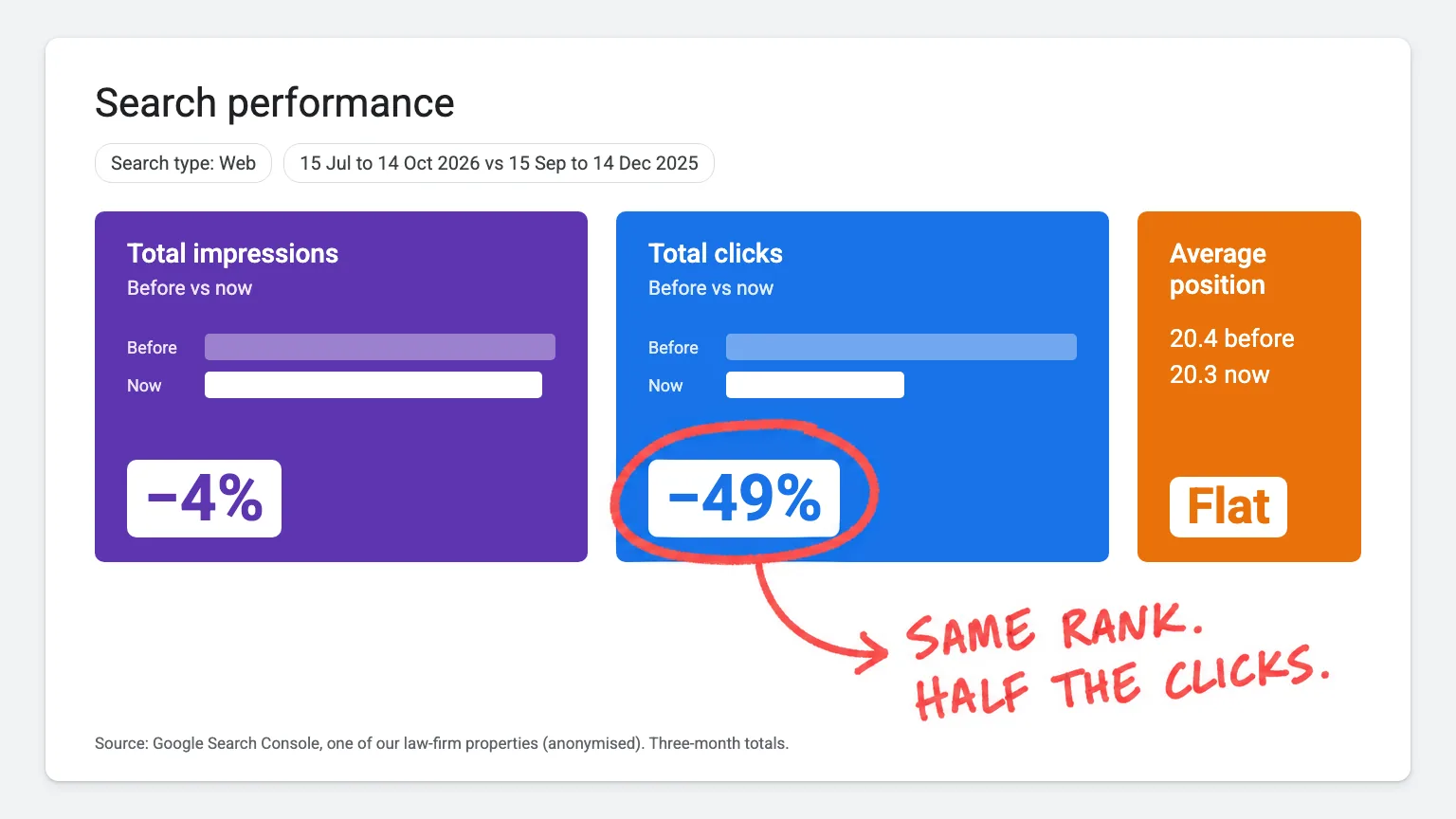
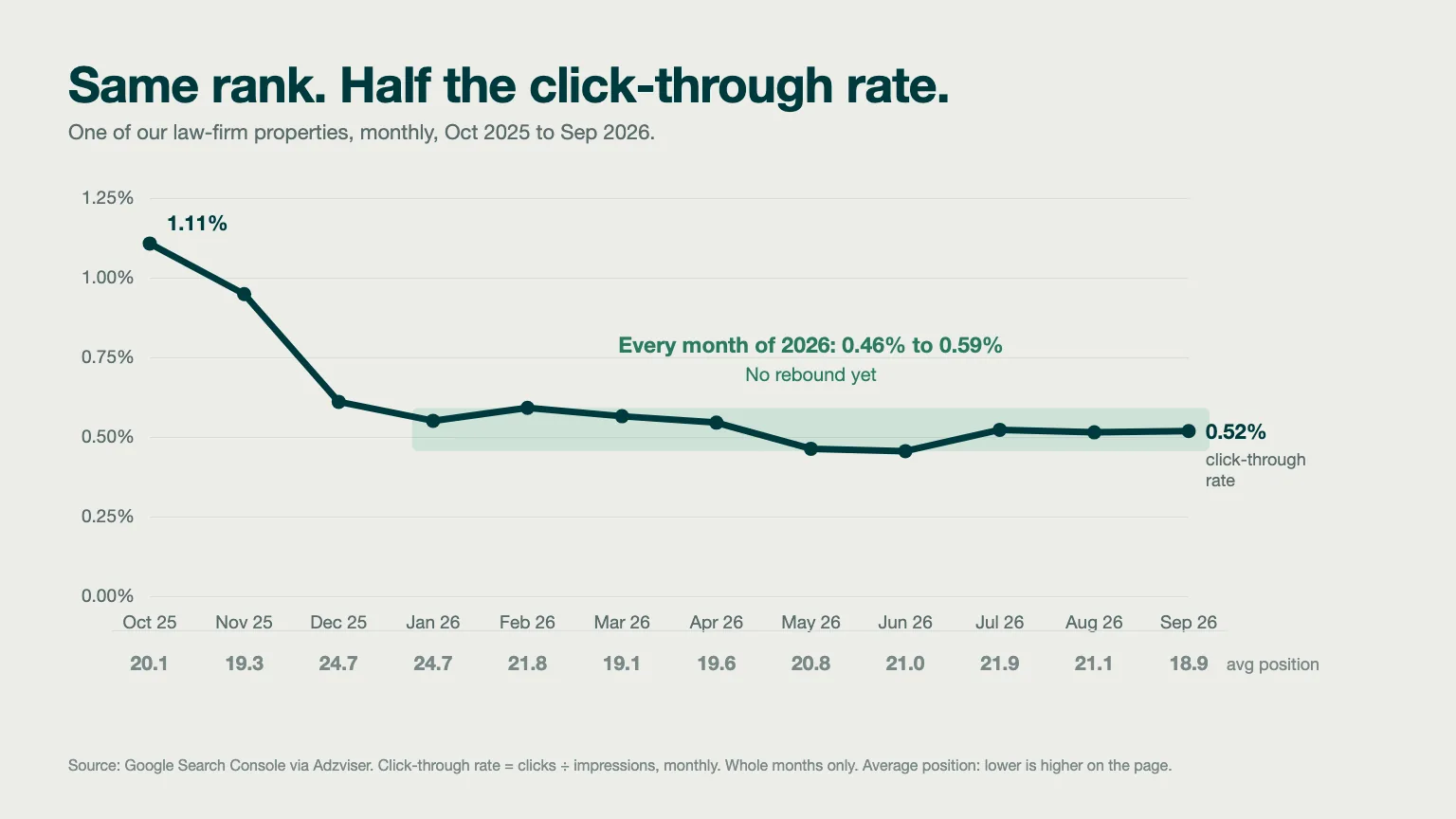
For one of the law firm websites we manage, search visibility has remained relatively stable over the past year. Impressions dropped just 4%, while average search position remained unchanged. However, clicks fell by 49% over the same period.
We reviewed Search Console data from two law firm websites we manage, up to 14 October 2026. While one reflects the decline in clicks we're increasingly seeing, the other continues to grow in visibility and traffic, despite a falling click-through rate (CTR).
The results highlight an important shift: appearing in Google's search results doesn't necessarily mean people are clicking through to your website.
In March, we explored how to get cited in Google's AI Overviews. This time, we're taking a closer look at what our own data reveals, what it could mean for law firms and how we're adapting our SEO strategies in response.
What changed in one law firm’s Search Console data?
The biggest change wasn't visibility or search rankings. It was the number of people clicking through to the website. For one of the law firm websites we manage, impressions declined by just 4%, while average search position remained stable. Despite this, clicks dropped by 49%.
To understand the change, we compared two reporting periods:
- Three-month comparison: 15 September to 14 December 2025, compared with 15 July to 14 October 2026.
- Year-on-year comparison: 15 September to 14 October 2025, compared with the same period in 2026, helping account for seasonal differences.
Both comparisons begin after 15 September 2025 for a specific reason, which we'll explain below.
Key finding: The website maintained similar visibility and rankings, but attracted significantly fewer clicks from Google Search.
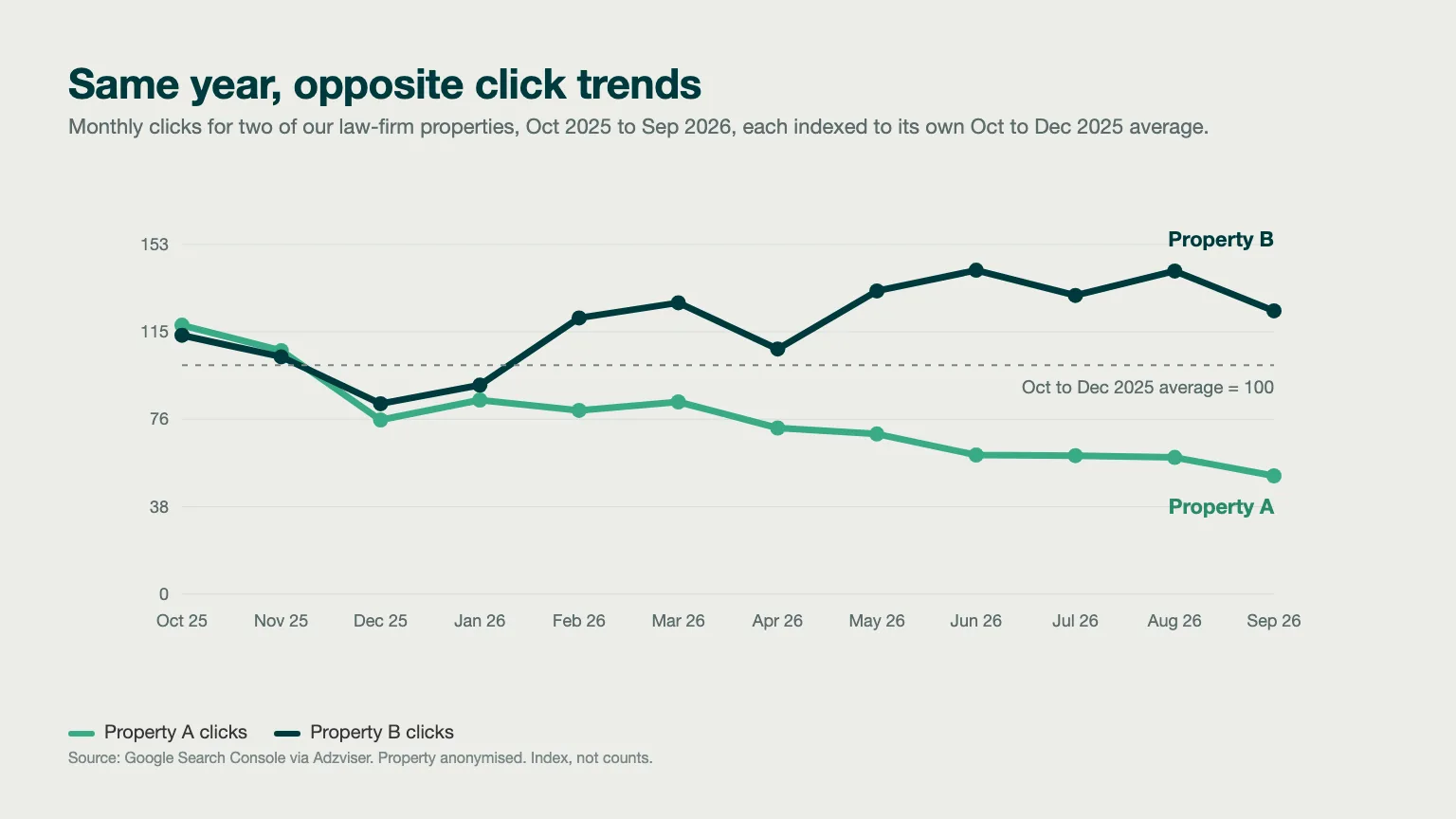
Property A reflects the decline we're increasingly seeing, while Property B tells a slightly different story. Property B recorded 38% growth in impressions and 26% growth in clicks, yet its click-through rate (CTR) still fell by around 9%.
In our view, the growth in visibility helped offset the decline in CTR, rather than eliminate it. We'll explore what may have contributed to this growth below.
Where did Property A's clicks go?
The biggest declines came from informational searches and articles, rather than searches from people actively looking for a lawyer.
When we analysed Property A's search queries, question-based searches experienced the steepest declines in clicks, while searches with stronger intent to engage a lawyer were less affected. Looking at individual pages, most of the lost traffic came from informational articles, which had previously generated the majority of the website's organic clicks.
Key takeaway: Informational content appears to be taking the biggest hit, while searches with stronger commercial intent are proving more resilient.
Informational articles showed the clearest decline in Property A, appearing more frequently in search results but attracting roughly half as many clicks.
Searches containing "lawyer" or "solicitor" were more resilient, with clicks falling just 15%, although these searches represented a relatively small share of overall traffic. Service pages also lost clicks, but their lower traffic volumes make the comparison less conclusive.
Property B provides an even clearer picture. For question-based searches, click-through rate fell around 13%, despite average search position remaining virtually unchanged, moving from 11.5 to 11.4.
The pattern suggests a growing gap between search visibility and actual website traffic, particularly for informational content.
Why is this happening now?
AI Overviews aren't new to Australia. Google launched them nationally in October 2024, followed by AI Mode in October 2025. Our data therefore reflects an ongoing shift in search behaviour, rather than a simple before-and-after comparison.
Independent research supports what we're seeing:
- Pew Research Center (July 2025): Users clicked traditional search results on 8% of visits featuring an AI summary, compared with 15% without one. Only 1% clicked a link within the summary.
- Ahrefs (February 2026): Research covering 300,000 keywords found AI Overviews were associated with a 58% lower average click-through rate for top-ranking pages.
- Seer Interactive (April 2026): Organic CTR on queries featuring AI Overviews fell to 1.31% in December 2025 before recovering to 2.36% by February 2026.
Seer's findings offer some encouragement, although we haven't seen a similar recovery in Property A, where monthly CTR remained between 0.46% and 0.59% throughout 2026.
Google presents a different perspective. In August 2025, Head of Search Liz Reid reported relatively stable organic clicks year-on-year, alongside an increase in what Google considers higher-quality clicks.
Google's AI search guidance also suggests visits originating from AI features may be more valuable.
Our take: Both perspectives can be true. Overall organic traffic may remain stable while informational content loses clicks. Without Google's underlying data, we can't independently verify its broader claims.
Is it all AI Overviews?
Not necessarily. Several factors can influence organic traffic, and Search Console can't isolate their individual impact.
- Search features: Ads, map results, videos and other features compete with traditional organic listings.
- Device changes: Property A's mobile impressions fell 23%, while desktop impressions increased 10%.
- Limited AI reporting: Search Console includes AI Overview and AI Mode activity within standard Web search reporting.
- Ranking changes: Property A's average position for question-based searches slipped from approximately 24 to 30, contributing to the decline.
Our findings are based on two properties, not a broader industry study. However, the pattern is clear: relatively stable visibility isn't necessarily translating into the same number of clicks, particularly for informational searches.
Our recommendation: Look beyond organic traffic and measure enquiries, signed clients and overall business outcomes. Focus on improving existing content, introducing original insights and building visibility across multiple channels.
How to read your own Search Console data
Before comparing performance, there's an important reporting change worth understanding.
Between 11 and 14 September 2025, impressions dropped approximately 60% for Property A and a third for Property B, while reported average positions improved significantly. Clicks changed comparatively little.
Search Engine Roundtable reported the shift coincided with Google's removal of support for the 100-results-per-page parameter, which affected automated search activity and reporting. This means comparisons spanning mid-September 2025 may give a misleading impression of ranking improvements or visibility losses.
Our Search Console checklist
Here's how we recommend reviewing your own performance:
- Open Search Console: Navigate to Performance → Search results and enable all four metrics.
- Compare consistent periods: Use equal-length reporting windows beginning after 15 September 2025.
- Check year-on-year performance: Compare equivalent dates to help account for seasonality.
- Review algorithm updates: Consider whether Google core updates may have influenced rankings.
- Filter for question searches: Add a filter → Query → Custom (regex), and paste
^(what|how|can|do|does|did|is|are|was|why|when|where|who|which|should|will|would|could|am|if)\s|\?$. Compare CTR at similar positions. - Review informational pages: Filter URLs containing /blog or your articles directory to identify changes in clicks and impressions.
- Compare devices: Check whether desktop and mobile performance tell different stories.
- Check your CRM: Compare organic traffic trends with enquiries and signed clients over the same periods.
Keep in mind Search Console excludes some anonymised queries. In Property A, visible query data represented only around one-fifth of total clicks, so these findings should be treated as a sample.
What we've changed in response
Improve the content you already have
Property B demonstrates how technical improvements and stronger content can help offset declining click-through rates. When we started managing the website, there were thousands of pages and substantial structural issues to address.
We've since focused on technical fixes, consistent content structures and improving pages to better match search intent. Across our comparison periods, Property B recorded 38% more impressions and 26% more clicks, despite a declining CTR.
While we can't attribute all the growth directly to our work, the results suggest improving existing content can help maintain momentum as search behaviour changes.
We've also seen clients gain more visibility and references after consolidating outdated articles and refreshing relevant content.
Our guide to appearing in AI Mode and AI Overviews explores this further.
Start with original insights, not AI-generated content
At Leadtree, we use AI to support research and drafting, but our content strategy remains human-led. One of the biggest changes we've made is collecting original insights before the writing process begins.
If you simply ask AI to write an article without providing anything unique, you're likely producing information it already knows. There's little reason for your content to stand out.
For many clients, we now begin each month's content planning with targeted questions and a recorded video interview. Detailed written responses work too, provided they offer genuine insight.
Our editorial team then develops, reviews and fact-checks the content before publication.
The goal is to create something useful and original, rather than another version of information already available online.
Make better use of your own business data
Some of the most valuable content opportunities are already sitting within your business.
For one client, we analysed hundreds of recorded intake calls to identify common customer questions and how the firm's experts answered them. This provided real insights into what prospective clients wanted to know, rather than relying entirely on keyword research.
The same approach can work across industries. An insurer, for example, could use its own claims data to identify suburbs experiencing the most hail damage.
Original research, customer insights and internal data can help create content competitors can't easily replicate.
Don't rely on Google alone
Search visibility is becoming increasingly competitive, making a broader marketing strategy more important. We recommend combining SEO and content with other channels, including paid advertising, social media and brand-building activity.
Brand recognition also matters. When an AI summary references multiple businesses, people may be more inclined to explore a name they already recognise.
Our article on why trust is becoming increasingly important for SEO explores this further. We're also hearing more clients report enquiries from people who originally discovered them through ChatGPT or other AI tools.
Interestingly, some users research through AI before searching for a business on Google, meaning the eventual visit may still appear as organic traffic.
This reinforces the importance of creating useful content, even when the customer journey doesn't begin or end with a traditional Google search.
Think beyond traditional SEO
People now discover businesses through TikTok, YouTube Shorts, AI assistants and Google. Our approach increasingly considers how content can perform across these different platforms, rather than treating SEO as a Google-only strategy.
We've also seen encouraging results from clients willing to invest in short-form video, particularly when their content shares genuine expertise.
So, is SEO dead?
I think the claim "SEO is dead" is overhyped, although I can understand where the concern comes from.
Having worked as Head of SEO at Flight Centre Travel Group around 2009 and 2010, I can appreciate how uncomfortable the past few years might have felt for anyone relying exclusively on traditional SEO.
Search has changed significantly, and strategies need to change with it. For me, the bigger risk is stopping content creation altogether.
If your business stops sharing expertise, answering customer questions and publishing useful information, you're reducing your opportunities to appear in search results, AI-generated answers and customer recommendations.
The same principle applies to the question we explored in July: is content marketing dead?
Our view remains the same. Content marketing isn't dead, but low-effort, generic content is becoming harder to justify.
What we're watching next
We'll continue monitoring two key areas across our client accounts:
- Click-through rate recovery: Whether Property A begins showing the improvement identified in Seer's research.
- Traffic versus enquiries: Whether declining organic clicks are translating into fewer enquiries and signed clients.
If clicks continue falling while enquiries remain stable, we'll prioritise the business outcomes over traffic figures alone.
Want to understand what's happening to your organic traffic?
If your Search Console shows steady impressions but declining clicks, it's worth investigating before assuming your SEO strategy has stopped working.
At Leadtree, we can review your Search Console performance, identify where traffic is being lost and assess whether AI Overviews, website issues or other search changes may be contributing.
We'll give you a clear picture of what's happening and where the opportunities are to improve.
The goal isn't simply to recover clicks. It's to make sure your search visibility continues delivering meaningful results for your business.
Book a time here: https://www.leadtree.agency/product/book-call